
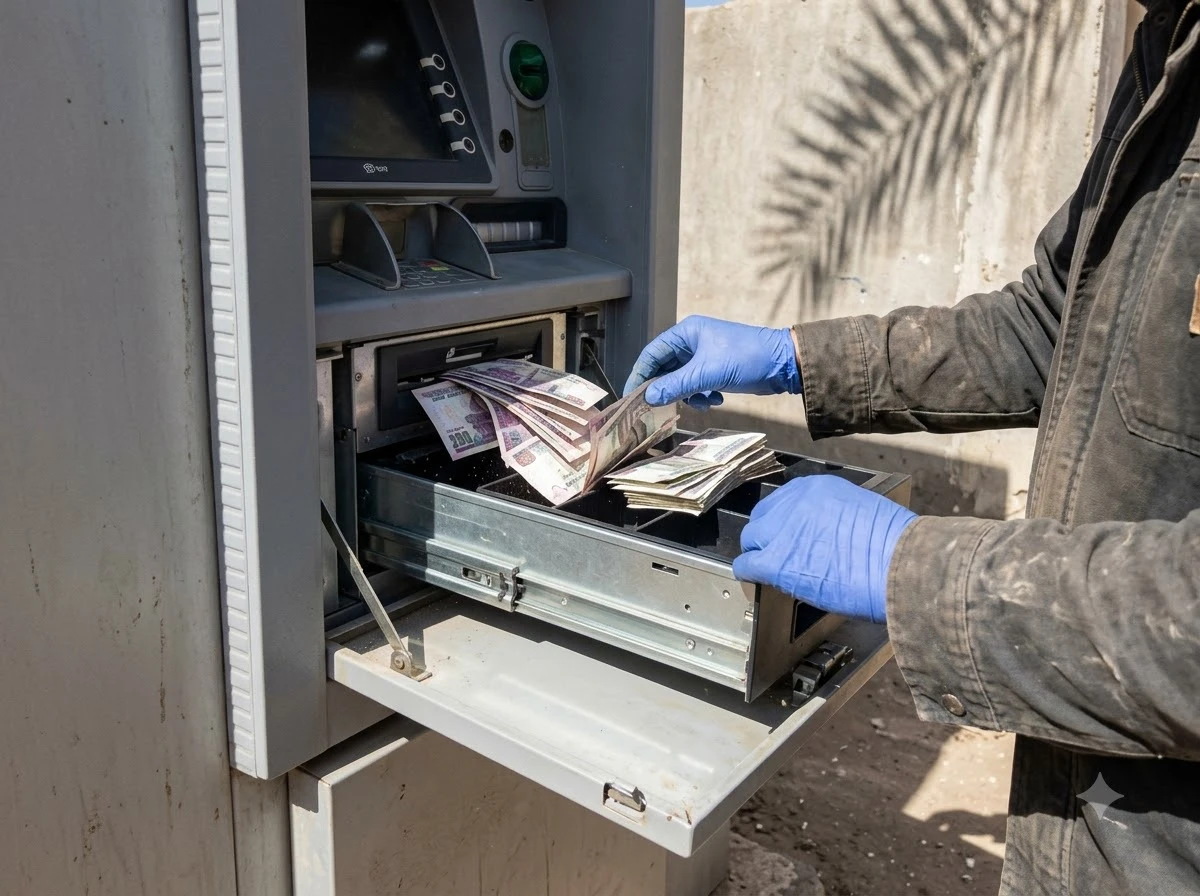
An ATM in Qay village, Ihnasiya district of Beni Suef Governorate, dispensed 2,000 Egyptian pounds whenever a customer requested 1,000 after a technician loaded 200-pound notes into the drawer the system treated as 100-pound notes. The error ran through multiple withdrawals on Monday until a cash-company official shut the machine down.
Farahat Sumaida, deputy head of the firm that feeds ATMs across the governorate, told Extra News the fault sat entirely with the loading step, not the bank software.
What followed was a brief window in which the machine paid double while accounts were debited only for the sums customers typed in. The gap between those two figures is the whole story: physical notes on one side, coded drawer values on the other, and a village that learned of the mismatch before the replenishment crew did.
The Drawer That Doubled Every Withdrawal
ATM cassettes are assigned fixed denominations in the machine’s software. Sumaida described a typical four-drawer layout: one for 200-pound notes, one for 100, one for 50 and one for 20, though the exact mapping varies by bank and model.
The technician placed five packs of 200-pound notes, totaling 100,000 pounds, into the drawer coded for 100-pound notes. A customer who tapped in 100 pounds received a single 200-pound bill. A request for 1,000 pounds produced ten 200-pound bills. The screen and the account debit showed the requested sum; the cash tray paid double.
- Drawer coding: software expects a fixed face value per cassette
- Physical load: notes of higher value placed in the lower-value slot
- Result: count of bills matches request, value does not
Sumaida stressed the bank system itself performed correctly. The mismatch between physical notes and coded drawer created the over-dispense.
Once that coding is set, the machine does not weigh or read the face value of each note as it leaves the cassette. It counts bills. Ten bills from a drawer marked as 100-pound notes look to the software like 1,000 pounds, whether the paper is worth 100 or 200. That is why every successful request in the window paid exactly double and why the account side of each transaction still looked ordinary.
The four-drawer pattern Sumaida outlined makes the error easy to picture and hard to spot in a hurry. Swap only one cassette and the other three can still be correct. Customers who took mixed denominations might not have noticed on the spot. Those who asked only for amounts the mis-coded drawer could satisfy walked away with a clean double payment and a receipt that matched what they had keyed in.
How News Spread Through Qay Village
The first surprised customer walked away with twice the cash. Word moved fast through the village south of Cairo. More residents queued, withdrew, and left with extra notes before anyone from the cash-management company arrived.
Ahmed Gamal, a local who posted about the glitch, said the pattern was consistent: 1,000 requested, 2,000 delivered. An employee of the replenishment firm was alerted, reached the site and took the machine offline for inspection and repair.
Residents then circulated appeals for the excess to be returned. One video circulating on Arabic channels captured a villager saying whoever took the money should bring it back because it is forbidden.
Speed defined both halves of the episode. Gossip about free extra cash outran the firm’s response; later, talk about returning what was taken outran any formal demand letter. In a small place like Qay, the same faces stand in the same queue and watch the same videos. That density turned a loading error into a public event within hours and then into a recovery drive almost as fast.
By the time the machine was powered down, the pattern Gamal described was already common knowledge. People did not need a statement from the company to know that 1,000 on the screen had meant 2,000 in the tray. They only needed one neighbour to fan a stack of 200-pound notes that should not have been there.
Fifty Thousand Pounds Missing After Five Packs
Of the 100,000 pounds loaded in 200-pound notes, roughly half covered legitimate withdrawals that matched account debits. The other half, about 50,000 pounds, went out as unearned surplus.
| Category | Amount (EGP) |
|---|---|
| Total 200-pound packs loaded | 100,000 |
| Correct-value portion of withdrawals | ~50,000 |
| Erroneous over-dispense | ~50,000 |
| Voluntary returns reported | ~22,000 |
| Remaining shortfall | ~28,000 |
Sumaida thanked Engineer Hussein from the village, who collected 13,900 pounds from neighbors, and Tariq, a Ministry of Education employee, who gathered another 4,300. Together those two efforts alone covered most of the early returns. Authorities are still reviewing transaction logs to identify the rest.
The split is almost even because the drawer paid double on every hit. For each pound the bank correctly took from an account, another pound left the cassette with no matching debit. Five packs set the ceiling at 100,000 pounds; the village and the logs will decide how much of the surplus half is recovered.
Hussein’s and Tariq’s hauls matter beyond the raw totals. They show that recovery began with named locals walking door to door, not with a call centre. Most of the 22,000 pounds reported back early came through those two channels. The rest of the 28,000 still open will depend on whether the same pressure, or the transaction logs, reaches the remaining holders.
What Egyptian Law Says About Keeping the Extra
Legal commentators treating the case note that excess cash from a machine error is not a gift. It remains the bank’s property. Keeping it after notice can amount to unjust enrichment or taking money without right.
- Transaction logs record card number, time and amount requested
- Banks or the cash firm can match over-dispenses to accounts
- Recovery may come by voluntary return, account deduction or formal claim
- Refusal after demand can open civil or criminal exposure
Experts advise immediate return once the error is known, precisely because the records make identification straightforward.
The legal frame is simple once the facts are fixed. The customer asked for one sum and received another. The extra never changed owner in the eyes of the law. Logs tie card numbers to times and keyed amounts, so the path from a double payout to a name is a matter of matching, not guesswork. That is why commentators treat delay after notice as a risk rather than a loophole.
Voluntary return, account deduction and formal claim are three routes to the same end. Village collection work has already used the first. The open 28,000 pounds is where the other two may still come into play if cooperation stalls.
Cash Companies Carry the Real Exposure
Sumaida was clear the shortfall belongs to the replenishment company, not the bank whose branding sits on the machine. Egypt’s ATM network, overseen through the Central Bank of Egypt ATM network services, relies on specialized cash-in-transit firms for loading and maintenance.
Similar pressure points surface elsewhere in the region. Saudi rules, for example, require dual control and camera rules for ATM cash feeding plus post-load verification. One SAMA circular even mandates test card checks after every cash load to catch exactly the denomination swap that occurred in Qay. Egyptian practice leans on the same dual-control principle, yet a single mis-sort still produced a five-figure hole.
Branding on the fascia and liability in the vault are different things. Customers see a bank name. The firm that opens the cassettes carries the loss when notes and codes diverge. Sumaida’s account places the Qay shortfall squarely on that side of the line.
Dual control and test withdrawals exist to stop a single mis-sort from emptying a cassette at the wrong value. When those steps hold, a drawer packed with 200-pound notes cannot run all morning as if it held 100s. When they slip, the arithmetic in Qay is what follows: five packs, a doubled payout stream, and a five-figure hole for the loader.
How Dual Control Is Supposed to Catch This
The regional rules Sumaida’s comments sit beside point to a short chain of checks. Two people handle the load. Cameras cover the work. A test card confirms that the first notes out match the values the software expects. Any one of those steps, done in full, is built to flag a cassette that holds 200-pound notes while coded for 100.
- Load under dual control so one person cannot seat the wrong pack alone
- Camera cover on the feed so the seating of each drawer is recorded
- Post-load test card to prove the first dispense matches the coded face value
- Shutdown on mismatch before the machine re-enters full service
In Qay the chain broke at the physical step. The software kept counting bills against the old code. The test that would have shown a 100-pound request producing a 200-pound note either did not happen or did not stop the machine from going live. The rest of the day was arithmetic: every request that hit that drawer paid double until a company official arrived and cut power.
Egyptian practice, as Sumaida described it, already leans on dual control. The episode does not reveal a missing rule so much as a missed execution. Five packs went into the wrong slot, customers formed a queue, and the firm learned of the error from the village rather than from its own post-load check.
Neighbors Turned Collectors Overnight
The same social network that first spread the news of free extra cash quickly flipped into an enforcement channel. Residents posted calls to return the money. Named locals knocked on doors and gathered stacks of notes for the company. Roughly 22,000 pounds came back that way within a day of the shutdown.
Whoever took money, it is haram, go return it.
Village resident appeal circulating on Arabic news channels
On X and local video platforms the dominant tone treated keeping the surplus as socially and religiously unacceptable. The rush to the machine and the later rush to repay sat side by side in the same small community.
Hussein and Tariq gave that turn a public face. One engineer and one Ministry of Education employee moved from neighbour to neighbour and put 13,900 and 4,300 pounds back within reach of the company. Their totals were not abstract. They were stacks of 200-pound notes that had left the ATM only hours earlier and were now being walked home in the other direction.
The religious framing in the circulating appeal mattered because it travelled on the same channels as the original tip. People who had heard they could draw double soon heard that keeping the extra was forbidden. In a dense village that second message did not need a court stamp to change behaviour. It needed familiar voices and a clear place to hand the money in.
What the Return Figures Show So Far
The early recovery numbers break into a clear pattern when set beside the two named collectors and the wider shortfall.
| Source | Amount (EGP) |
|---|---|
| Engineer Hussein’s collection | 13,900 |
| Tariq’s collection | 4,300 |
| Other voluntary returns | balance of ~22,000 |
| Still outstanding | ~28,000 |
Hussein’s share alone is more than half of everything returned in the first wave. Tariq’s share lifts the named total past 18,000 pounds. The remainder of the 22,000 came through the same neighbour networks without the same public labels. About 28,000 pounds is still outside those channels.
That split is why Sumaida’s public ask for further cooperation still matters. Logs can match cards to over-dispenses, yet door-to-door work closed a large piece of the gap before any deduction notice had to land. The open balance is the test of whether the village wave continues or whether the firm must lean on account-level recovery for the rest.
Nothing in the figures suggests the over-dispense was small change for the loader. Fifty thousand pounds left without a matching debit. Twenty-two thousand came back on social pressure. Twenty-eight thousand remains the live exposure.
The Shortfall That Still Sits Open
About 28,000 pounds remain unaccounted for after the voluntary returns. Sumaida publicly asked Beni Suef residents for further cooperation. Investigators continue matching logs to cards so the company can recover the balance by deduction or claim.
50,000 EGP total over-dispense
~22,000 EGP already returned by neighbors
~28,000 EGP still outstanding
Five packs of 200-pound notes at the root of the mismatch
The machine is offline pending full repair and re-coding of the drawers. No bank name has been released. The episode leaves the cash-handling firm with both a concrete loss and a public demonstration that village networks can close part of the gap faster than formal process alone.
Until the drawers are re-coded and the cassette map matches the notes inside, the ATM stays dark. Until the logs and the remaining holders align, the 28,000 pounds stays on the firm’s books. Qay showed how fast a single mis-load can empty value into a queue, and how fast the same queue can hand part of it back when the mistake becomes common knowledge.
