
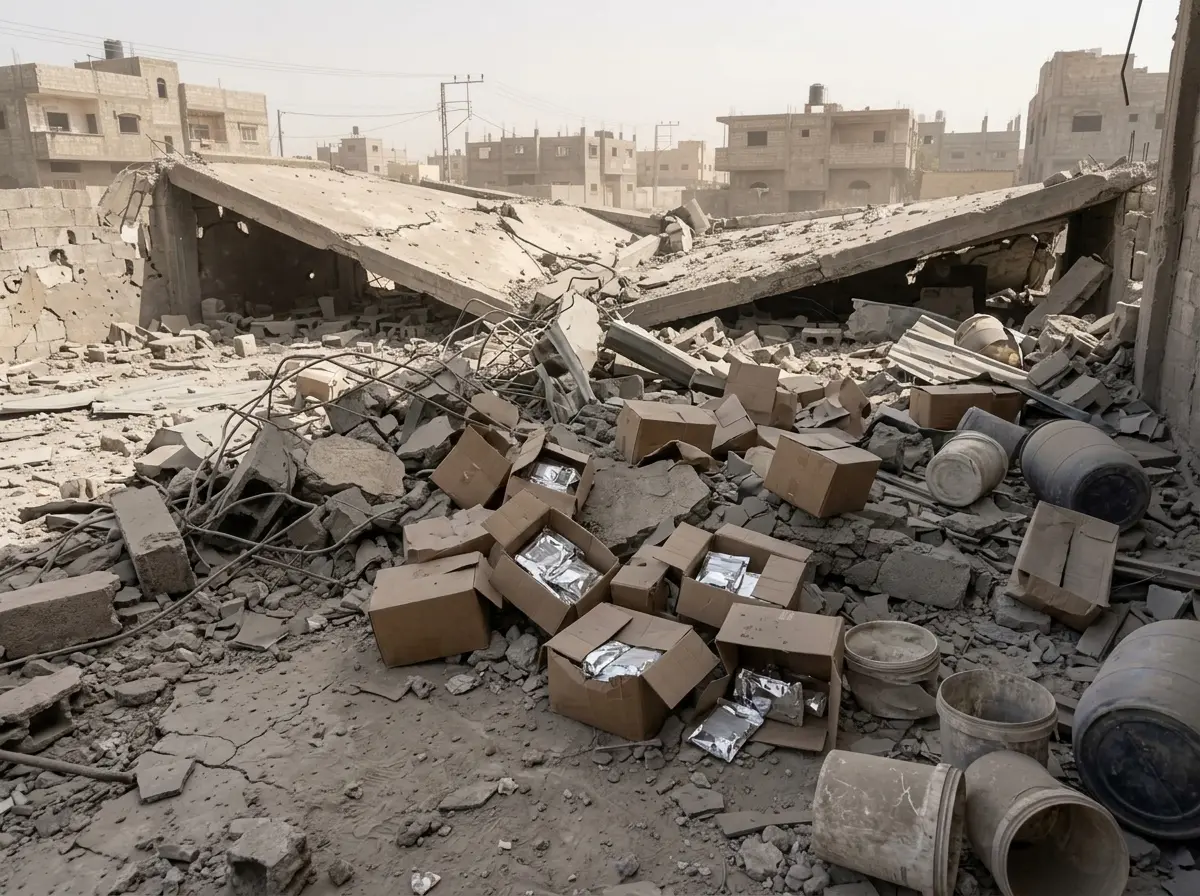
An Israeli military strike overnight into Tuesday destroyed a warehouse in Deir al-Balah that held nutritional supplements for malnourished children, pregnant women and breastfeeding mothers, Medical Aid for Palestinians said. The blast collapsed the roof and walls, burying the entire stock and rendering it unfit for use. The same day local medical sources reported at least seven Palestinians killed in separate attacks across Gaza.
The warehouse belonged to Ard El Insan, a partner of the British charity MAP that supplies about 60 medical points. Each point serves up to 100 women and children daily. The hit landed days after a UNICEF survey recorded lingering chronic malnutrition even as acute cases had fallen since the October 2025 ceasefire.
The loss landed on a system already stretched thin. Acute malnutrition rates had dropped after aid expanded under the ceasefire, yet chronic damage and weak diets left thousands still dependent on the exact stocks now buried. Oxygen stations, reduced to a fraction of their pre-war network, faced the same pressure on the same day.
The Warehouse Hit in Deir al-Balah
MAP said the strike targeted a nearby building late Monday. The force brought down large sections of the warehouse structure. Supplies intended for the 60 clinics were completely buried under rubble.
Sahar Salem, project coordinator for Ard El Insan, described the loss in direct terms.
Losing these quantities in their entirety is a major blow to our work and will undoubtedly affect our ability to reach the children and women who need these services, particularly given the conditions they continue to face in the aftermath of starvation.
Sahar Salem, Project Coordinator, Ard El Insan
She noted that two colleagues had been killed and another wounded since the war began. Rowida Al-Sabbah, MAP’s nutrition programme lead, said the damage disrupted a service rather than just a building. The boxes were doses meant for specific children and mothers who rely on them. AEI staff are checking other warehouses to keep some distribution running. The MAP statement on the buried stocks called for protection of humanitarian facilities and supplies.
Those doses were not generic bulk food. They were portioned for pregnant women, breastfeeding mothers and children already showing stunting, anaemia or poor dietary diversity. When the roof came down, the pipeline to the 60 points lost a full cycle of planned deliveries at once. Staff now must reassign whatever remains in other sites, a slower process that leaves gaps at the clinic door.
Seven Deaths Across the Strip on Tuesday
Local hospital sources tallied the day’s fatalities. Three people died in a strike on a home in Beit Lahiya near Kamal Adwan Hospital, according to a source at al-Shifa. A drone strike on a civilian gathering in Khan Younis’s al-Mawasi area killed one man and injured three others. Three more died from earlier wounds in Khan Younis, two from a Monday attack and one from injuries two weeks prior, Al Jazeera Arabic correspondent Nour Khaled reported.
- Beit Lahiya home strike: three killed, others injured
- al-Mawasi drone strike: one killed, three injured
- Earlier Khan Younis wounds: three deaths reported Tuesday
These incidents occurred against a backdrop of more than 1,296 Palestinians killed since the October 2025 ceasefire, according to the Palestinian Ministry of Health figures cited by MAP.
The three clusters sat in different corners of the strip yet arrived on the same calendar day as the warehouse blast. Hospital sources treated them as separate events. Together they added to a post-ceasefire toll that MAP has tracked in the same briefings that cover aid damage.
Only 12 Oxygen Stations Still Run
Gaza’s Health Ministry Director-General Dr Munir al-Bursh told Al Jazeera that Israel continues to escalate attacks and violate the ceasefire, which he said is present in statements but absent from daily life. He reported that only 12 oxygen stations remain operational out of around 34.
“If this oxygen supply stops, these people will die,” al-Bursh said. “We do not want to reach the point where a doctor is forced to choose between two patients, deciding who receives oxygen and who is left without it.” The al-Bursh warning on oxygen choice was posted days earlier and matched the Tuesday briefing.
Earlier ministry statements and hospital officials confirmed the same 12-of-34 figure. Stations run beyond design limits. Spare parts and oils remain blocked. At Al-Aqsa Martyrs Hospital in Deir al-Balah, two of four stations have stopped; the others face constant faults. Oxygen purity has dropped to 60-70 percent in some wards. Neonatal units, intensive care and operating rooms depend on the supply.
Oxygen snapshot
- 12 of ~34 stations still working
- 4 of 30 cylinder-filling devices operational
- Stations designed for ~8 hours now run up to 20 hours daily in some sites
- Any further breakdown risks cutting supply to patients
Running a station for 20 hours on an eight-hour design shortens the time between failures. When purity falls to 60-70 percent, wards that need clean supply for surgery or newborn care absorb the shortfall first. The blocked spare parts and oils leave no local fix. Each further fault narrows the margin al-Bursh described, where a doctor must decide who receives oxygen and who does not.
What UNICEF Measured Days Before the Strike
On 24 August UNICEF released findings from its Gaza SMART Survey conducted between 31 May and 15 June 2026 in accessible areas covering most of the population. Acute malnutrition among children under five stood at a low 1.3 percent combined global acute malnutrition. That drop followed the post-ceasefire surge in aid after famine conditions in August 2025, when monthly admissions for treatment had peaked near 17,000 before falling under 3,000 by March 2026.
Chronic effects remained. Stunting affected 12.2 percent of children under five. Overweight stood at 4.0 percent. Only 22.4 percent of children aged 6-23 months received a minimum acceptable diet; 73.0 percent had eaten unhealthy foods the previous day. Diarrhoea hit 37.1 percent of under-fives in the prior two weeks. Maternal malnutrition was also documented, with more than half of pregnant women suffering severe anaemia according to related reporting cited by MAP.
| Indicator | Rate | Notes |
|---|---|---|
| Child stunting (under 5) | 12.2% | Chronic, cumulative damage |
| Acute malnutrition (under 5) | 1.3% | Low after aid scale-up |
| Minimum acceptable diet (6-23 mo) | 22.4% | Very poor quality |
| Unhealthy foods previous day | 73.0% | 6-23 months |
| Diarrhoea prior 2 weeks | 37.1% | Under-fives |
UNICEF Regional Director Edouard Beigbeder said the gains are fragile and depend on sustained access, funding and markets. Without them progress could reverse within months. The UNICEF SMART survey findings from June and the full Gaza SMART Survey 2026 report underline that acute recovery does not erase longer damage. The warehouse stocks were exactly the supplements meant to protect against that reverse.
The survey window closed in mid-June. The public release came on 24 August, hours before the overnight strike. That timing left little room between the warning about fragile gains and the burial of stocks meant to hold those gains in place. Low acute rates sat beside high stunting, poor diets and widespread diarrhoea, a mix that still required steady supplement delivery through the 60 points.
A Ceasefire Present in Statements
The ceasefire took effect in October 2025. Aid and commercial traffic expanded afterward, allowing the measured drop in acute malnutrition. Yet strikes and displacement orders have continued. MAP noted more than 1,296 killed since that date. In an August 17 Fox News interview, US President Donald Trump said Israel “should not be striking in Gaza” and that Hamas had agreed to lay down weapons under a US-backed plan. Strikes have not stopped.
- October 2025: Ceasefire begins; aid flows increase
- August 2025 peak: Near 17,000 monthly acute malnutrition admissions before the deal
- March 2026: Admissions fall under 3,000
- May-June 2026: SMART survey records low acute rates but 12.2% stunting
- 17 August 2026: Trump calls for halt to strikes
- 24-25 August 2026: UNICEF report released; warehouse destroyed overnight
Al-Bursh’s phrase captures the gap: the agreement appears in statements while remaining absent from life on the ground. Crowd reactions on X, including a widely shared Drop Site News summary of the MAP account, treated the warehouse hit as evidence that residual recovery capacity itself has become a target.
The sequence runs from the October opening of aid routes through the March drop in admissions and the summer survey, then to the mid-August call for a halt and the late-August warehouse loss. Each step shows partial relief under pressure that never fully lifted. The 1,296 figure keeps rising in the same period that nutrition indicators improved on paper.
The 60 Clinics Face Thin Reserves
Ard El Insan feeds about 60 medical points across the strip. Each point can see up to 100 women and children in a day. The buried warehouse held the supplements those visits require for malnourished children, pregnant women and breastfeeding mothers.
MAP has also flagged rising need among children aged 5 to 10. That age band sits outside the under-five survey focus yet still draws on the same distribution chain. Two AEI staff killed and one wounded since the war began cut into the team that moves boxes from store to clinic.
- About 60 medical points supplied by the AEI-MAP partnership
- Up to 100 women and children served per point each day
- Supplements aimed at children, pregnant women and breastfeeding mothers
- Growing demand noted for children aged 5 to 10
- Two AEI colleagues killed and one wounded since the war began
AEI staff are already checking other warehouses so some distribution can continue. That workaround spreads thinner stock across the same caseload. When more than half of pregnant women already face severe anaemia, any break in the daily dose schedule lands on patients with little buffer left.
Acute Progress Meets Chronic Strain
The SMART numbers draw a sharp line between what improved and what did not. Acute malnutrition among under-fives fell to 1.3 percent after aid scaled up. Stunting held at 12.2 percent. Only 22.4 percent of children aged 6 to 23 months met a minimum acceptable diet, while 73.0 percent had eaten unhealthy foods the day before the survey teams asked.
| Measure | Improved path | Persistent problem |
|---|---|---|
| Acute malnutrition | 1.3% (low) | Risk of reversal without steady aid |
| Treatment admissions | Under 3,000 by March 2026 | Had peaked near 17,000 in August 2025 |
| Child stunting | – | 12.2% still recorded |
| Diet quality (6-23 mo) | – | 22.4% minimum acceptable; 73.0% unhealthy foods |
| Maternal anaemia | – | More than half of pregnant women, severe |
Beigbeder warned that the gains depend on sustained access, funding and markets and could reverse within months. The warehouse stocks were one tool against that reverse. Their burial removes a concrete layer of protection at the same moment oxygen capacity sits at 12 of roughly 34 stations and purity slips in some wards.
Diarrhoea in 37.1 percent of under-fives over a two-week span adds another drain on already weak nutrition. Overweight at 4.0 percent shows diet quality problems run in more than one direction. Together the indicators explain why MAP and AEI treat the buried boxes as a service failure, not only a logistics loss.
Who Loses When the Boxes Are Buried
The 60 medical points reach women and children who already face high anaemia and stunting rates. Needs have grown among children aged 5 to 10, MAP said. Two AEI staff dead and one wounded illustrate the direct cost to the delivery network. Hospitals ration oxygen while neonatal and ICU patients depend on the remaining stations. The second-order effect is not one day’s deaths alone; it is the erasure of the thin buffer that the ceasefire aid window had built against another slide into acute crisis.
AEI is trying to shift stocks from other sites. MAP continues to call for the ceasefire to be upheld and made permanent, and for protection of civilian infrastructure under international humanitarian law. Spare parts for oxygen generators and new stations remain blocked. The next mechanical failure or strike would force the doctor’s choice al-Bursh described.
Patients at the clinic level feel the shortfall first. A mother turned away when supplements run out joins the same fragile pool the survey already flagged. A neonatal ward on reduced purity oxygen faces the choice al-Bursh named. Those pressures arrive together, not in sequence.
Gaza’s remaining oxygen network and the scattered nutrition stocks now carry the weight of whatever recovery the ceasefire still allows.
