
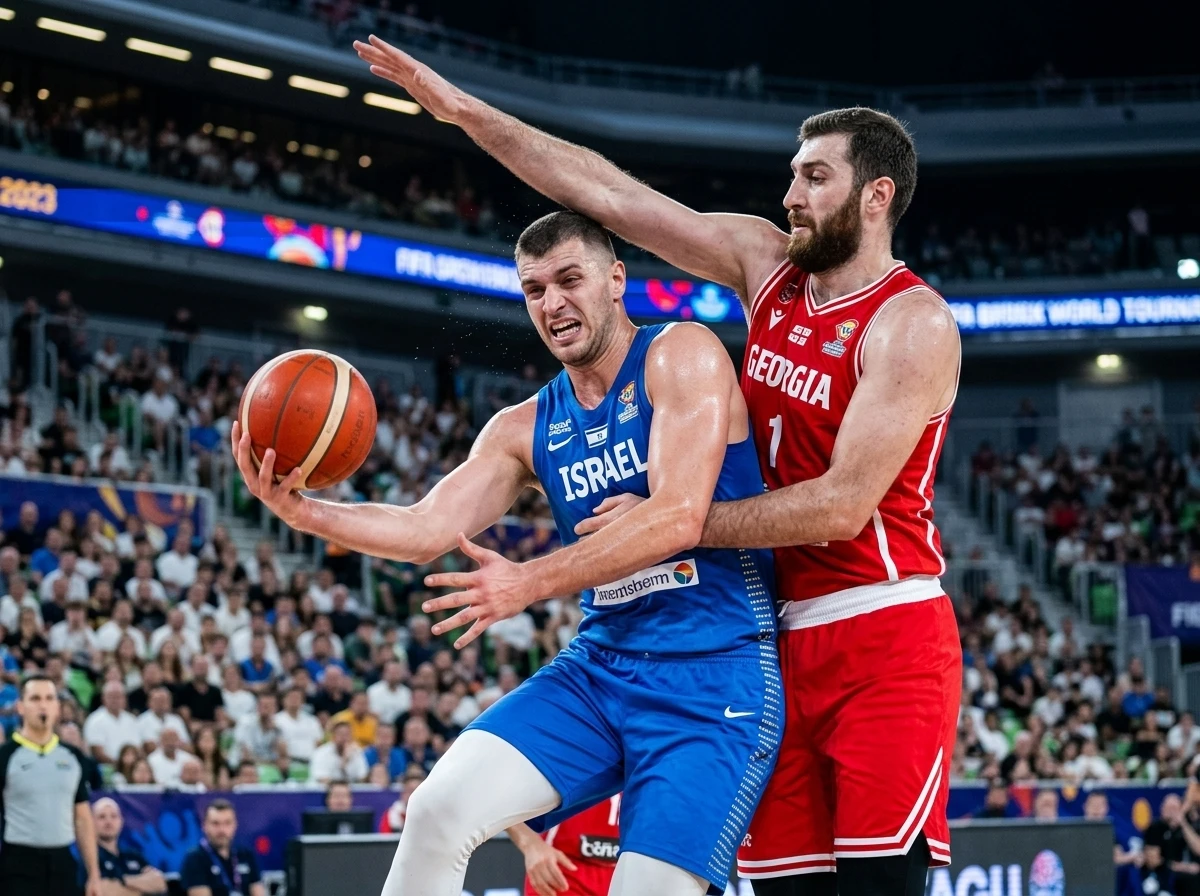
Israel’s national basketball team fell 101-90 to Georgia in a World Cup tune-up in Tbilisi after leading for long stretches, with Roman Sorkin’s 25 points unable to prevent a late collapse following travel delays from a Ben-Gurion Airport strike.
The loss closed preparation for the FIBA Basketball World Cup 2027 European Qualifiers second-round window, where the blue-and-white face Poland on Thursday and Latvia three days later in Riga.
Competitive stretches across three quarters offered Beit-Halahmy usable film. The fourth-quarter fade offered a warning. Both now travel with the squad into a Group K window that leaves little room for incomplete performances.
How Israel Built Then Lost Control
Head coach Ariel Beit-Halahmy started captain Yam Madar, Khadeen Carrington, Guy Palatin, Netanel Artzi and Sorkin. The Maccabi Tel Aviv big man scored 11 points in the first quarter as Israel took a 25-17 lead.
Georgia’s frontcourt of Toko Shengelia, Goga Bitadze and Sandro Mamukelashvili made life hard inside. Limited early support beyond Madar and brief flashes from Adam Ariel let the hosts rally to a 43-41 halftime edge.
Israel found rhythm in the third. Ariel and Tamir Blatt combined for 15 points as the side dropped 28 in the period and edged ahead 69-68 entering the fourth.
The game stayed tight until consecutive Georgia threes made it 83-78 with just over five minutes left. Beit-Halahmy called timeout. The hosts pulled away for the win on a closing 15-3 type run noted across Israeli coverage.
The swing from early control to a double-digit defeat followed a clear sequence. Israel dictated the opening period with interior scoring, surrendered the halftime edge when the supporting cast thinned, reclaimed the lead with perimeter bursts in the third, then could not answer when Georgia strung together threes and offensive boards.
- First quarter: Sorkin’s 11 points fueled a 25-17 Israel lead.
- Halftime: Georgia completed the rally to lead 43-41.
- End of third: Ariel and Blatt’s combined 15 points helped produce 28 in the period and a 69-68 edge.
- Late fourth: Consecutive Georgia threes made it 83-78 with just over five minutes left.
- Final: A closing 15-3 type run sealed the 101-90 result.
| Player | Points | Rebounds | Assists |
|---|---|---|---|
| Roman Sorkin | 25 | 6 | – |
| Yam Madar | 16 | 8 | 8 |
| Adam Ariel | 15 | – | – |
| Khadeen Carrington | 12 | – | – |
| Tamir Blatt | 8 | – | – |
Also scoring for Israel: Netanel Artzi 4, Rafi Menco 3, Guy Palatin 3, Itay Segev 2, Ethan Burg 2. Lior Carreira, Yotam Hanochi and Yair Kravitz saw minutes. Georgia got 22 from Bitadze, 20 from Mamukelashvili and 17 plus 9 rebounds from Shengelia.
Sorkin’s full-game line still topped the sheet. Madar’s 16 points, 8 rebounds and 8 assists kept possessions organized even as the lead changed hands. The gap sat in the minutes after the starters tired, when Artzi, Menco, Palatin, Segev and Burg could not match the hosts’ physical edge on the glass or the perimeter.
Travel Chaos Reached the Court
The team arrived after a disrupted journey. Flight delays and the Ben-Gurion Airport strike that hit mid-August left passengers facing multi-hour waits and diverted flights. The Israel Airports Authority workers’ action created staffing gaps and baggage backups that stretched into the following days.
That fatigue showed when Georgia’s size imposed itself in the final frame. Israel had competed for three quarters. Legs gave out when the hosts hit threes and attacked the glass.
Preparation for a physical European opponent already demands sharp timing on help defense and offensive rebounding. Multi-hour waits and diverted flights compress recovery windows. By the time consecutive threes made it 83-78, Israel lacked the fresh legs to contest the arc and clean the defensive glass in the same possession.
The collapse was not a sudden talent gap. It was the predictable cost of arriving late into a matchup against a frontcourt built to punish tired rotations. Beit-Halahmy now carries that lesson into a window that again features short rest between games.
Georgia’s NBA Frontcourt Set the Terms
Bitadze, Mamukelashvili (now with the Los Angeles Lakers) and Shengelia formed a physical trio that limited clean looks for Sorkin after his hot start. Mamukelashvili added playmaking and defensive versatility in the exhibition, posting 20 points, six rebounds and six assists in one reported line.
- Bitadze led Georgia with 22 points as the primary interior scorer.
- Mamukelashvili spaced the floor and facilitated while adding steals.
- Shengelia controlled the boards with 9 rebounds alongside 17 points.
Israel’s perimeter support arrived in waves rather than sustained stretches. Madar’s triple-double threat line (16-8-8) kept the offense moving, yet the supporting cast could not match Georgia’s depth when the game tightened.
The three Georgia bigs did not simply outscore Israel inside. They dictated where Sorkin could catch the ball after the first quarter and forced Madar to create against length on every pick-and-roll. When Ariel and Blatt heated up in the third, the hosts still had enough size to contest without fouling and enough depth to keep the pressure constant.
Combined, Bitadze, Mamukelashvili and Shengelia produced 59 points. That interior load left Israel chasing the game whenever the perimeter shots cooled. Carrington’s 12 points and the scattered contributions from Artzi, Menco and Palatin never formed a second wave strong enough to answer.
Group K Leaves Little Margin
Israel carries a Israel’s 2-4 first-round record into the second round of the European Qualifiers. Results from the first round carry over into four groups of six. The top three in each advance to the 2027 World Cup.
Group K includes Poland (perfect through six first-round games), Croatia and Germany (both strong), Latvia, Netherlands and Israel. Israel sits on 8 points with a +1 point differential, level with the Netherlands and behind the leaders.
| Team | Record | Points | PD |
|---|---|---|---|
| Poland | 6-0 | 12 | +90 |
| Croatia | 5-1 | 11 | +158 |
| Germany | 5-1 | 11 | +74 |
| Latvia | 3-3 | 9 | +37 |
| Netherlands | 2-4 | 8 | +4 |
| Israel | 2-4 | 8 | +1 |
The European Qualifiers group format and schedule demands consistent results across remaining windows. Israel needs wins or strong showings against the sides above them to climb.
Carryover scoring means every first-round result still counts. Poland’s perfect 6-0 mark and +90 differential set a pace Israel cannot ignore. Croatia’s +158 and Germany’s +74 show how far the top tier has already pulled clear on margin. Latvia’s 9 points and +37 keep another rival ahead before the Riga window even tips.
Israel and the Netherlands share 8 points, with the Dutch holding a slight edge on differential at +4 against Israel’s +1. That three-point gap on the scoreboard is thin enough to flip with one strong half. It is also thin enough to vanish if late collapses like Tbilisi repeat against stronger opposition.
Poland Arrives First in Riga
Thursday’s tip against Poland at Xiaomi Arena opens the window. Poland has outscored opponents by a wide margin and averages over 94 points per game in the qualifiers compared with Israel’s roughly 80. Head-to-head history is even overall, but recent meetings have been tight and physical.
Three days later comes Latvia on home soil for the hosts. Both games sit in a short turnaround after the Georgia trip. Madar leads Israel in scoring average at 24.7 points per game in the qualifiers. Sorkin sits at 17.0 with strong efficiency and blocks. Tomer Ginat has posted high efficiency numbers when available.
Stats snapshot from qualifier averages:
- Madar 24.7 ppg, high steals rate
- Sorkin 17.0 ppg, 1.3 blocks
- Team 79.7 ppg scored, 34.2 rebounds
The Israel versus Poland in Riga matchup will test whether the competitive stretches against Georgia can translate against a complete Polish side that has not lost in the first round.
Poland’s scoring average above 94 points per game sits well clear of Israel’s 79.7. Closing that gap requires the same interior creation Sorkin showed in the first quarter in Tbilisi and the sustained guard play Madar produced across three quarters. A single hot stretch will not suffice against a side that has not dropped a first-round game.
| Side | Qualifier scoring | First-round mark |
|---|---|---|
| Poland | Over 94 ppg | 6-0, +90 PD |
| Israel | 79.7 ppg | 2-4, +1 PD |
Latvia presents a different problem three days later. The hosts hold a 3-3 record and 9 points, already one win clear of Israel in the standings, and they will play in front of their own crowd. The short turnaround after Poland leaves little time to correct whatever the first game exposes.
The Riga Schedule Compresses Every Mistake
Two games in three days after a travel-disrupted exhibition leave almost no margin for slow starts or late fades. Poland tips first. Latvia follows on home soil. Recovery between those nights is measured in hours, not practice days.
Israel’s qualifier profile already shows a side that scores 79.7 points per game and pulls 34.2 rebounds. Those numbers held up for stretches against Georgia. They did not hold for 40 minutes once the hosts imposed size and hit consecutive threes. Poland’s higher scoring rate and undefeated first-round record will test the same soft spots earlier and more often.
Minute management becomes the practical lever. Madar’s 24.7-point average and high steals rate make him indispensable on both ends. Sorkin’s 17.0 points and 1.3 blocks anchor the interior. Ginat’s efficiency matters when he is available. Burning those pieces early against Poland risks empty minutes against Latvia.
The Georgia film already showed what happens when the supporting cast cannot hold a lead. Artzi, Menco, Palatin, Segev and Burg all scored in Tbilisi. None produced enough sustained stretch scoring to stop a 15-3 type run. That pattern cannot repeat twice in Riga without damaging the climb from 8 points.
What Competitive Stretches Must Become Now
Three quarters of resistance in Tbilisi proved Israel can share the floor with a physical European frontcourt. Sorkin’s opening burst and Madar’s full-game facilitation were not flukes. They were the baseline the staff must extend across full games.
The standings reinforce the urgency. Poland, Croatia and Germany already sit on 11 or 12 points with heavy differentials. Latvia holds 9. Israel and the Netherlands share 8. Only the top three in Group K advance. Every possession that slips away in the fourth quarter in Riga widens a gap that carryover points make hard to close later.
Beit-Halahmy’s available tools remain the same ones that worked in stretches: Sorkin creating against size, Madar rebounding and distributing from the guard spot, Ariel and Blatt supplying secondary bursts, Carrington adding athleticism. The question is whether those tools can stay sharp when rest is short and the opponent does not fade.
What This Window Requires From Beit-Halahmy’s Side
The Georgia game offered useful data. Sorkin can create against size. Madar can facilitate and rebound from the guard spot. Ariel and Blatt provide secondary scoring bursts. Carrington adds athleticism.
Depth remains the question. When the starters fatigue, production drops. Georgia’s late surge exploited exactly that gap. Poland and Latvia will do the same if Israel cannot sustain intensity for 40 minutes on short rest.
- Protect the paint and glass against bigger lineups.
- Generate more consistent second-unit scoring.
- Manage minutes carefully across the two Riga games.
- Convert competitive halves into full-game wins.
Israel has shown it can hang with physical European sides for stretches. The second-order cost of the travel-disrupted prep and the fourth-quarter fade is that those stretches must become complete performances immediately, or the path to the World Cup narrows further in a group already stacked against them.
The checklist above is not abstract. Paint protection speaks directly to the Bitadze-Mamukelashvili-Shengelia problem that limited Sorkin after the first quarter. Second-unit scoring speaks to the quiet minutes from everyone outside the top five scorers once Georgia’s threes landed. Minute management speaks to a Thursday-Sunday turnaround in Riga after a disrupted arrival in Tbilisi. Full-game wins speak to the difference between a 69-68 edge after three quarters and a 101-90 final.
Tip-off against Poland comes Thursday night in Riga.
