
Fourteen fossilized shark teeth pulled from phosphate beds on Egypt’s Abu-Tartur Plateau have expanded the known Late Cretaceous shark fauna of the Western Desert and sketched a layered marine ecosystem that once thrived where only sand remains.
The finds, described in a short communication available online 18 August 2026, come from the Duwi Formation and represent five extinct lamniform species, two of them first records for Egypt and one a possible first for Africa. The work was led by paleontologist Tarek Yassin of Cairo University with co-authors Jorge D. Carrillo-Briceño, René Kindlimann, Alhussein Ibrahim and Mohamed K. AbdelGawad.
Together the specimens turn a single industrial exposure into a calibrated snapshot of Campanian shelf life. They also narrow a long-standing imbalance: Egypt’s Western Desert is already famous for dinosaurs, turtles and mosasaurs, yet its shark record has trailed the better-sampled phosphate basins of Morocco.
Five Species Join the Abu-Tartur List
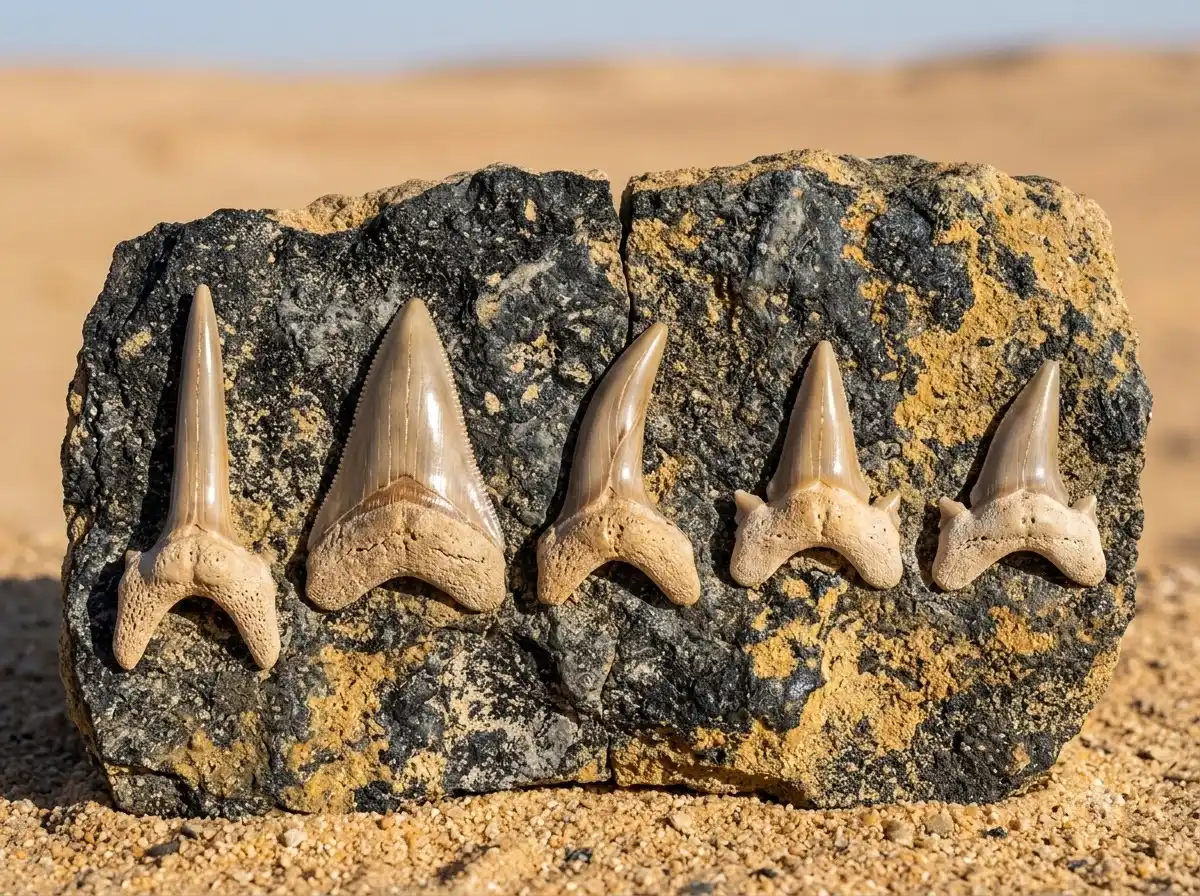
Surface collecting in the Maghrabi-Liffiya sector of the plateau recovered the isolated teeth from black and yellow layers of the phosphate bed. Colour variation tracks chemical weathering of the ore. All specimens are housed at the Vertebrate Palaeontology Laboratory, Geology Department, Faculty of Science, Cairo University.
The five taxa are new to the Abu-Tartur area. Earlier work by the same group had already recorded two other shark species at the site, bringing the total known from this layer to at least seven.
| Species | Key note | Tooth character |
|---|---|---|
| Cretalamna cf. C. maroccana | New to Abu-Tartur; four teeth measured 13.8-19 mm high | Narrow pointed triangular central cusps |
| Scapanorhynchus cf. S. raphiodon | Possible first African record and youngest known occurrence | Long slender needle-like crowns |
| Serratolamna cf. S. serrata | First record for Egypt | Broad form suited to slicing |
| Squalicorax bassanii | First record for Egypt | Serrated cutting edges |
| Squalicorax pristodontus | New to Abu-Tartur | Broad serrated crowns |
Subtle and not-so-subtle differences in crown shape, serrations and cusplets allowed the assignments by comparison with records elsewhere. One tooth curves sharply; others carry small lateral cusplets. Cartilage skeletons rarely fossilize, so teeth remain the primary evidence for these animals.
Four of the Cretalamna teeth fall in a tight size band, which helps anchor the identification even though the material is isolated. Needle crowns on the Scapanorhynchus specimens stand apart at a glance from the broader cutting forms of Squalicorax and Serratolamna. That morphological spread is what lets a handful of loose teeth map onto five distinct taxa rather than a single generalist predator.
Because each tooth is an isolated element, the team relied on published comparative series from other basins to place the Egyptian material. The resulting list is deliberately cautious, with “cf.” notations where full species certainty still waits on more specimens.
How Phosphate Beds Locked the Record
The Duwi Formation records the onset of fully marine conditions in the region during a major Late Cretaceous transgression. It sits above the Quseir Formation and below the Dakhla Formation. Micropaleontological work places the black shale overlying the fossil-bearing phosphorite in the late Campanian.
- Quseir Formation underlies the sequence and marks the transition into marine flooding.
- Duwi Formation holds the phosphorite beds and the shark teeth recovered at Abu-Tartur.
- Overlying black shale within the same package dates to the late Campanian on micropaleontological evidence.
- Dakhla Formation caps the stack once the Duwi interval closes.
Phosphorite commonly forms where marine productivity is high and phosphorus is concentrated. The Abu-Tartur deposits therefore preserve both the animals and a signal of the waters that supported them. The authors thank Misr Phosphate Company for assistance at the mine in New Valley Governorate; industrial exposure of the beds made systematic collecting practical.
Collectively, this assemblage highlights a nutrient-enriched, high-productivity marine ecosystem along a phosphogenic shelf margin.
Tarek Yassin and colleagues, Cretaceous Research
Low sediment accumulation rates condensed the interval, so the teeth represent a time-averaged sample rather than a single mass-death event. That condensation is what turns a thin phosphate bed into a dense paleontological archive.
Without the mine cuts, the same thin beds would remain buried and largely inaccessible. Industrial stripping of the ore simply brought the condensed archive to the surface, where surface collecting could recover teeth that would otherwise stay locked in place.
Nearshore Scavengers and Outer-Shelf Hunters Shared the Water
Tooth form points to different feeding styles and habitats rather than direct competition for the same prey.
- Squalicorax teeth suggest input from nearshore or inner-shelf settings where scavenging and generalist cutting would pay off.
- Scapanorhynchus needle crowns align with deeper outer-shelf and slope conditions, better for spearing softer or mid-water prey.
- Cretalamna and Serratolamna support stable open-shelf conditions, filling intermediate predatory roles.
| Setting | Taxa indicated | Feeding style |
|---|---|---|
| Nearshore to inner shelf | Squalicorax | Scavenging and generalist cutting |
| Open shelf | Cretalamna, Serratolamna | Intermediate predation, slicing |
| Outer shelf to slope | Scapanorhynchus | Spearing softer or mid-water prey |
The team interprets the mix as evidence of upwelling that delivered nutrients from deeper water into the sunlit zone. Plankton blooms would have fed small fish and invertebrates, which in turn supported the sharks and larger marine reptiles known from related Egyptian deposits. Other North African phosphate sites in Morocco and farther east show similar multi-species shark assemblages, indicating the southern Tethys margin was a productive belt for these predators.
A single water column that grades from inner shelf to slope can host all three guilds at once. Teeth from each guild then wash or settle into the same phosphogenic traps, producing the mixed assemblage recovered today. The pattern does not require every animal to have lived side by side in one narrow bay; it only requires a productive margin whose habitats were linked by currents and by the condensation process itself.
What the Condensed Record Changes for Africa
The new Late Cretaceous lamniform assemblage fills a geographic gap. Egypt’s Western Desert has yielded terrestrial dinosaurs, turtles, mosasaurs and other marine reptiles, yet its chondrichthyan record has lagged behind Morocco’s famous phosphate basins. Two of the five species are firsts for the country; Scapanorhynchus cf. S. raphiodon may be the first confirmed for the African continent and could push the taxon’s known last appearance younger, pending more specimens and taxonomic checks.
The paper published in Cretaceous Research therefore does double duty: it adds names to local lists and tightens the chronological and environmental framework for southern Tethys sharks during the Campanian. Future work can test whether the same niche stack appears in coeval Egyptian sections farther east or west.
Each new Egyptian occurrence also recalibrates how far individual taxa ranged along the southern Tethys margin. A first country record is not merely a checklist entry; it anchors the species inside a dated formation whose sea-level and productivity context is already partly known. That context is what lets later workers compare Egypt directly with Moroccan and other North African phosphate faunas instead of treating the Western Desert as a blank zone.
Sea Level, Climate and the Vanished Seaway
During the Late Cretaceous the planet ran warmer, with little polar ice and higher global sea levels. Estimates of the long-term highstand commonly fall in the range of roughly 100-250 metres above present, enough to flood large parts of northern Africa and connect shallow shelves to the Tethys Ocean. The Duwi beds sit inside that flooded margin.
A Duwi Formation phosphorite accumulation model developed earlier for Abu-Tartur already combined upwelling with high-energy reworking. The new shark data fit that picture: productivity high enough to sustain multiple large predators, yet with enough hydrodynamic sorting to concentrate teeth and phosphate in discrete beds. When sea level later fell and tectonics rearranged the basins, the seafloor became the arid plateau visitors see today.
Warm climate and elevated sea level set the broad stage; local upwelling and reworking wrote the fine print that preserved the teeth. Remove either the highstand or the nutrient pump and the same margin would likely have left a thinner, less informative record. The modern desert surface is simply the end member of that long withdrawal.
Teeth Carry the Signal Cartilage Cannot
Lamniform sharks build their skeletons from cartilage, a tissue that almost never survives burial in recognizable form. Teeth, by contrast, are dense, mineral-rich and shed throughout life. Once dropped onto a phosphogenic shelf, they resist decay long enough to be concentrated by the same low sedimentation rates that built the ore beds.
That taphonomic filter explains why fourteen isolated crowns can outline an entire guild structure. Crown height, serration pattern and cusp shape are durable traits. They survive weathering that would erase softer tissues and even most bone. Colour differences between black and yellow layers record later chemical alteration of the phosphate, not differences in the living animals, yet the original morphology remains readable enough for species-level comparison.
The same filter also sets the limits of the study. Without associated vertebrae or jaws, body size estimates stay rough, and behavioural inferences rest on analogy with tooth form rather than on stomach contents or bite marks. Still, for a condensed Campanian shelf, teeth are the archive that exists, and the Abu-Tartur sample shows how much ecological signal that archive can hold.
Further Collecting Still Has Room to Run
The authors note that confident assignment of the Scapanorhynchus material will need additional specimens and possible taxonomic revision. The same phosphate layers have already produced other marine vertebrates; continued surface work and careful stratigraphic control can test how many more shark taxa sit in the condensed beds and whether the niche pattern holds across the plateau.
Fourteen teeth will not rewrite every map of Campanian oceans. They do, however, turn one industrial phosphate mine into a calibrated sample of a productive southern Tethys shelf and give Egyptian localities equal weight with better-known North African phosphate faunas.
Each new visit to the Maghrabi-Liffiya sector can add crowns that either reinforce the five-taxon list or force a revision. Stratigraphic pin-pointing matters as much as raw counts: teeth tied to distinct black or yellow horizons will show whether the niche mix was stable through the condensed interval or shifted as sea level and productivity changed. The mine roads and spoil already provide the access; the remaining work is systematic recovery and comparison.
Southern Tethys Margins Mirror One Another
Morocco’s phosphate basins have long set the standard for North African Late Cretaceous shark work. The Abu-Tartur assemblage now shows that Egypt’s Western Desert hosted a comparable multi-species mix under similar phosphogenic conditions. Shared taxa and shared tooth guilds imply that the southern Tethys margin functioned as a connected productive belt rather than a string of isolated pockets.
Upwelling, high marine productivity and later condensation appear in both regions. So do nearshore cutting forms and deeper-water spearing forms in the same beds. The parallel does not erase local differences in exact species lists or bed thickness, but it does place the Egyptian teeth inside a wider paleobiogeographic pattern already sketched by the Moroccan record.
For field programs, that mirror image is practical. Methods that work in one phosphate district become reasonable starting points in the other, and first records on one shore raise testable expectations on the next. The Abu-Tartur sample is small, yet it is already large enough to join that conversation on equal footing.
Frequently Asked Questions
Which five extinct shark species were identified from the Abu-Tartur teeth?
The taxa are Cretalamna cf. C. maroccana, Scapanorhynchus cf. S. raphiodon, Serratolamna cf. S. serrata, Squalicorax bassanii and Squalicorax pristodontus. All are new to the Abu-Tartur Plateau; the last two are also first records for Egypt as a whole.
How old are the Duwi Formation phosphate beds that held the fossils?
The fossil-bearing phosphorite and the overlying black shale are assigned a late Campanian age on micropaleontological evidence, placing them in the Late Cretaceous roughly 80-72 million years ago depending on stage boundary calibrations.
Why do paleontologists call the site a shark graveyard if the teeth are time-averaged?
Low sediment rates condensed material from multiple ecological settings and successive intervals into thin phosphate layers. The concentration of teeth creates the appearance of a graveyard, yet the assemblage is a long-term accumulation rather than a single catastrophic die-off.
What does the mix of tooth shapes reveal about the ancient environment?
Needle-like Scapanorhynchus crowns point to deeper outer-shelf or slope habitats, while serrated Squalicorax teeth indicate nearshore or inner-shelf input. Cretalamna and Serratolamna forms support open-shelf conditions, together implying a productive, vertically structured water column fed by upwelling.
Where are the original specimens kept?
The fourteen isolated teeth are curated at the Vertebrate Palaeontology Laboratory in the Geology Department, Faculty of Science, Cairo University, under numbers that include the CUAT series for the Cretalamna material.
