
Hezbollah chief Naim Qassem on Friday accused Lebanese authorities of subjecting the country’s armed forces to ongoing humiliation by implementing a US-brokered framework with Israel, demanding to know what seven rounds of talks had achieved and pledging his group would not abandon supporters.
Speaking on the anniversary of the 2006 war, Qassem framed the June deal and its pilot zones as Israeli dictations that expose the Lebanese army to pressure instead of protecting it. The speech lands as Rome talks stall and the army deploys into test areas still shaped by Israeli conditions.
His timing ties a wartime anniversary to a live diplomatic deadlock. The army is already moving into the first pilot villages while the next Rome round remains only scheduled, not secured. That gap between deployment and unfinished verification is the space Qassem is working to fill.
Qassem’s Direct Challenge on Dignity and the Army
Qassem asked how authorities could accept “this ongoing humiliation of the Lebanese army, exposing it to bombardment and Israeli pressures, instead of acting as its protectors.” He called the framework “Israeli dictations that the authority signed” and rejected any inquiry committee overseeing army deployment, operations and internal details.
Where is the patriotism? Where is the dignity of the army that ought to be preserved?
He insisted there had not been “a single achievement from the seven rounds of negotiations” and urged officials to reverse the deal. “We will remain steadfast and will not accept surrender or the violation of our country’s sovereignty,” he said, adding that sacrifices were “an act of faith and will.” To supporters he promised: “We will not abandon you, and we are with you in the same trench.”
In fuller remarks he warned of popular anger that “knows its hour, and it may erupt,” told the state to at least answer Israeli Defense Minister Israel Katz’s statements that troops would not withdraw, and mocked the pilot-zone concept itself. “What is this invention that you have called ‘pilot zones’? Zawtar Gharbieh, which was not occupied, has now become a pilot zone that Israel must authorize you to enter?”
The speech does more than reject a text. It casts every LAF step into a cleared village as proof that the state accepted Israeli terms over army dignity. By pairing the “no surrender” pledge with a warning that anger may erupt, Qassem keeps pressure on both the government and on any future verification body that would inspect Hezbollah infrastructure.
He also refuses the inquiry committee outright. That stance blocks external oversight of army deployment and internal details at the same moment the framework requires verified clearance before wider LAF control. The result is a public claim of solidarity with the army that in practice freezes the tools meant to expand its authority.
What the June Framework Requires
The full trilateral framework text signed June 26 commits Israel and Lebanon, with US support, to a sequenced process restoring Lebanese Armed Forces (LAF) authority pending verified disarmament of non-state groups, chiefly Hezbollah, and progressive IDF redeployment.
| Clause focus | Core commitment |
|---|---|
| Sovereignty and monopoly of force | Lebanon rebuilds state monopoly on arms; no non-state military role |
| Pilot zones mechanism | LAF assumes full security in agreed zones after verified clearance; two initial zones set, more by mutual consent |
| Sequenced redeployment | IDF progressive move-out tied to verified disarmament and LAF control |
| Verification and coordination | US-backed Military Coordination Group; international support for LAF capacity |
| Reconstruction | International aid conditioned on milestones; no funds to non-state groups |
Lebanon reaffirms exclusive LAF responsibility for security. Israel states it has no territorial ambitions and that ending the non-state threat removes any need for presence. The text never uses the word “withdrawal,” preferring “redeployment.”
That wording choice matters for both capitals. Redeployment can pause, reverse or stretch across election calendars. Withdrawal implies a finished exit. The framework’s designers left the pace to verified milestones, which is why seven rounds have produced parameters and understandings without a fixed pullout map.
Aid follows the same logic. International funds are conditioned on milestones and barred from non-state groups. Reconstruction therefore depends on the same clearance and LAF-control steps that Hezbollah rejects. The money and the guns are locked to one sequence.
Pilot Zones Put the Army on the Front Line
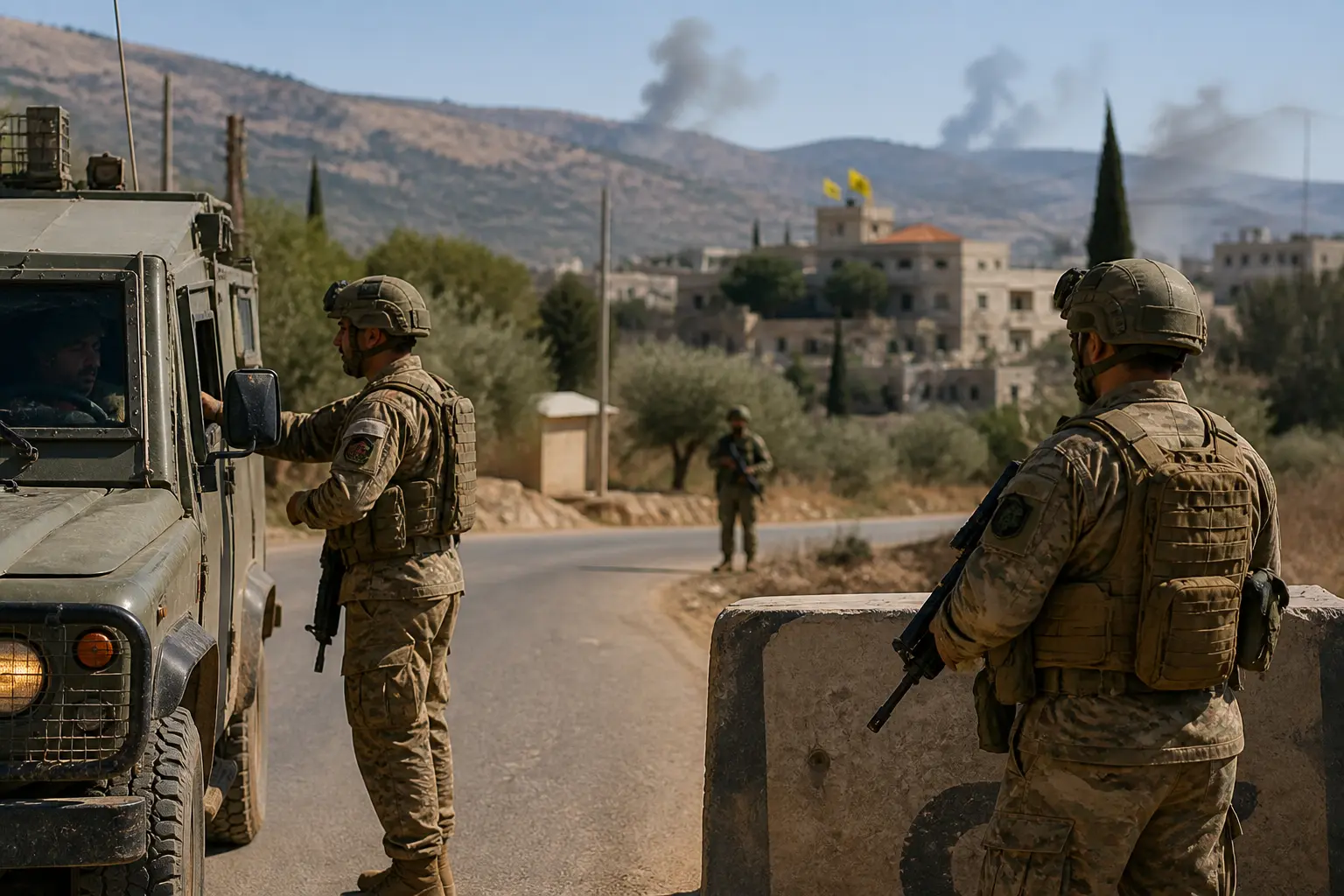
Under the deal the IDF clears infrastructure, a third party verifies, then vetted LAF units take sole control and keep non-state actors out so civilians can return and reconstruction begin. Operations started in July in villages including Zawtar al-Gharbiyeh, Froun and Srifa.
- Clearance: destroy or disable weapons, caches, tunnels and command centers
- Verification via the Military Coordination Group for Lebanon
- LAF sole operational control once cleared
- State-led reconstruction, not Hezbollah-linked entities
The four-step clearance and verification process places heavy practical demands on the LAF: inspecting private homes where weapons have been stored, dismantling underground networks, and blocking smuggling. Past LAF performance under earlier cease-fires fell short of full disarmament, and Israeli sources say many sites remain uninspected.
Qassem’s charge that the army is humiliated tracks the operational reality. Soldiers enter zones still subject to Israeli authorization and bombardment risk while Hezbollah refuses to surrender weapons. The force meant to embody sovereignty becomes the visible face of a deal its main domestic rival rejects.
Two to three initial pilot villages now carry the full weight of the experiment. Each home inspection and tunnel search is both a security task and a political signal. If the LAF cannot show exclusive control, the next zones stay closed and Israeli forces remain in the roughly 10 km strip they hold.
Civilians waiting to return watch the same sequence. State-led reconstruction is promised only after clearance and LAF control. Any delay keeps displacement in place and leaves the government answering for a deal that has not yet delivered either homes or a visible Israeli exit.
Rome Talks Hit Verification and Expansion Walls
The seventh round in Rome in early August discussed expanding pilot zones and countries for a verification committee. Lebanon sought next zones around Bint Jbeil or Khiam and a faster timetable. Israel insisted verification of Hezbollah infrastructure clearance come first and proposed zones outside its buffer in some accounts.
Talks ended early amid escalation. A State Department spokesperson called the sessions constructive and said sides reached understandings on parameters to unlock future zones. Washington announced another Rome round for early September. Beirut remains frustrated that Israel decides the withdrawal pace, especially with Israeli elections approaching in October.
Key numbers from the ground:
- More than 4,300 killed in Lebanon since March per Lebanese figures, without combatant-civilian split
- ~10 km deep strip seized by Israeli forces
- Over 1 million Lebanese displaced at peak
- Two to three initial pilot villages under early LAF deployment
The Lebanese death toll past 4,300 continues to shape public pressure on both the government and Hezbollah.
The gap between the two sides is structural, not cosmetic. Lebanon wants geographic expansion and speed. Israel wants proof that clearance of infrastructure is real before any wider move. Understandings on parameters keep the channel open, yet they do not settle who moves first.
| Track | Lebanese position | Israeli position |
|---|---|---|
| Next zones | Bint Jbeil or Khiam area | Verification first; some accounts point outside the buffer |
| Timetable | Faster redeployment pace | Pace tied to confirmed clearance |
| Verification body | Wider country participation discussed | Clearance proof before expansion |
October elections in Israel add another clock. Beirut fears decisions slow further as campaigns harden. Washington’s September date is meant to hold the process in place before that window closes.
Who Carries the Political Cost Inside Lebanon
President Joseph Aoun and Prime Minister Nawaf Salam have pressed for faster Israeli pullouts and condemned demolitions. Aoun’s late-July White House visit sought US leverage. Qassem dismissed the scene as one American-Israeli camp with Lebanon subordinate.
Hezbollah has rejected direct talks from the start and refuses disarmament. By casting the LAF as victim of government weakness, Qassem both shields his arsenal and undercuts the state’s claim to monopoly of force. Crowds on X amplified the “no surrender” and “dignity of the army” lines, treating the speech as proof the deal hands Israel a veto over Lebanese troops.
Italy has been discussed as a possible participant in verification structures for the free zones, adding a European layer that still leaves the LAF as the boots on the ground. The army receives international capacity support conditioned on milestones, yet operates under dual scrutiny.
Aoun and Salam must show progress to a public that counts more than 4,300 dead and remembers peak displacement above one million. Every delayed zone and every unresolved inspection becomes their political problem. Qassem’s framing turns that same delay into evidence that the authorities chose humiliation over protection.
Capacity support for the LAF does not erase the contradiction. Donors condition help on milestones the framework itself defines. Hezbollah’s refusal to disarm keeps those milestones contested. The army therefore trains and deploys under rules its strongest domestic opponent will not accept.
How the Sequence From Signing to September Unfolded
The diplomatic calendar since late June shows why Qassem can claim seven rounds produced no achievement while Washington still calls the channel constructive. Each step advanced process language more than ground facts.
- June 26: Trilateral framework signed; sequenced LAF authority and IDF redeployment set on paper.
- July: Pilot operations begin in Zawtar al-Gharbiyeh, Froun and Srifa after clearance and verification steps.
- Late July: President Aoun visits the White House seeking faster pullouts and US leverage.
- Early August: Seventh Rome round discusses zone expansion and verification countries; talks end early amid escalation.
- Early September: Further Rome round announced to lock parameters for future zones.
- October: Israeli elections approach, tightening the political window for any accelerated redeployment.
The list makes the bind plain. Signing and pilot entry happened. Verified expansion and a visible Israeli move-out have not. Qassem’s anniversary speech lands between the August stall and the September attempt, aimed at freezing the middle of the sequence.
For the LAF the calendar is not abstract. Units already in the first villages must hold sole control while the next zones stay under negotiation. International support and reconstruction funds remain tied to the milestones still in dispute.
Why Pilot Entry Outpaces Political Cover
The framework’s designers assumed clearance, verification and LAF control would build domestic legitimacy as they advanced. The opposite pressure is visible now. Entry into two or three villages came before a settled verification committee roster and before any broad public sense that Israeli redeployment is near.
Qassem exploits that imbalance. He treats pilot zones as an invention that requires Israeli authorization for the army to enter ground that was not occupied, using Zawtar Gharbieh as his example. The charge sticks because soldiers do operate under residual Israeli conditions and bombardment risk while Hezbollah keeps its weapons.
State institutions carry the exposure. The presidency and cabinet defend a US-brokered text that never promised immediate withdrawal. The army executes the local steps. Hezbollah claims the mantle of dignity without submitting to the inspections the text demands. Political cost therefore concentrates on the actors who signed and who deploy, not on the actor who refuses the sequence.
Italy’s possible role in verification would add a European flag to the free zones. It would not change who walks the streets or who faces popular anger if the hour Qassem describes arrives. Boots and blame remain Lebanese.
Echoes of 2006 and the Limits of State Authority
Qassem chose the anniversary of the 2006 war deliberately. Then as now, Hezbollah claimed victory through survival while the state absorbed reconstruction and political fallout. The current framework tries to reverse that pattern by making LAF control the condition for Israeli redeployment and aid.
Success requires the army to do what it has not fully done before: clear private property, tunnels and financing networks while Hezbollah retains the ability to re-infiltrate or intimidate. Failure keeps Israeli forces in place and leaves the government looking unable to deliver either security or dignity.
The next Rome round in September will test whether verification parameters can expand the zones or whether Qassem’s pressure freezes the process. For now the Lebanese army remains the stakeholder with the least room to maneuver and the most exposure on the ground.
The 2006 parallel also limits how far the government can sell patience. Reconstruction then fell on the state after the fighting stopped. This time aid is gated behind disarmament milestones Hezbollah will not meet on the framework’s terms. The old pattern of resistance claiming survival and the state paying the bill is exactly what the June text tried to break.
If verification stays narrow and zones stay few, the reversal fails in public view. Israeli forces remain in the seized strip, displacement and the death toll keep their political weight, and the LAF stays the face of a stalled bargain. That is the outcome Qassem’s speech is written to hasten or to claim credit for resisting.
Qassem closed by telling supporters the hour of anger may come and that those opposing the resistance would bear responsibility. The framework’s designers cast the LAF as the instrument of restored sovereignty. On the anniversary stage that same force became the symbol of national humiliation.
