
Doha and Tehran are close to finishing feasibility studies for a power line that would carry up to 1,000 megawatts of Qatari electricity into Iran, built on a 2022 agreement that survived a year in which Iranian strikes damaged Qatar’s main liquefied natural gas (LNG) facility. Stimson Center analysts who track the project say the repair bill alone will run into the billions and take years to clear.
That single fact captures something bigger than one pipeline dispute or one insurance premium spike. Across the Middle East, cross-border electricity links are advancing on an unusually busy schedule right now, even as Red Sea war-risk premiums surge and Suez Canal traffic thins out. The projects moving fastest are not necessarily in the countries with the biggest oil and gas reserves. They are in the places that have convinced financiers, regulators and neighbors that a deal signed today will still hold in five years.
Power Lines Rise While Shipping Lanes Go Dark
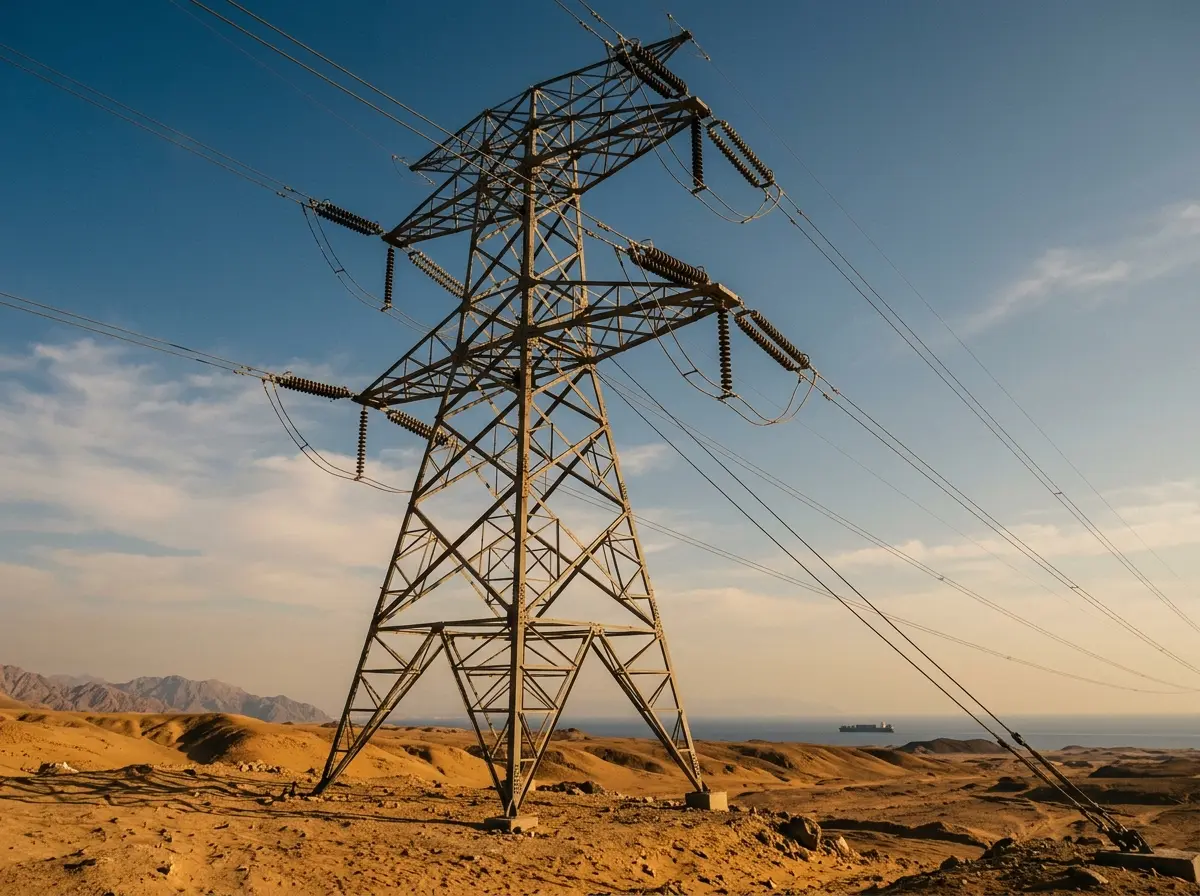
Start with what is under construction right now. The Gulf Cooperation Council’s power grid operator began building a direct 400-kilovolt link between the UAE and Oman this year, and Saudi Arabia’s state news agency reported the connection running two 400 kilovolt lines spanning 530 kilometers between the Al Sila substation in the UAE and the Ibri substation in Oman.
Iraq’s link into the same Gulf grid is even further along. The country’s electricity ministry says the connection is about 95 percent complete and due to enter service in April with a 500-megawatt capacity, a $220 million project years in the making. Egypt and Jordan, meanwhile, renewed their bilateral electricity exchange contract for 2026 and are studying an expansion of their link toward roughly 2,000 megawatts, backed by a Kuwaiti-funded feasibility study running through the Arab Fund for Economic and Social Development.
This is not happening in a calm neighborhood. War-risk insurance premiums for voyages through the southern Red Sea have jumped past 1 percent of a ship’s value, up from around 0.3 percent before Houthi threats resumed, with some quotes for voyages into Saudi Red Sea ports running close to 3 percent. The two trends, wires going up and sea lanes going dark, are running side by side.
| Project | Route | Capacity | Status |
|---|---|---|---|
| GCC-Oman interconnection | Al Sila, UAE to Ibri, Oman | Two 400kV lines, ~530 km | Construction underway |
| Iraq-GCC interconnection | Gulf grid to Iraq | 500 MW | 95% complete, live in April |
| Egypt-Jordan expansion | Egypt to Jordan | Studying increase to ~2,000 MW | Feasibility study funded, 2026 contract renewed |
| Qatar-Iran link | Qatar to Iran | Up to 1,000 MW | Feasibility studies nearing completion |
Four projects, four very different political relationships, all moving forward at once. That is the part the shipping headlines miss.
Three Kinds of Trust Now Decide Who Gets Financed
A framework circulating in Middle East Monitor’s energy commentary this week gives this pattern a name: Energy Trust Diplomacy. The argument is that electricity grids, hydrogen corridors and digital energy systems cannot be switched on and off with political moods the way an oil tanker can be rerouted, so credibility itself becomes a strategic asset alongside reserves and pipelines.
The framework breaks that credibility into three layers that operate at once.
- Political trust – confidence that today’s agreements survive tomorrow’s crises, without requiring identical foreign policies between neighbors.
- Institutional trust – confidence that contracts, regulations and dispute mechanisms hold up regardless of who is in power.
- Operational trust – the habit of cooperation built by grid operators, engineers and regulators handling routine technical work that rarely makes the news.
The GCC grid operator’s own history illustrates the third layer. Beyond raw reliability, the interconnected network has let member states lean on each other for emergency power during supply disruptions and peak demand, and each successful rescue reinforces the case for the next expansion. Kuwait’s development fund recently signed a new financing agreement for grid expansion with the GCC operator, the kind of routine institutional step that rarely draws attention but keeps the pipeline of projects funded.
Jordan Cashes In Its Trust Badge
Jordan is the clearest example of credibility converting into capital. The kingdom has no significant oil or gas reserves of its own, yet Fitch, the credit rating agency, affirmed Jordan’s long-term foreign-currency rating at BB- with a stable outlook this year, citing economic resilience, reform progress and a strong banking sector. Fitch projects growth of about 2.6 percent in 2026, accelerating in 2027 as trade with Iraq and Syria expands.
Earlier this year, the EU’s foreign policy chief Kaja Kallas stood in Amman and called Jordan the EU’s most trusted Middle East partner. That designation and the Fitch rating are not the same instrument, but they measure the same thing from different angles: outside institutions willing to bet on Jordan’s follow-through.
- BB- – Jordan’s affirmed Fitch rating this year, with a stable outlook despite regional turmoil.
- 2.6% – Fitch’s 2026 growth projection for Jordan, expected to accelerate in 2027.
- 2,000 MW – the expanded electricity-exchange capacity Jordan and Egypt are now studying together.
None of that resource poverty stopped Jordan from becoming the physical hub for the Egypt-Iraq interconnection, the trilateral project that only works because all three governments kept showing up to the regulatory table even when their politics diverged elsewhere.
Cyprus and Egypt Sign the Deal Geology Could Not Force
The Eastern Mediterranean shows the opposite pattern: abundant resources without enough credibility to move them to market fast. Egypt and Cyprus signed a framework agreement in March to jointly develop the Aphrodite and Kronos offshore fields, a deal years in the making despite gas sitting there the whole time.
The holdup was never geology. Cyprus’s export strategy depends on routing future production through Egyptian processing facilities, but Turkey disputes parts of Cyprus’s maritime claims and argues that Turkish Cypriots hold rights to offshore resources in the same waters. Meanwhile Egypt’s own flagship field, Zohr, has suffered water infiltration that cut output and pushed Egypt back into being a net gas importer, even as Cairo pursues other credibility-building moves like tax reforms aimed at rebuilding business trust.
Significant offshore discoveries created expectations of a fast regional export corridor years ago. Unresolved maritime disputes and shifting alignments kept slowing projects that looked commercially obvious on paper. The gas was never the problem.
Doha’s Wire to Tehran
The Qatar-Iran electricity plan is the hardest test of the trust framework, because there is barely any political trust involved. Qatar is proposing to share power with a country whose forces damaged its own LNG terminal, and Iran has spent the past year turning to Turkey and Azerbaijan for the same kind of emergency electricity supply it now wants from Doha.
Analysts reading the same facts land in different places on what it actually proves.
- Stimson Center analysts call it hard pragmatism: Doha is managing a difficult neighbor and building leverage, not extending trust.
- Carnegie Endowment for International Peace frames it as a live test of selective cooperation with Iran after direct military escalation.
- The Energy Trust Diplomacy framework would count the studies themselves as operational trust, regardless of the motive behind them, since routine technical cooperation tends to outlast the politics that produced it.
Whichever reading holds up, the studies keep moving. That alone separates this project from the Eastern Mediterranean’s stalled gas corridor.
Could a Red Sea Escalation Freeze the Financing?
Yes, and the financial signals are already flashing. War-risk premiums for southern Red Sea transits have more than tripled off their recent lows, and the shipping group BIMCO has warned premiums could jump further if attacks resume at their earlier pace, in some cases adding hundreds of thousands of dollars to a single voyage.
Suez Canal container traffic tells the same story in volume terms. The canal handled roughly 80 containerships a week before the crisis; by mid-January that had fallen to just 26, with most carriers still defaulting to the longer Cape of Good Hope route. Egypt has Suez Canal revenue exposed to the Houthi blockade at the same moment it is trying to convince investors its regulatory environment is stable enough for long-horizon energy projects.
Hormuz is under strain at the same time, which matters because insurers and financiers price regional risk as a single number, not chokepoint by chokepoint. A long-horizon interconnector or hydrogen corridor that takes a decade to pay back becomes harder to finance every time premiums move, regardless of which specific waterway triggered the jump.
What Regional Planners Want Built Next
The Energy Trust Diplomacy framework’s own prescription is less about grand summits and more about plumbing. It calls for independent regional arbitration mechanisms so cross-border energy disputes get resolved through predictable procedure rather than political bargaining, plus harmonized grid codes, shared hydrogen certification rules and coordinated cybersecurity protocols.
It also argues for sequencing: small, incremental confidence-building steps, joint grid management centers, shared emergency response drills, before politically ambitious mega-projects. The GCC’s own history backs that logic up. The interconnection authority did not start with a headline project; it built a track record of emergency power-sharing first, and the Oman expansion and Kuwaiti financing agreement followed once that record existed.
Iraq’s link into the Gulf grid is scheduled to switch on in April, a 500-megawatt milestone with none of the fanfare that pipelines and export terminals used to command.
Frequently Asked Questions
What is the GCC Interconnection Authority?
It is the operator of the first cross-border electricity grid in the Arab Gulf, linking Bahrain, Kuwait, Oman, Qatar, Saudi Arabia and the UAE so members can share reserves, cut generation costs and support each other during emergencies or peak demand.
Why did Suez Canal revenue fall?
Houthi attacks pushed most shipping lines onto the longer Cape of Good Hope route around Africa. Canal revenue had already fallen to $7.2 billion in the 2023-24 financial year from $9.4 billion the year before, and container traffic through the canal has stayed far below pre-crisis levels since.
What is Energy Trust Diplomacy?
It is a framework, laid out in Middle East Monitor’s energy commentary, describing the deliberate use of political credibility, institutional reliability and technical cooperation to reduce uncertainty and enable long-term regional energy integration, treated as a strategic asset alongside physical resources.
Why is Egypt importing gas despite having its own reserves?
Egypt’s Zohr field, once its largest offshore discovery, has suffered water infiltration that has cut production. The decline has been steep enough to turn Egypt from a gas exporter into a net importer even as it signs new Eastern Mediterranean cooperation deals.
How many countries are connected to the GCC power grid?
Six: Bahrain, Kuwait, Oman, Qatar, Saudi Arabia and the UAE, with Iraq’s separate 500-megawatt link into the same grid due to go live in April and an Oman expansion already under construction.
