
Egypt’s historic World Cup run ended in Atlanta on Tuesday night with a 3-2 loss to defending champions Argentina, but the scoreline tells only part of the story. Lionel Messi equalised in the 84th minute and Enzo Fernandez headed in the stoppage-time winner after Argentina had trailed by two goals to nil, completing a comeback that sent the holders into the quarter-finals and Egypt home to a reception that went well beyond the bounds of football.
The match was decided in the last 13 minutes. It was also decided, according to Egypt’s staff and a leading refereeing expert, by an off-the-ball tug that nobody in the Atlanta stadium saw until VAR replayed it from almost 100 yards away.
A 13-Minute Collapse: How Argentina Overturned a 2-0 Lead
Egypt led 2-0 from the 67th minute. Yasser Ibrahim rose to head them in front from a corner in the 15th, and Mostafa Ziko finished the move that made it two with the Argentine crowd already restless. Messi had earlier missed a penalty, saved by Egypt’s 22-year-old goalkeeper Mostafa Shobeir. Then, in the space of thirteen minutes, the match tilted.
Cristian Romero pulled one back in the 79th, heading in a Messi cross. Messi struck the equaliser five minutes later, his eighth goal of the tournament and the 21st of his World Cup career, a record-extending mark. Fernandez rose to meet a cross from Lautaro Martinez in the 90+2 to seal the 3-2 win, per the Argentina-Egypt match report and Messi’s stoppage-time comeback. Argentina now meet the winner of Switzerland and Colombia in the quarter-finals next Saturday, a path set out in the preview of Argentina and Egypt’s last-16 meeting in Atlanta written before kick-off.
The Egypt squad was carrying more than a lead by the 67th minute. They were carrying a result that, until the final quarter of the match, had looked historic.
- 15th minute: Ibrahim heads Egypt in front from a corner.
- 67th minute: Ziko scores to make it 2-0.
- 79th minute: Romero heads in off a Messi cross, 2-1.
- 84th minute: Messi strikes the equaliser, his 8th of the tournament.
- 90+2: Fernandez heads in the stoppage-time winner.
The Goal That Never Stood: VAR, Lisandro Martinez, and the Refereeing Verdict
The single decision Egypt could not recover from was the one that came after Ziko’s first-half finish. The on-field officials had allowed the goal. The VAR booth, led by French referee Francois Letexier’s team, pulled it back for a Marwan Attia challenge on Lisandro Martinez in the move that preceded the finish. The referee, Attia argued, never blew for a foul in real time. The review that came after, according to one of the Premier League’s former officials, should never have led to a reversal.
Writing in the analysis accompanying the match coverage, refereeing expert and former Premier League official Graham Scott called the call wrong. Attia’s challenge on Lisandro Martinez in the build-up to Ziko’s 67th-minute effort was “normal contact and should be regarded as such, rather than considered a foul,” Scott wrote. The contact had taken place “almost 100 yards from goal, and Argentina had every opportunity to regroup.” Per the Hossam Hassan’s post-match accusations and the refereeing expert verdict, the same logic cleared an alleged foul on Mohamed Salah in the minutes before Argentina’s winning goal. Egypt’s second penalty claim of the night, on Salah, was not given.
The numbers around that VAR sequence made Egypt’s grievance harder to set aside:
- Argentina’s three goals arrived inside 13 minutes, from the 79th to the 90+2.
- The Attia-Martinez challenge took place almost 100 yards from goal, per the refereeing expert analysis.
- Egypt finished the match with four yellow cards, including one to head coach Hossam Hassan.
- Referee Francois Letexier officiated the round-of-16 tie.
- Egypt were denied two separate VAR reviews: Ziko’s disallowed goal and the Salah penalty claim.
Hassan’s X Gesture: The Anti-Racism Protocol the Referee Did Not Stop For
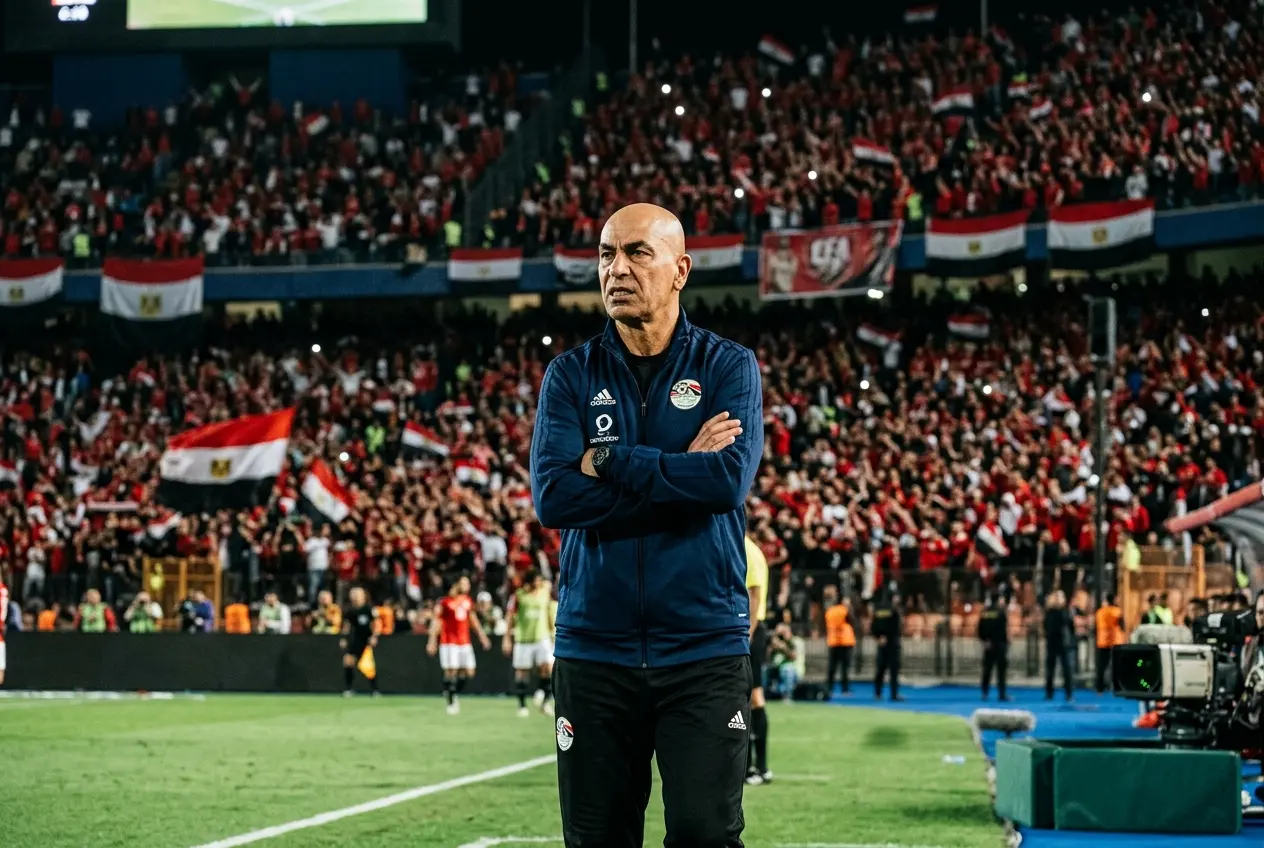
In the dying minutes, with the match tilting against his team, Hossam Hassan crossed his arms into an X across his chest. The gesture, introduced by FIFA in 2024, is the body’s official signal for any player or team official who believes racist abuse has occurred on the pitch. Under the protocol, the referee is meant to halt play and address the incident.
The whistle did not come for the gesture. It came minutes later to end the match. Hassan, who was already on a yellow card by then, received the booking during the same passage of play, per the match report. The exact moment of the X and what triggered it were not confirmed by either FIFA or Hassan’s camp in the hours after the match; the meaning of the gesture remains a matter of reporting rather than official statement.
What is documented is that X gesture was made, that it was made by Egypt’s head coach, and that the on-field protocol that should have followed it did not visibly follow. That gap between what FIFA’s rulebook prescribes and what the match officials did is the part of the night Egyptian supporters carried with them, along with the disallowed goal.
Hassan would later be asked about the gesture. His response, in a separate press appearance, was to redirect the conversation to Palestine.
The Palestinian Flag That Made Egypt Bigger Than a Match
The image most shared from Egypt’s World Cup campaign did not come from the Argentina match. It came five days earlier, on the night Egypt beat Australia 4-2 on penalties in the round of 32, sealing the country’s first knockout-stage victory in 92 years of tournament football. After the win, Hossam Hassan walked the pitch at Dallas Stadium holding a large Palestinian flag overhead, the crowd around him chanting “Free, free Palestine.”
My heart and soul are with them.
He was dedicating the win to “the good and noble” Egyptian and Palestinian people, he said, per the Hossam Hassan’s Palestinian flag celebration after Egypt’s win over Australia. Yahia Qalash, the former head of Egypt’s Journalists’ Union, called it “the most significant scene” and “a telling scene in an exceptional moment.” The video went viral within hours. FIFA told the Associated Press that “flags representing all 211 FIFA Member Associations are permitted at FIFA tournaments.” The Palestinian Football Association is one of those members.
The shootout itself had been built on homework, with Egypt’s analysts pulling up a Real Madrid-Levante clip in which Kylian Mbappé scored a penalty against Mathew Ryan, the Australia goalkeeper who came on in the 119th minute. Mohamed Salah finished the resulting Panenka down the middle, a kick he said he had decided on only as he stood over the ball, in a story told in the how Egypt studied Mathew Ryan on Real Madrid tape to win the shootout dispatch. Four days later, the same flag that Hassan had carried on that Dallas pitch was on Egyptian supporters’ phones in Atlanta, framing the disallowed goal and the stoppage-time defeat.
Cairo to Gaza: How the Wider Arab World Responded
By the time the Egypt squad reached their hotel in Atlanta, the congratulations were already pouring in from Cairo. Egyptian President Abdel Fattah el-Sisi posted on X thanking the players for “an honourable performance” and a historic World Cup run, writing that “the future is brighter for you.” The Egyptian Football Association’s own account was quicker: “You were men of great responsibility. Proud of you. Thank you for everything,” it posted.
The praise ran deeper than Cairo. The Palestinian ambassador to the United Kingdom commended Egypt’s “historic performance” while criticising the referee, a sentiment that ran across social media. A Gaza-based fan posted a longer account of what the match had meant inside the besieged territory, describing streets emptying into viewing areas set up among the rubble of bombed buildings, with Egyptian flags strung overhead.
His words, reported by Al Jazeera, captured the night:
- “Can you imagine the level of injustice we live here in Palestine? Imagine a football team being eliminated from the World Cup simply because it raised the Palestinian flag and spoke about Gaza.”
- “Everyone here in Gaza was out in the streets watching. For a moment, they forgot the unbearable reality they endure every day.”
- “Perhaps a football match was their only hope of making their voices heard by the world.”
- “I swear our tears fell with joy after every Egyptian goal.”
- “Even our simplest moment of joy was taken away from us.”
The frame the region settled on was not the scoreline. It was the flag, the disallowed goal, and the gesture the referee did not stop for.
Carragher, Mourinho, and the Verdict From Outside Egypt
The most cited outside voice was Jamie Carragher’s. The former Liverpool defender, watching on television, went after the VAR decision in Premier League terms.
I assure you that if the goal was against another team, it would have been allowed. If it happened in the Premier League, La Liga or Serie A, it would have been a goal even after VAR review. There have been many contradictions in this tournament.
Jose Mourinho, the Portuguese coach now at Real Madrid, took a sharper tone, per reporting that Al Jazeera itself flagged as “reportedly” sourced. He called the officiating “daylight robbery.” His fuller quote: “It’s a shame what football is becoming. How do you let the play continue, allow the goal to be scored, and only then decide to go back and cancel it? If there was a foul, stop the game immediately. Don’t wait until after the goal.” Some football analysts pushed back. Ali El Garni told Al Jazeera that “robbed might be a strong word” but added that the 50/50 calls had all fallen Argentina’s way. Simon Chadwick of Emlyon Business School, also speaking to Al Jazeera, called the period “unusual” and questioned why VAR had intervened on the Attia incident when the on-field referee had not blown for a foul at the time. The refereeing expert verdict published alongside the post-match coverage reached the same conclusion from a different angle: the contact was normal, the distance was too great, and the VAR intervention was a “massive overreach.”
None of those verdicts changed the scoreline. They did set the terms of the post-match debate.
The Pharaohs Head Home, the Holders Move On
Outside the team hotel in Atlanta, Egyptian supporters waved flags and set off flares that coloured the sky red. Mohamed Salah and his teammates stepped out to greet them. Inside the same building, the head coach was telling reporters that he would not be watching the rest of the tournament.
“I’m going home and won’t be watching any more games from the tournament,” Hassan said. “What happened to us wasn’t fair. We should have had a penalty, a goal was disallowed, and I don’t know why it was disallowed.” He also said, in the same post-match news conference: “We have suffered injustice… We would have deserved to earn this win, but we are leaving with honor, with pride, regardless of this defeat.” Ziko, the striker whose goal had been taken away, was more direct in his on-pitch interview with TSN: “We wanted to make you all happy. It was not in the cards. It was the referee. The cup is directed towards Argentina.” Argentina, who had missed a penalty, fallen two goals behind, and relied on a stoppage-time header to survive, move on to face Switzerland or Colombia with their World Cup defence intact.
Frequently Asked Questions
Who refereed Egypt vs Argentina at the 2026 World Cup?
French referee Francois Letexier officiated the round-of-16 match at Atlanta’s Mercedes-Benz Stadium. Egypt finished the match with four yellow cards, including one to head coach Hossam Hassan.
What was the X gesture Hossam Hassan made during the match?
FIFA introduced the crossed-arms X signal in 2024 as the body’s official way for players or team officials to report racist abuse on the pitch. Under the protocol, the referee should stop the match and address the incident; the meaning of Hassan’s specific X was not confirmed by FIFA or by Hassan’s camp in the hours after the game.
When was the last time Egypt reached the knockout stage of a World Cup?
The 2026 round of 32 was Egypt’s first knockout-stage appearance in the country’s 92-year World Cup history. Egypt’s earlier 3-1 win over New Zealand in the group stage was their first World Cup match victory in that span, and the penalty win over Australia was their first knockout-stage victory.
What did Messi say after Argentina’s comeback?
Messi credited the team’s character after the 3-2 win. “This is the World Cup for you,” he told reporters. “It wasn’t easy to come back from two goals down. But as I always say, this group never gives up. We always try to fight until the end.”
How did Egypt get to the round of 16 against Argentina?
Egypt finished the group stage with a 3-1 win over New Zealand, their first World Cup match victory in 92 years of tournament history, and then beat Australia 4-2 on penalties after a 1-1 draw in the round of 32. The draw set up the Atlanta tie with the defending champions.
