
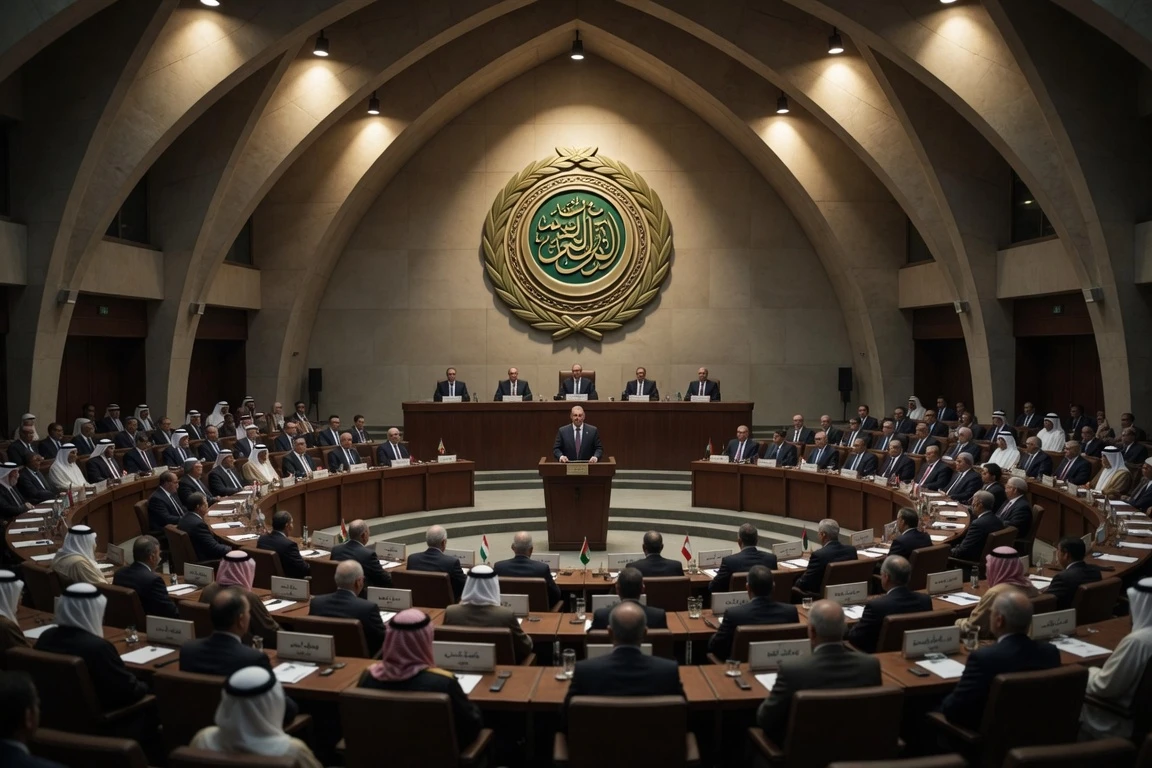
Cairo is set to host the 8th Conference of the Arab Parliament and Speakers of Arab Councils on Saturday, gathering parliamentary leaders from across the Arab world at the headquarters of the Arab League General Secretariat. The one-day meeting, the eighth in a series that has run since the Arab Parliament relocated to Cairo in 2012, will set the regional legislative body’s working agenda for the coming months. It also doubles as the annual rendezvous between the Arab Parliament itself and the speakers of national councils and parliaments from Arab League member states, a two-track gathering that combines an internal coordination session with a wider political summit.
The conference opens against a backdrop of overlapping pressures: protracted instability in several Arab countries, an unresolved Palestinian question, and a regional push to build Arab digital policy from the ground up, with new rules written inside Arab legislative chambers. The published programme, as laid out in the agenda for Saturday’s Cairo meeting, places three principal agenda files at the centre of the day. Speakers of parliament and council chairs are expected to use the gathering to align their positions across all three files before the agreed language is carried into international forums such as the United Nations General Assembly and the Inter-Parliamentary Union.
- Arab national security and the protection of Arab peoples’ gains
- The Palestinian cause and the rights of the Palestinian people, including the establishment of an independent state with Jerusalem as its capital
- Arab Digital Sovereignty as a strategic file for the region’s digital future
National Security as the Frame
Arab national security sits at the very top of the published agenda. According to the conference programme, participants will examine how Arab parliaments can play a more active role in protecting the security of their states at a time when several Arab countries are navigating internal and cross-border challenges. The stated aim is to “unify parliamentary visions regarding strategic issues” so that legislative chambers can contribute to regional stability and “the protection of Arab peoples’ gains.”
That framing places the security track above the other two in the published order, a deliberate signal of how the host organisers expect delegates to read the day. Security in this context is broad. It includes the threat picture inside Arab states, the integrity of borders, and the parliamentary contribution to counter-terrorism and counter-extremism legislation, an area in which several Arab parliaments have already built up dense statute books in the last two decades. Putting the file first is also a way of signalling that the Palestinian and digital tracks will be read through a security lens, not in parallel with it.
The agenda is also a recognition of the political climate in which the meeting is being held. Several Arab states have spent the last two years recalibrating their security relationships with regional and external partners, and the speakers’ conference is one of the few forums where parliamentary leaders from across the Arab world sit in the same room with a single shared text in front of them.
The Palestinian File Returns to Center Stage
The Palestinian cause retains its traditional weight. Delegates will discuss mechanisms to “counter attempts to liquidate the Palestinian cause” and address ongoing violations against the Palestinian people, the programme states.
Speakers will explore ways to support the establishment of an independent Palestinian state with Jerusalem as its capital, framed as a coordinated Arab effort at both regional and international levels. The continued centrality of the file in the published text is itself a signal of how Arab parliamentary leaders expect the day’s resolutions to be read abroad, where the Palestinian question remains the most legible marker of any unified Arab position.
The Palestinian track echoes the focus of the seventh conference held in Cairo in February 2025, which centred on a unified Arab parliamentary position in support of the Palestinian people and rejection of any proposals for their forced displacement. That continuity is deliberate: the parliament uses these annual gatherings to refresh the Arab position on Palestine rather than reset it, and the resolutions on Palestine tend to be the ones with the longest shelf life across Arab foreign policy cycles.
The persistence of the file also reflects the wider diplomatic picture, including ongoing debates at the United Nations and joint Arab statements on the two-state solution, a track covered in detail by India’s parallel push for a two-state solution at the UN. Arab states have spent the last two years trying to keep a common front on the Palestinian question, and the parliamentary layer is one of the few places where the language of those statements is rehearsed before ministers and heads of state take it up.
The Quiet File on Digital Sovereignty
The least-reported item on the agenda is also the one with the longest horizon. The conference places “special emphasis” on Arab Digital Sovereignty as a strategic file linked to the future of regional development, the programme states.
The digital sovereignty track reflects a wider shift in how Arab legislatures read the region’s technological dependencies. Arab Parliament Speaker Mohammed bin Ahmed Al Yamahi, in his June 19 address in Marrakech to the Fourth Economic Parliamentary Forum for the Euro-Mediterranean and Gulf regions, framed the file in unusually direct terms. The forum, organised by Morocco’s House of Councillors and the Parliamentary Assembly of the Mediterranean, brought together parliamentary delegations from both regions.
The challenge is no longer merely acquiring technology, but rather developing the capacity to produce, localise, and advance it, while establishing the necessary legislation to protect societies from its risks.
Mohammed bin Ahmed Al Yamahi, Speaker of the Arab Parliament, at the Fourth Economic Parliamentary Forum for the Euro-Mediterranean and Gulf regions in Marrakech, June 19, 2026.
The Cairo conference elevates the digital sovereignty file to a top-tier agenda item at the annual speakers’ gathering. The head of the policies and legislation committee at the Arab Parliament, in remarks covered in a write-up of the proposed digital charter, has pointed to a charter that would help reduce excessive reliance on foreign digital infrastructure, language that hints at a regional data-localisation and platform-governance push yet to be finalised. Member-state parliaments will be the ones to translate the eventual framework into national law, which is why the speakers’ conference, rather than the Arab Parliament’s own sessions, is the chosen venue.
What the Eighth Conference Changes
The seventh and eighth conferences share a venue, a host institution, and a deep preoccupation with Palestine. The February 2025 meeting closed around a unified Arab parliamentary action plan for Palestine and a document titled “An Arab Parliamentary Vision to Achieve and Promote Peaceful Coexistence.” Saturday’s meeting swaps the coexistence document for the digital sovereignty file, a change that suggests the Arab Parliament is recasting its annual output to put governance on the table alongside diplomacy.
The shift is small in language and large in direction. The seventh conference produced joint declarations on Palestine and coexistence. The eighth conference is moving toward legislative frameworks that member-state parliaments would translate into national law. That is a different kind of output, and it puts a heavier load on the speakers of national councils, who are the ones with the procedural power to introduce the framework back home.
| Item | 7th Conference (February 2025) | 8th Conference (June 2026) |
|---|---|---|
| Venue | Arab League headquarters, Cairo | Arab League General Secretariat, Cairo |
| Anchor theme | Palestinian cause and peaceful coexistence | National security, Palestinian cause, Arab digital sovereignty |
| Key output | Unified action plan for Palestine; coexistence vision document | Resolutions and recommendations on three files; parliamentary roadmap |
| Source reporting the agenda | Saudi Press Agency | Voice of Emirates |
The Speaker Steering the Arab Parliament
Mohammed bin Ahmed Al Yamahi, a member of the United Arab Emirates’ Federal National Council, has served as Speaker of the Arab Parliament since October 2024. The Arab Parliament is the legislative body of the Arab League, with its headquarters relocated from Damascus to Cairo on May 22, 2012, where it has remained.
Al Yamahi has used his recent public appearances to push the technology and digital transformation file hard, framing it as central to the parliament’s relevance in a region whose economic plans increasingly run on data infrastructure. He has also used the platform to call for closer coordination between Arab parliaments and international financial institutions, and to argue that parliaments must move beyond their traditional legislative role and “contribute to building regional consensus” on economic and technology policy.
Saturday’s conference is the first major test of whether that rhetoric translates into a coordinated Arab legislative position. Al Yamahi’s wider public posture, including his rejection of what he has called media allegations directed at individual Arab states, suggests the conference will also be read as a stage for him to manage intra-Arab tensions in real time, a pattern visible in the wider picture of Arab states coordinating pressure behind the scenes on a range of regional files.
The Roadmap Out of Cairo
The conference is expected to conclude with a set of resolutions and recommendations reflecting a unified Arab parliamentary stance, according to the published programme. Those resolutions will form the parliamentary roadmap for the coming phase, the programme says, covering the national security, Palestinian, and digital sovereignty tracks in that order.
Al Yamahi’s wider public posture suggests the digital file will be the one he tries hardest to elevate, even as the security and Palestine tracks keep the spotlight. The roadmap’s final wording will be the deliverable that Arab foreign ministries carry into the September window of UN General Assembly diplomacy.
- Date: Saturday following June 23, 2026
- Venue: Arab League General Secretariat, Cairo
- Agenda files: 3
- Speaker of the Arab Parliament: Mohammed bin Ahmed Al Yamahi, in office since October 2024
- Arab Parliament headquarters in Cairo since May 22, 2012
Frequently Asked Questions
When and where is the 8th Arab Parliament Conference being held?
Saturday, at the Arab League General Secretariat in Cairo. The published programme describes it as a one-day meeting of Arab parliamentary leaders and the speakers of Arab councils and parliaments.
What is the Arab Parliament?
The Arab Parliament is the legislative body of the Arab League. Its headquarters have been in Cairo since 2012, when the sessions were transferred there from Damascus.
What are the three main agenda items?
The published programme lists Arab national security, the Palestinian cause and the protection of Palestinian rights, and Arab Digital Sovereignty as the three principal agenda files.
What is Arab Digital Sovereignty?
The conference programme describes Arab Digital Sovereignty as a strategic file linked to building a secure electronic environment, supporting sustainable development, and protecting Arab cybersecurity interests, with new Arab frameworks and legislation for the digital space as the proposed instruments.
Who is the current Speaker of the Arab Parliament?
Mohammed bin Ahmed Al Yamahi, a member of the United Arab Emirates’ Federal National Council, has served as Speaker of the Arab Parliament since October 2024.
