
Motorola Solutions agreed to buy D-Fend Solutions, an Israeli counter-drone startup, for $1.5 billion on Monday, in what Hebrew media called the largest sale of an Israeli defense company on record. The Raanana-based firm builds technology that hijacks rogue drones in mid-flight using radio waves, taking control of the aircraft rather than jamming its signal or shooting it down. The transaction is expected to close in the fourth quarter of 2026.
The price is the headline. The detail that matters more is the timing and the shape of it: this is Motorola’s second drone-related purchase in roughly a year. Together with the company’s 2025 takeover of Silvus Technologies, it gives the firm both the networks that keep drones flying and the means to pull hostile ones out of the sky, just as a new US law opens a domestic market for exactly that capability.
What D-Fend Does That Jamming Cannot
Most counter-drone systems do one of two crude things. They jam, flooding the radio spectrum to sever a drone’s link to its pilot, which also knocks out nearby communications and can send the drone crashing into a crowd. Or they go kinetic, firing nets, lasers or rounds to bring the aircraft down, scattering debris over whatever sits below.
D-Fend’s flagship product, EnforceAir, takes a third route. It uses non-kinetic RF cyber-takeover (radio-frequency manipulation that seizes a drone’s control channel), detecting the aircraft, identifying it, then commandeering it and landing it safely in a chosen spot. Authorized drones and surrounding signals keep working. That distinction is the whole pitch, and Motorola’s chief executive leaned on it in announcing the deal.
Rogue drones have transformed our skies into a landscape of unpredictable risk, where simple detection is no longer enough.
That was Greg Brown, Motorola Solutions’ chairman and chief executive, in the company’s announcement of the counter-drone purchase. The technology already has a wide footprint. EnforceAir runs in more than 30 countries, including NATO members, guarding airports, military zones and critical infrastructure. In the United States it is used by three federal departments:
- The Department of Homeland Security (DHS), which polices borders and protects domestic infrastructure
- The Department of Defense (DoD), which secures military installations
- The Department of Justice (DOJ), which covers federal facilities and major public events
The Fiber-Optic Drones It Cannot Stop
Here is the catch that the celebratory coverage skips. A takeover system needs a radio link to hijack, and a jam-proof system needs radio emissions to disrupt. Neither works on a drone that carries no radio at all.
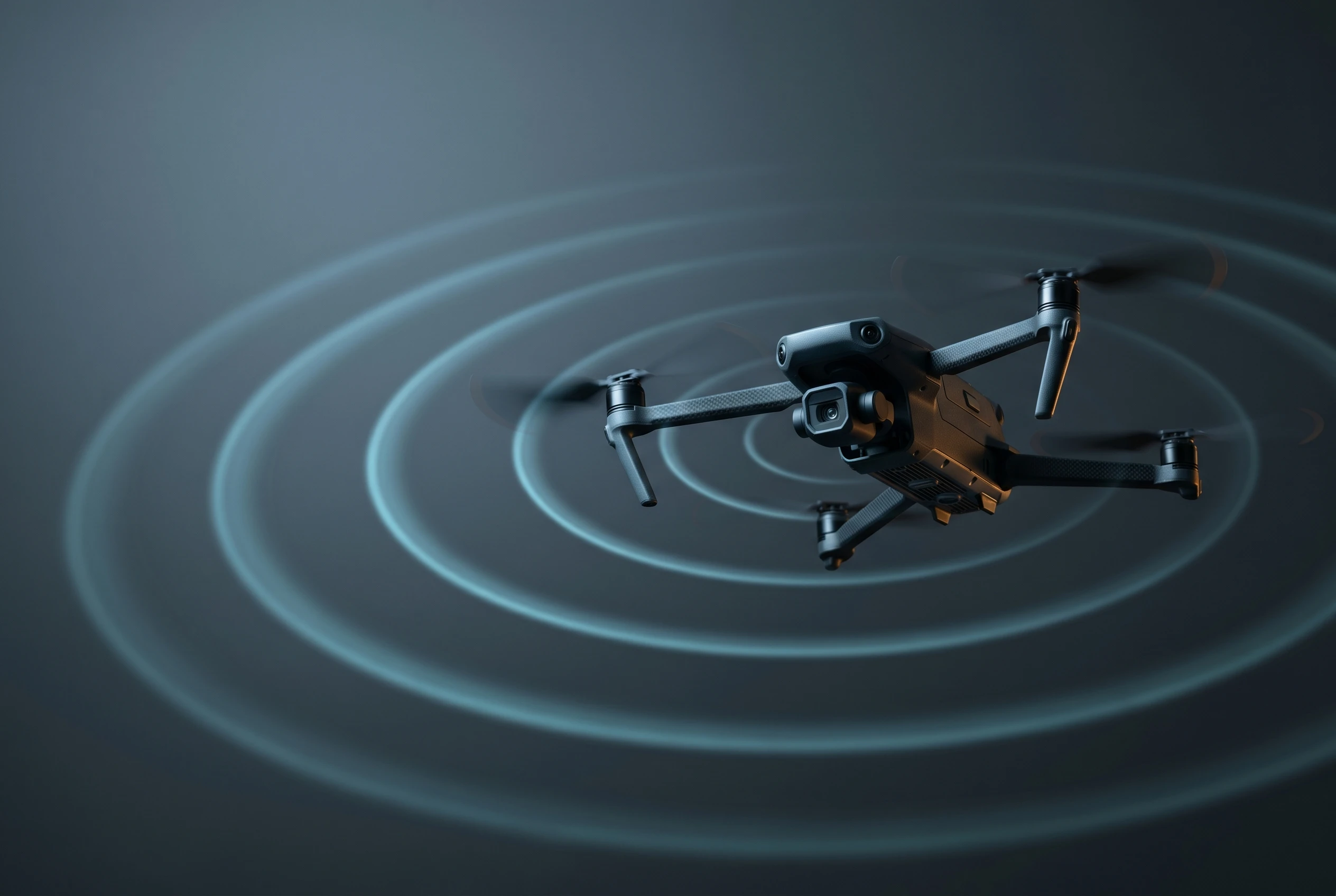
That is the cutting edge of drone warfare right now. Fiber-optic-guided drones spool out a thin physical cable as they fly, sending video and commands down the wire instead of over the air. They emit nothing for D-Fend to grab or scramble. Hezbollah has used exactly these cabled drones against Israel in recent weeks to deadly effect, part of an arsenal that Israeli officials warn is expanding toward Israel’s major cities. EnforceAir would be useless against them.
So the buy is best read as a bet on the civilian threat, not the front line. Airports, stadiums, prisons and data centers face hobbyist and commercial quadcopters flown by remote pilots over radio. Those are the targets D-Fend handles well, and they are the ones multiplying fastest in the places Motorola already sells.
Two Deals in a Year Build One Airspace Business
D-Fend does not stand alone in Motorola’s plan. In May 2025 the company agreed to buy Silvus Technologies for $4.4 billion, a maker of mobile ad-hoc network (MANET) gear that gives drones and unmanned systems secure, infrastructure-free links for video and data. The earnout terms, worth up to an additional $600 million through 2028, are laid out in the Silvus acquisition disclosure filed with the SEC.
Put the two purchases side by side and the strategy reads cleanly. Silvus keeps friendly drones connected. D-Fend takes hostile ones down. A police department, a military customer or an airport authority can now buy both ends of the airspace problem from a single vendor it already knows for radios and body cameras.
| Deal | Price | Announced | What it adds |
|---|---|---|---|
| Silvus Technologies | $4.4 billion | May 2025 | Secure mesh networking that keeps authorized drones flying and connected |
| D-Fend Solutions | $1.5 billion | June 2026 | Radio-takeover defense that seizes and lands rogue drones |
The combined spend runs to nearly $6 billion in roughly twelve months, a heavy commitment from a company best known for two-way radios and public-safety software. It signals that Motorola sees airspace security as a core line of business rather than a side experiment.
How a New US Law Created Buyers for Takeover Tech
The deal makes more sense once you read the law behind it. The Safer Skies Act, enacted as part of the fiscal 2026 National Defense Authorization Act, lets trained and certified state and local police officers detect, track and, where permitted, actively hijack and safely land unauthorized drones. Before this, that authority sat almost entirely with a handful of federal agencies, and a local cop who seized control of a drone risked breaking federal law.
That single change turns thousands of police departments into potential buyers of non-kinetic takeover tools, and D-Fend is one of the few vendors with a field-proven product to sell them. Motorola, which already supplies much of that same police market, completed its $4.4 billion Silvus purchase in August 2025, days before the new fiscal year, and is moving fast to stack the next piece on top.
The urgency is not abstract. Rogue drones forced repeated airport shutdowns across Europe over the past year, and drone attacks struck infrastructure during the recent fighting between the United States, Israel and Iran, including a strike that reached a secure US facility in Riyadh. Every such incident sells the case for systems that neutralize a drone without jamming the radios or peppering a runway with debris.
The Numbers Behind a Record Israeli Defense Exit
For Israel’s defense sector, the price tag is a milestone. D-Fend was founded in Raanana in 2016 and last carried a valuation of about $200 million in 2024, according to estimates reported by the Haaretz daily. Selling for $1.5 billion two years later puts the exit at roughly 7.5 times that mark, and its more than 200 employees move to Motorola Solutions when the deal closes, the Globes business newspaper reported.
The financials underneath help explain the premium:
- $185 million in revenue expected for full-year 2026, after three straight years of growth above 50%
- 7.5 times the company’s 2024 valuation, the jump from a roughly $200 million estimate to the sale price
- $8.42 billion, the size the global anti-drone market is forecast to reach by 2031, up from $2.47 billion this year
That market projection comes from the research firm Mordor Intelligence, whose anti-drone market forecast puts the compound annual growth rate near 28% through the end of the decade, with North America the largest single region. A buyer paying eight times trailing revenue for D-Fend is wagering that the curve holds and that police, not just armies, become the volume customers.
Whether that wager pays off depends on demand the cabled drones now reshaping warfare cannot touch. The deal is set to close in the fourth quarter of 2026, when D-Fend’s staff and its takeover technology become Motorola’s to sell into the market its Silvus radios already reach.
