
A storage jar pulled from a layer of ash at Tel Azekah, an ancient city overlooking the Elah Valley in modern Israel, carries one of the last messages Egypt’s administration ever left in Canaan. Written in hieratic, the cursive script Egyptian clerks used for accounts and paperwork, the inscription dates to the second half of the 12th century BCE and points to a tax-and-tribute bureaucracy still working as the empire’s grip on the region slipped away.
The note itself is ordinary, the sort of clerical scrawl that normally rotted away with the papyrus it was written on. It outlived everything around it for a grim reason: the town that produced it burned to the ground, and the fire baked the record into the earth where it sat for the next three millennia.
A Storage Jar in the Ashes of Azekah
Archaeologists lifted the vessel from the northwestern slope of the mound during the long-running excavation at Tel Azekah, a dig running since 2012 under Oded Lipschits of Tel Aviv University and Manfred Oeming of Heidelberg University. The jar sat inside a room that had once worked as a potters’ quarter, surrounded by the wreckage of a single violent afternoon.
What the team found around it reads like a household frozen mid-use:
- A complete potter’s wheel, still in place on the workshop floor
- Clay storage silos and a clutter of tools for shaping and polishing pots
- Smashed storage containers, a cooking pot, a bowl and an oil lamp
No one was actually making pots when the roof came down. The evidence suggests the room had been handed over to storage by then, which is why the inscribed jar was resting among the other vessels rather than sitting fresh off the wheel. Preservation across the site is good enough that the excavators have taken to calling Azekah a “mini-Pompeii,” a tell where everyday objects stayed where their owners dropped them.
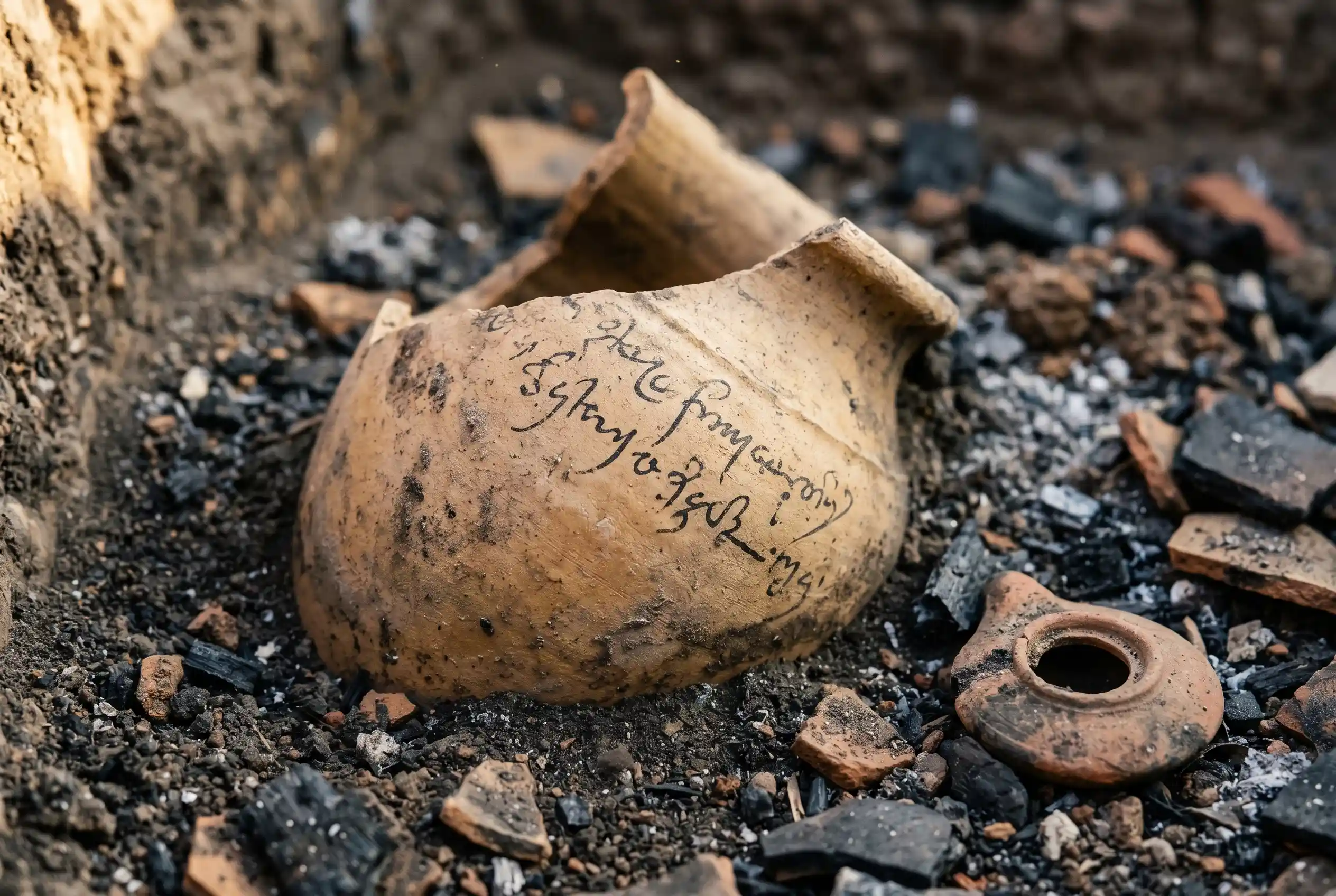
What the Scribe Wrote in Black Ink
The text was applied in black ink by a hand the researchers describe as a trained professional, not an amateur copying signs he half understood. Part of it is missing. What survives includes an Egyptian title that reads as “supervisor” or “overseer,” and that single word is carrying most of the argument in the study, led by Egyptologist Deborah Sweeney at Tel Aviv University and published in the journal of the university’s Institute of Archaeology.
Sweeney sets out two ways to read the broken line, and they pull in slightly different directions.
An Official’s Name
The first reading takes the surviving title as part of a personal name and rank: the record of an official working inside the Egyptian system. That official need not have been Egyptian by birth. Egypt routinely recruited locals into its provincial apparatus, so the man behind the inscription may well have been a Canaanite who learned the script and served the foreign administration that ran his region.
A Tax Tally
The second reading ties the text to a Canaanite term, “brit,” used for the tax or tribute owed to Egyptian authorities. Similar wording shows up on a small group of inscribed bowls from the Ramesside period that scholars have studied as tax dockets, including the work on hieratic brit bowls from Ramesside Canaan. On this reading the jar names the official in charge of collecting and forwarding those deliveries. Either way, the message is the same: paperwork was still being filed in the name of the empire.
Why Hieratic on a Jar Is Unusual
Hieratic inscriptions do turn up in Canaan, but almost always on bowls, the standard carrier for Egyptian-style tax records in the region. Only a handful of comparable texts exist at all, and a storage jar is an odd place to find one. That rarity is part of why Sweeney treats the find as the latest known hieratic text from the Late Bronze Age in the southern Levant, a region that runs from southern Israel up through the coastal plain.
The script also sat at the heart of a slow handover that scholars track through these very objects, the gradual scribal shift from Egyptian hieratic to the early alphabet. Set against the known find-spots, the Azekah jar stands out on the carrier alone.
| Site | Object carrying the text | Note |
|---|---|---|
| Lachish | Bowls | Tax and tribute dockets in ink |
| Tel Sera’ | Bowls | Administrative records, Ramesside era |
| Deir el-Balah | Bowls and vessels | Linked to an Egyptian garrison settlement |
| Tell el-Far’ah (South) | Bowls | Southern administrative finds |
| Tel Azekah | Storage jar | Latest known example; unusual carrier |
Lay the jar beside the bowls and it looks less like a one-off curiosity and more like a clerk reaching for whatever vessel was at hand to log a transaction.
A Jar That Traveled from Gath
The clay told its own story. Under the microscope the fabric turned out to be a mix of local soils and crushed sandstone, a recipe that points away from Azekah itself. The researchers traced it to nearby Tell es-Safi, the site usually identified as ancient Gath, about 8 kilometres (5 miles) to the west.
That short trip carries weight. It means the jar was made in one major Canaanite center and ended up in another, with an Egyptian administrative note attached to it somewhere along the way. Goods moved between towns, and so, apparently, did the bureaucracy that taxed them. The find quietly fills in the working relationship between local potting centers, the communities that used their wares, and the foreign officials skimming a share off the top.
A Record That Should Have Rotted Away
Almost everything Egypt’s clerks wrote in Canaan is gone. The bulk of official record-keeping ran on papyrus, and papyrus does not survive in the damp soils of the Levant. The same way Egyptian scribes logged their dealings with Canaan on papyrus that mostly perished, the day-to-day accounts of the province dissolved centuries ago. What is left comes down to the stubborn fragments that happened to be scratched onto pottery and then sealed in by disaster.
The Azekah jar is one of those accidents of preservation. A clerk logged a routine delivery, the town burned, and the heat fixed the ink and the vessel in a destruction layer that no later builder disturbed. The numbers around it are easy to underestimate:
- 3,200 years in the ground before the jar was lifted and read
- 8 kilometres (5 miles) between where the jar was made and where it was found
- Two centuries of abandonment at Azekah after the fire
A document built to be thrown out within a season instead became the longest-surviving trace of a system that thought it would last.
Egypt’s Grip on Canaan, and How It Slipped
Egypt had run the southern Levant for roughly three centuries by the time this jar was filled. The conquest began under Pharaoh Thutmose III in the 15th century BCE, and the province was managed from a string of garrisons, with annual tours to gather tribute and a network of local rulers kept in line. By the Ramesside period of the 19th and 20th dynasties, that apparatus was deeply embedded in places like Azekah, down to the script its tax men used.
It did not last much longer. Across the 12th century BCE the whole eastern Mediterranean order came apart in the Late Bronze Age collapse, the cascade of failures that ended Hittite power, broke the Canaanite city-state system and pulled Egypt back inside its own borders. That same upheaval reached far further back into the relationship, the kind documented by finds such as Egyptian donkeys ritually buried beneath Canaanite homes long before this period. You can read the broader unraveling in accounts of the collapse that closed the Bronze Age across the region.
Azekah caught it directly. Radiocarbon dates put the city’s destruction near the end of the 12th century BCE, and after the fire the site sat empty for roughly two hundred years. When the potters’ quarter burned, the inscribed jar tipped into the ash and stayed there, a tax man’s note left behind in a town that no one came back to rebuild.
Frequently Asked Questions
What is the Tel Azekah jar inscription?
It is a hieratic text written in black ink on a complete ceramic storage jar found at Tel Azekah in Israel. The surviving words include an Egyptian title meaning “supervisor” or “overseer,” and researchers read it as evidence of Egyptian tax or administrative activity dating to the second half of the 12th century BCE.
What does hieratic script mean?
Hieratic is a cursive, shorthand form of Egyptian writing that scribes used for administration, accounts and record-keeping, as opposed to the formal hieroglyphs carved on monuments. Its presence in Canaan signals that Egyptian-trained clerks were operating there, since the script was tied to the empire’s bureaucracy.
Why is the jar important for understanding Egypt’s rule in Canaan?
Because it may be the latest known hieratic inscription from the Late Bronze Age in the southern Levant, it captures Egyptian administration still functioning at the very end of imperial control. Most such records were written on papyrus and have not survived, so this fired-clay example is one of the few direct clues to how the system worked in its final phase.
Where was the jar actually made?
Clay analysis points to Tell es-Safi, the site widely identified as ancient Gath, about 8 kilometres (5 miles) west of Azekah. The vessel was produced in one Canaanite center and ended up in another, showing that goods, and the bureaucracy attached to them, moved between major settlements.
What was the Late Bronze Age collapse?
It was a wave of destruction and decline across the eastern Mediterranean during the 12th century BCE that ended the Hittite empire, broke the Canaanite city-state system and forced Egypt to withdraw from the region. Azekah was destroyed near the end of that century and then abandoned for roughly two hundred years.
Who led the study?
The research was led by Deborah Sweeney, an Egyptologist at Tel Aviv University, and published in the journal of the university’s Institute of Archaeology. The jar came from the Lautenschläger Azekah Expedition, directed by Oded Lipschits of Tel Aviv University and Manfred Oeming of Heidelberg University.
