
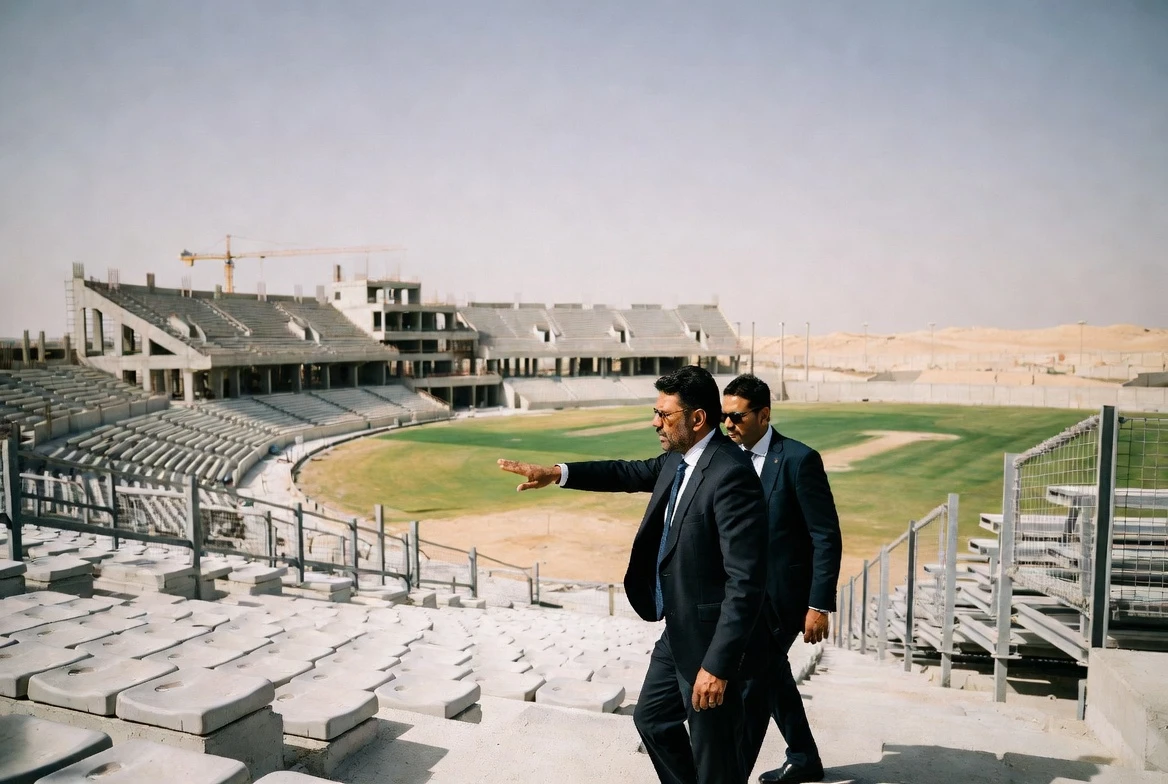
Pakistan Cricket Board Chairman Mohsin Naqvi toured the King Fahd Abdulaziz University cricket ground in Jeddah on Friday, walking the stands with Saudi Arabian Cricket Federation Chairman Prince Saud bin Mishal Al Saud. The two reviewed proposed upgrades aimed at meeting International Cricket Council standards, and match officials briefed them on the venue’s planned expansion and modernization.
The visit followed a memorandum of understanding the PCB and SACF signed earlier in the same trip, the boards’ first strategic agreement. Under the deal, the PCB will construct the stadium itself, with all facilities built to ICC requirements, the joint statement said. Naqvi, who also serves as Pakistan’s interior minister, travelled to the Kingdom for talks that touched security and institutional cooperation alongside the sporting track. The deal makes Pakistan the contractor for an international-standard cricket venue in Jeddah.
The Friday Tour of King Fahd Ground
King Fahd Abdulaziz University’s cricket ground in Jeddah hosted a working inspection, not a groundbreaking, on Friday. Naqvi and Prince Saud walked the enclosures, examined the stands and held detailed discussions on what needs to change before the venue can meet ICC standards. Match officials also presented detailed plans for the future expansion and modernization of the facility.
This project represents an important milestone in the development of cricket in Saudi Arabia. It is an honour for the Pakistan Cricket Board to contribute to the Kingdom’s exciting cricket journey, and I sincerely appreciate the continued support of Prince Saud bin Mishal Al Saud.
Naqvi made the remarks at the venue on Friday in comments published by the PCB’s newswire and circulated to the press. He framed the venue as a future stage for international matches and major global events in the Kingdom, and thanked Prince Saud for the visit and for his broader cooperation.
The Friday walk-through sat inside the same visit that produced the MoU. Naqvi’s trip also covered security, counter-narcotics and institutional cooperation between the two governments, with his interior ministry portfolio the cross-government piece. The MoU signing on Wednesday set up the inspection on Friday. The PCB and the SACF published the agreement on their official channels the same day the cricket agreement was signed.
The MoU That Preceded the Tour
The PCB and the SACF signed the memorandum of understanding on Wednesday, the first strategic agreement of its kind between the two boards. Naqvi and Prince Saud put pen to paper in the same trip to the Kingdom. The signing set the frame for Friday’s walk-through.
The SACF chairman framed the partnership as a long-term effort that reaches beyond a single venue. ‘Today’s partnership is not only about developing an international cricket stadium in Jeddah; it is about building a long-term future for cricket in Saudi Arabia through shared ambition, trusted partnerships and sustainable investment,’ the joint statement quoted Prince Saud as saying. Under the deal, the PCB will construct the stadium itself, with every facility built to ICC requirements, the joint statement said. The English-language statement put out by the PCB said the venue would be equipped to host international matches and major tournaments. Naqvi called the deal a ‘lasting legacy’ for the cricket community, in remarks the PCB published on Wednesday. Both boards, the statement added, will continue working together beyond construction, including on technical programmes and competition development, with the same MoU providing a framework for broader collaboration between Pakistan and Saudi Arabia.
Why Pakistan Carries the Saudi Cricket Build
Cricket first reached Saudi Arabia in the early 1960s, brought in by Pakistani and Indian expatriates who formed local clubs by the mid-1970s. The Saudi Cricket Centre, the federation’s predecessor body, was set up under state patronage in 2003 and converted into a federation in January 2020 with Prince Saud as its first chairman.
Naqvi’s trip had two streams. He chairs the Pakistan Cricket Board and serves as Pakistan’s interior minister, the role that took him to Riyadh for talks on security, counter-narcotics and institutional cooperation alongside the sporting track. The cricket agreement was signed in the same visit, with both streams on his agenda.
Pakistan’s PCB brings technical expertise to the agreement. The joint statement listed infrastructure development, technical expertise, venue planning and operational standards as the streams of cooperation, with the exchange of expertise between the two boards a fifth stream. Naqvi called the project ‘a milestone for the promotion of cricket in Saudi Arabia’ and a ‘lasting legacy’ for the cricket community. The two boards had not previously signed a strategic agreement, the PCB said in its statement.
The PCB’s role on this deal extends beyond cricket. Naqvi’s interior ministry portfolio carried the cross-government cooperation piece alongside the cricket deal, with the agreement signed in the same trip as the security and institutional talks. The cricket agreement is the cricket-specific track within the visit, which also touched security, counter-narcotics and institutional cooperation. The MoU commits both boards to a multi-year programme of infrastructure and competitions on the cricket side, the joint statement said. The deal also ties the cricket track to Saudi Vision 2030, with the project expected to support sports investment, sports tourism, public participation and quality-of-life gains.
The Numbers Saudi Cricket Carries
The federation is headquartered in Riyadh, with operations in Jeddah. The country became an ICC affiliate member in 2003 and was promoted to associate membership in 2016, the ICC member profile for Saudi Arabia shows. Saudi Arabia ranks 28th in the global T20 world ranking.
- 107 cricket grounds nationwide
- 15 regional cricket associations across 11 Saudi cities
- 370 registered cricket clubs
- 7,200+ registered senior players
- 9,000+ junior cricketers in the age-group ranks
The federation runs three major national competitions annually and 12 inter-school age-group competitions across U-13, U-16 and U-19 brackets. Its coaching pipeline runs to 43 level-1 coaches, 28 level-2 coaches and 9 level-2 umpires, with 51 level-1 umpires and 215 elementary-level umpires below them. The federation’s operational footprint also includes two cricket academies and three AstroTurf wickets on top of the 107 grounds. The federation’s grassroots reach grew out of cricket that Pakistani and Indian expatriates brought into the country in the 1960s. The Jeddah ground under review on Friday would be the federation’s flagship venue and the piece most directly tied to the ICC certification pathway for international fixtures.
How Vision 2030 Reshapes the Picture
The Jeddah project lives inside Saudi Arabia’s broader Vision 2030 plan. The PCB’s English-language statement tied the stadium work to the Kingdom’s 2030 vision, listing sports investment, sports tourism, public participation and quality-of-life gains among the project’s expected contributions.
The PCB brings the technical expertise, with Naqvi’s role as Pakistan’s interior minister the cross-government pathway that took him to Riyadh. The two countries have run cooperating tracks on security, counter-narcotics and institutional links for years, with the cricket agreement sitting inside that mix. Naqvi’s interior ministry portfolio and the PCB chairmanship both went on his agenda for the trip. The PCB’s English-language statement framed the deal as part of the broader collaboration between Pakistan and Saudi Arabia.
Naqvi’s framing on Friday reached for diplomatic register. The SACF chairman drew the partnership as a long-term effort, framing it as a multi-year programme in the joint statement issued on Wednesday. The PCB’s English-language statement also covered the broader bilateral trip, with the agreement a piece of the cooperation track between Pakistan and Saudi Arabia that also touched security, counter-narcotics and institutional cooperation.
The Tests Before an International Match
The Friday walk-through confirmed what is changing on the ground, not when the venue will host an international fixture. The deal committed the PCB to build to ICC requirements, but neither the MoU nor the inspection fixed a date or a fixture list for any match. The path from upgraded venue to certified host is the piece neither document addressed. The two boards framed the deal as a long-term programme, with the upgrade process the next visible marker.
The headline requirement is whether the upgraded venue can satisfy the ICC certification pathway for hosting international matches. The PCB said the build will meet those requirements, but the proof point is a hosted match and that has not been announced. The two boards’ framing of the deal as long-term is a steer toward that stage, not a guarantee. The MoU commits both boards to multi-year cooperation, with the build the most visible piece of a deal that also covers competition programmes and the exchange of expertise. The Pakistan-Saudi cricket relationship, in other words, has a deal on paper and a venue in waiting, with the live fixture still to come.
