
Egypt has added another foreign name to the list of companies circling its Eastern Desert gold belt. The Mineral Resources and Mining Industries Authority (MRMIA, the state body that licenses and oversees mining in Egypt) signed a memorandum of understanding (MoU, a non-binding cooperation framework) with Turkiye-based OZ Mining to run a preliminary study of gold ore and associated mineral deposits in the desert that stretches between the Nile and the Red Sea.
On its own, the deal is small and carries no drilling obligation. Set against the past two months of activity in Cairo, it reads as the clearest signal yet that Egypt’s mining overhaul is beginning to pull in the foreign explorers it was rewritten to attract.
OZ Mining’s Egypt Entry Begins With a Framework Memo
The agreement was witnessed by Karim Badawi, Egypt’s Minister of Petroleum and Mineral Resources, and follows talks held in Turkiye in April plus a round of working meetings between MRMIA staff and OZ Mining officials. Its job is narrow: to set a mutually agreed basis for jointly assessing gold deposits and to map out where the two sides might cooperate.
What the document is not matters just as much. It is a framework instrument, carrying no exploration licence, no resource estimate, and no production commitment. If the geology checks out, binding agreements would have to follow before anyone moves earth.
OZ Mining brings a working résumé rather than a marquee one. The company extracts gold, silver, and base metals across Turkiye, Africa, and Latin America, and its chief executive, Taner Yilmaz, said the firm wants to operate at full capacity in Egypt and tap the incentives the petroleum ministry has rolled out. Badawi cast the signing as another step in the ministry’s push to draw new investment and foreign operators into the sector.
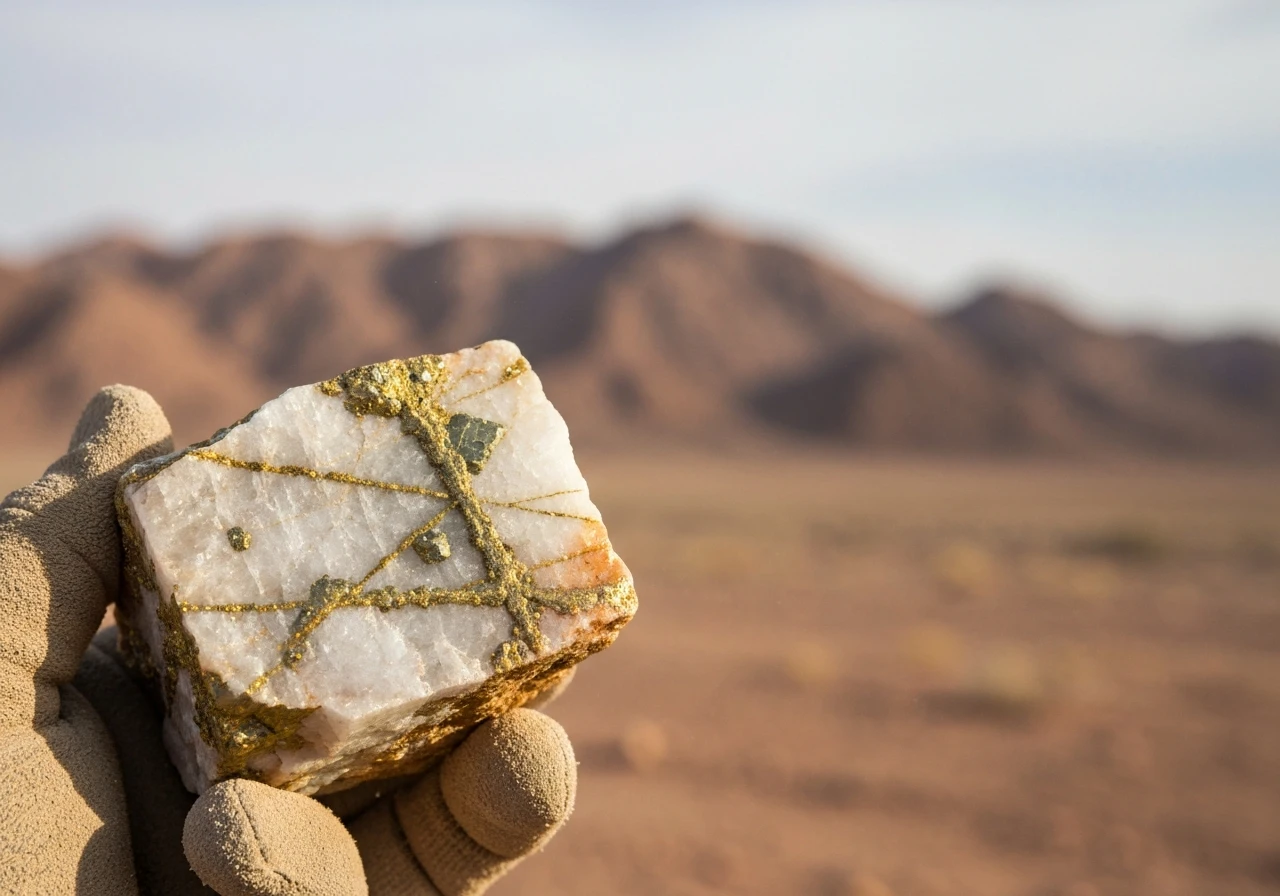
Cairo’s Foreign-Explorer Queue Is Getting Longer
Strip out the OZ Mining headline and a pattern shows up underneath. In the space of a few weeks, Egypt has stacked up at least half a dozen separate moves by foreign banks, surveyors, and miners aimed at the same mineral endowment, and the memorandum is simply the latest entry.
The breadth is the tell. A development bank, a Spanish geophysics contractor, a Chinese industrial group, and gold operators from three continents are all positioning around Egyptian ground within the same window, much of it tied to Cairo’s Golden Triangle mining feasibility study and the wider Eastern Desert.
| Party (origin) | Recent move | Mineral focus |
|---|---|---|
| OZ Mining (Turkiye) | MoU for preliminary assessment | Gold and associated minerals |
| EBRD (European Bank for Reconstruction and Development) | MoU to support sector reform | Mining sector-wide |
| Xcalibur Smart Mapping (Spain) | National airborne geophysical survey | Metallic and industrial minerals |
| Xingfa Group (China), with Phosphate Misr and WADICO | Processing-project study | Phosphate, quartz, silica |
| AngloGold Ashanti | Sukari exploration expansion | Gold |
| Aton (Abu Marawat) | Concession terms amended | Gold |
Six Millennia of Gold Under the Eastern Desert
The reason the desert keeps drawing prospectors sits in the rock. Egypt’s Eastern Desert is part of the Arabian-Nubian Shield (ANS, a band of ancient Precambrian crust flanking the Red Sea), a geology that hosts structurally controlled gold in quartz veins classed as late Neoproterozoic orogenic deposits.
This is not unexplored country in the historical sense. Miners have pulled gold from these veins for more than 6,000 years, from before the Old Kingdom through to today, leaving behind a dense record of ancient workings that modern geologists still use as targeting clues. Academic work on six thousand years of gold mining in Egypt and Nubia maps how widely the old workings spread.
The numbers behind the belt explain the queue:
- 6,000 years of recorded gold extraction across the Eastern Desert basement.
- 250 sites of ancient gold production scattered through the same shield rocks.
- 320 blocks of roughly 170 square kilometres each auctioned to speed up exploration.
- 500,000 ounces a year produced at AngloGold Ashanti’s Sukari mine, Egypt’s only large-scale gold operation so far.
What has been missing is modern, systematic coverage. Most of the belt has never been mapped with current geophysics, which is exactly the gap the new entrants and Cairo’s data drive are trying to close.
What Egypt Changed to Win the Capital
The deals are not arriving by accident. Egypt’s cabinet has endorsed a revised mining investment law built to make the country’s terms competitive with rival jurisdictions, and the headline change rewires project economics in the investor’s favour.
The core measures are concrete and quantified:
- The minimum government shareholding in a project drops from 25 percent to 10 percent, leaving private operators a larger share of cash flow.
- The mining-site lease cost is cut by 60 percent.
- A move toward a royalty-and-tax hybrid replaces the older production-sharing model, giving investors more predictable returns.
- A digital mining cadastre, expected in the first half of the year, lets firms pull geological data and file permit applications online.
- Spain’s Xcalibur is flying Egypt’s first nationwide airborne minerals survey in more than 40 years across six geological regions.
Better data lowers the cost and risk of finding ore, and specialist firms such as consultants running gold-target selection in the Eastern Desert have been arguing for years that the belt was starved of exactly this kind of modern coverage. The reforms aim to hand that homework to explorers before they commit.
The Conversion Problem Cairo Hasn’t Solved
Here is where the mixed verdict comes in. A memorandum is a long way from a working mine, and Egypt’s recent past is littered with incentives that read well on paper and stalled in practice.
Reporting on the ground has described investors buried in paperwork, with mining incentives that failed to translate into the rush of activity officials promised. Framework MoUs convert into licences, then into drilling, then into production, only when the bureaucracy behind them moves at the same speed as the marketing.
The scale of the ambition makes the gap obvious. Egypt wants mining to climb to 6 percent of GDP by 2030 from a share that currently sits below 1 percent, a roughly sixfold jump in a few years.
That target cannot be met by signing ceremonies. It needs explorers actually drilling the ANS, hitting economic grades, and clearing permits fast enough to pour metal, and the historical record of Egyptian gold, traced in detailed reviews of the country’s classification of gold mineralization in Egypt, shows how rarely ancient promise has translated into modern tonnes.
For now, OZ Mining sits at the very front of that pipeline, with the longest distance still to travel.
September’s Cairo Forum Becomes the Next Marker
The calendar already holds the next test. Badawi has announced a special edition of the Egypt Mining Forum for 28 and 29 September in the New Administrative Capital, held under the patronage of President Abdel Fattah El-Sisi and pitched at global miners and international investors.
If the forum produces signed exploration licences and field programs rather than another round of memoranda, Egypt’s claim to be reopening the Eastern Desert starts to look real. If it produces a fresh stack of MoUs and little drilling, the OZ Mining deal will read in hindsight as one more handshake in a queue that never quite reached the ground.
