
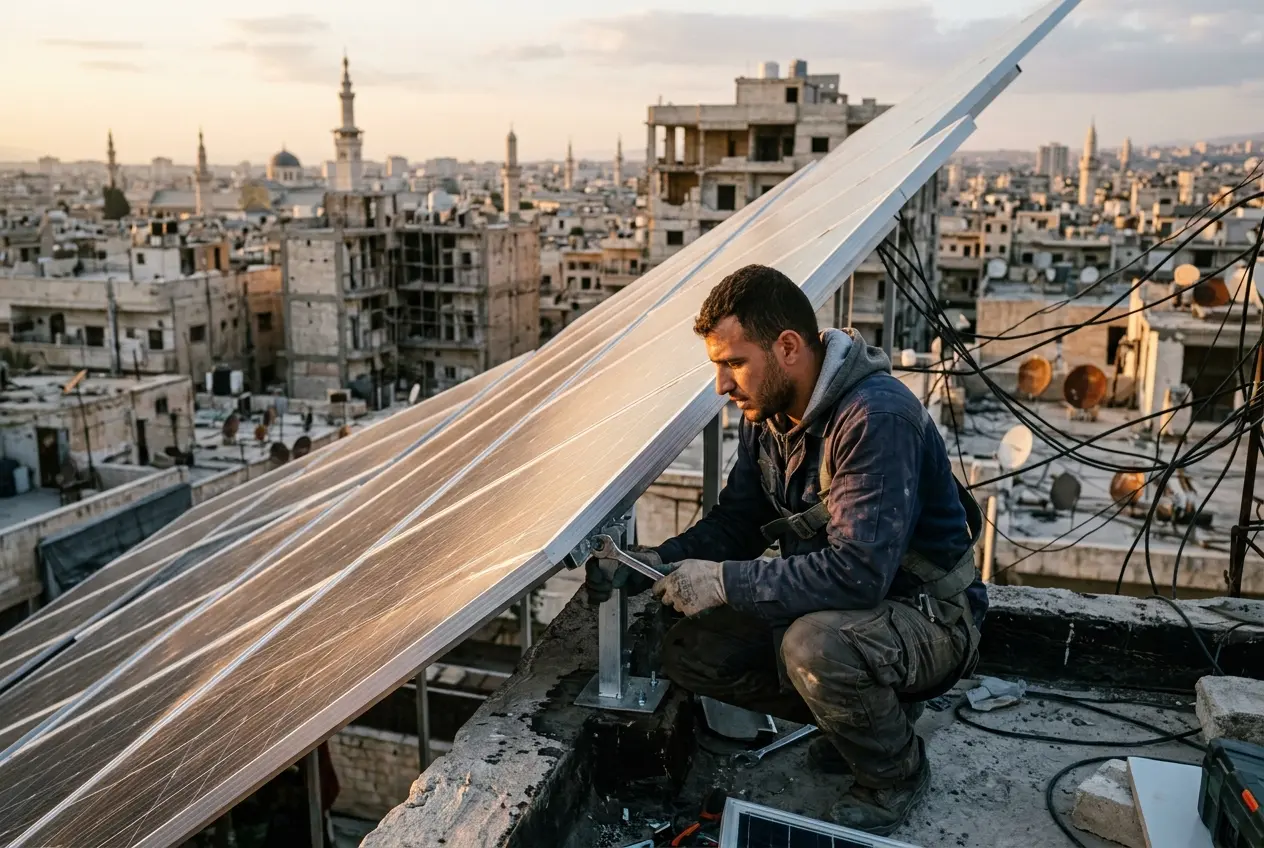
Syria’s off-grid rooftop solar capacity rose from 249 megawatts in 2022 to 2,060 MW in 2025, according to data cited by The National. The panels went up on apartment rooftops in Damascus and Aleppo, financed by individual households. The grid provides at best about four hours of electricity a day.
Renewables now make up a third of Syria’s national generating capacity, The National reports, leaving the country behind only Lebanon and Jordan in regional renewables share. A quarter of Syrian households have installed some form of solar power. The new post-Assad government is hurrying to repair the conventional grid the rooftops have, in effect, replaced.
Four Years, Twentyfold Growth
The Abu Dhabi-based International Renewable Energy Agency began tracking Syria’s off-grid solar in 2022, when installed capacity stood at 249 MW. By the end of 2023 it had reached 931 MW. A year later it was 1,500 MW. By 2025 the figure stood at 2,060 MW. The expansion has happened almost entirely on apartment and villa rooftops in Syrian cities.
Syria’s Off-Grid Solar Capacity (IRENA Data)
| Year | Capacity |
|---|---|
| 2022 | 249 MW |
| 2023 | 931 MW |
| 2024 | 1,500 MW |
| 2025 | 2,060 MW |
Lebanon and Jordan, the only regional countries with a higher renewables share than Syria, reached that position largely through hydropower and imported electricity. Their rooftop solar sectors are smaller in absolute terms. Syria’s rooftop build-out has occurred almost entirely without state coordination, financed household by household.
The 2,060 MW came from households, shops and small workshops buying their own panels and batteries. The state has, until recently, watched. Local diesel generators still hum on side streets, where fuel is scarce and expensive.
A Grid That Could Not Catch Up
Syria’s national network provides at best about four hours of electricity per day. Local diesel generators fill the gap, but fuel is scarce and expensive for most people, and the shortfall is not new. Electricity generation reached about 45 terawatt-hours in 2010. It tumbled to under 20 TWh by 2015 and never recovered.
The new post-Assad government is racing to restore gas supplies and repair dams and power stations. The work will take years. The rooftops do what the grid cannot, keeping lights, refrigerators and water pumps running across Syria’s cities. Household-scale installations substitute for grid power during the day. Batteries carry households through the night.
Why the Rooftop Beat the Megaproject Here
For most Syrians, a 1.5 to 3 kilowatt household system is the relevant unit. It runs lights, appliances and farm water pumps, with batteries carrying the household through the night. Such a system costs from $2,500 to $4,500 installed, several months of average earnings at the country’s per-person income of about $800. Syrians have found the money anyway.
The kind of large-scale, on-grid solar made famous by Dubai’s Mohammed bin Rashid Solar Park reached just 189 MW in Syria by 2025. Agreements have been signed for larger projects with Saudi and Qatari-led consortia. Implementation will take years; the rooftops did not wait.
The contrast is in the numbers. The 189 MW utility project has taken years in negotiation. The distributed solar fleet grew from 249 MW to 2,060 MW over the same period, on household budgets. The distributed build was financed by individual buyers, mostly with cash.
In a broken-grid country, distributed solar is the only way to keep a refrigerator running. The economics of scale that justify a 2 GW plant disappear when no grid exists to receive its output.
Crisis Solar Is a Regional Pattern
Syria is not alone in its rooftop push. Other regional countries suffering severe blackouts have rushed to rooftop solar for the same reason. Lebanon, Yemen and Pakistan all fit the pattern.
Per The National, off-grid solar in Lebanon, Yemen and Pakistan has followed the same path. In each country, what started as a niche choice has become a household necessity. The shared driver is simple. When the grid fails, distributed solar becomes the grid.
The Subsidy Trap Keeping Libya and Iraq Off the Roofs
Libya and Iraq struggle with serious power shortages of their own. Per The National, both are “only haltingly beginning to put panels on their buildings.” The reason is policy, not poverty.
Fuel and electricity in both countries are heavily subsidised. That keeps the official price of grid power artificially low. A household weighing a $2,500 solar system compares it to a subsidised kilowatt-hour bill that looks cheap, even when the grid still does not deliver. The subsidies could be redirected at solarisation instead. The rooftops would follow.
Libya and Iraq “should be much more able to afford solar systems than Syrians,” The National argues. The subsidies trap them in the very grid failure that drove Damascus to the rooftops.
What Distributed Solar Does That Al Dhafra Cannot
The Gulf states have largely chosen the opposite path. Their reliable, generally cheap mainstream grids have not required household solar adoption. Large users such as factories, malls and hotels have installed rooftop systems because their bills justify it. As of June 2025, Dubai had 725 MW of distributed solar under its Shams scheme.
Abu Dhabi launched the second phase of its solar self-supply policy in March 2026. Oman had reached an estimated 130 MW of small and medium installations by the end of 2025. Large-scale plants dominate Gulf solar strategy. The 2 GW Al Dhafra plant in Abu Dhabi is the template. It generates more cheaply per kilowatt-hour than rooftop panels.
Distributed solar offers value a single megaproject cannot match. Teamed with batteries, it reduces the grid capacity required, particularly in dense urban environments. It spreads variability over larger areas, and improves resilience in remote or mobile sites such as islands, mining and drilling operations, military bases and construction sites. And in land-scarce Bahrain, it saves ground that a megaproject would consume.
Where distributed solar still earns its place:
- Dense urban districts where grid upgrades are slow and costly
- Remote sites: islands, mining, drilling, military bases, construction camps
- Land-scarce cities such as Bahrain, where ground-mount space is limited
- Local installer networks that export skills to other MENA and African markets
The Gulf states have not needed a Syrian-style solar revolution. They may yet need a Syrian-style solar sector, if only to deploy the small-scale skills that crises elsewhere will keep demanding.
Rooftop Cities Built by Choice, Not Crisis
Outside the crisis countries, several cities have dense rooftop solar for different reasons. Honolulu, San Diego, Adelaide and Dezhou in Shandong all qualify. Honolulu and San Diego combine sunny climates with high retail power tariffs; Adelaide has strong rooftop uptake on similar terms. Dezhou is a centre of Chinese solar manufacturing, and the local market reflects that.
In each case the grid stands ready to complement the solar output, or to soak up excess generation. That is the condition Syria’s grid cannot yet meet, though the new government is working on it. For households without a roof, or those renting, “balcony” solar kits plugged into a wall outlet have filled part of the gap in Europe and parts of Asia. Tall apartment buildings, where the roof alone would not serve all residents, can mount panels on the facade. These options may reach Syrians once the crisis ends.
What the Rebuilders Will Have to Decide
The new Syrian government has inherited a population already wired around its own solar infrastructure. As construction picks up, refugees return, and industry revives, electricity consumption will rise sharply. Syria’s 2,060 MW of rooftop capacity now sits alongside just 189 MW of utility-scale solar.
Cutting diesel generator use will ease pressure on city air, in streets that today resemble Beirut or Baghdad. Per The National, residents’ health will benefit from removing the noisy, polluting diesel generators that plague the streets. Distributed solar saves fuel, eases the burden on the national grid, and reduces the need for reinforcement to meet peak demand. It also creates a sector of small installers whose skills can be exported across the region. The 2,060 MW installed so far is the work of households buying their own panels and batteries while the state, until recently, watched.
The rebuilders’ task is to formalise a system that has, until now, run without them. According to The National, distributed solar “can speed their rebuilding process and unlock capital.” The choice facing the new government is whether to recognise what its citizens have already built.
Syria’s Solar Boom in Numbers
- 2,060 MW: Syria’s off-grid solar capacity in 2025
- 189 MW: Syria’s utility-scale solar in 2025
- About 4 hours: daily grid electricity in Syria
- 725 MW: Dubai’s distributed solar under Shams (June 2025)
- 130 MW: Oman’s distributed solar (end 2025)
- 2 GW: Abu Dhabi’s Al Dhafra plant capacity
- $2,500 to $4,500: cost of basic 1.5 to 3 kW Syrian home system
- ~$800: Syrian per-person income
Frequently Asked Questions
How much solar capacity has Syria installed?
Syria’s off-grid solar capacity reached 2,060 megawatts in 2025, up from 249 MW in 2022, according to IRENA data cited by The National. Renewables now make up a third of national generating capacity, behind only Lebanon and Jordan in the region.
Why is Syria’s national grid only providing four hours of electricity a day?
The shortfall dates back to the civil war. Electricity generation reached about 45 terawatt-hours in 2010, fell to under 20 TWh by 2015, and never recovered. The post-Assad government is repairing gas supplies, dams and power stations, but the work will take years.
How much does a basic home solar system cost in Syria?
A 1.5 to 3 kilowatt system costs from $2,500 to $4,500 installed, according to The National. With per-person income estimated at about $800, that is several months of average earnings for a typical household.
Which other countries have followed Syria’s rooftop solar lead?
Lebanon, Yemen and Pakistan have all expanded rooftop solar in response to grid failures, per The National. The shared driver is a state unable to deliver reliable power, paired with households wealthy or desperate enough to buy their own.
Why are Libya and Iraq slower to adopt rooftop solar?
Heavy fuel and electricity subsidies in both countries keep grid tariffs artificially low, distorting the comparison households make when weighing a solar investment. Per The National, redirecting those subsidies at solarisation would unlock similar adoption.
How does Syria’s solar story compare with rooftop cities like Honolulu or San Diego?
Those cities combine sunny climates with high retail power tariffs or a strong local solar industry. Their grids are built to complement solar output. Syria’s grid cannot yet do that. The two cases show the same technology under different grid conditions.
