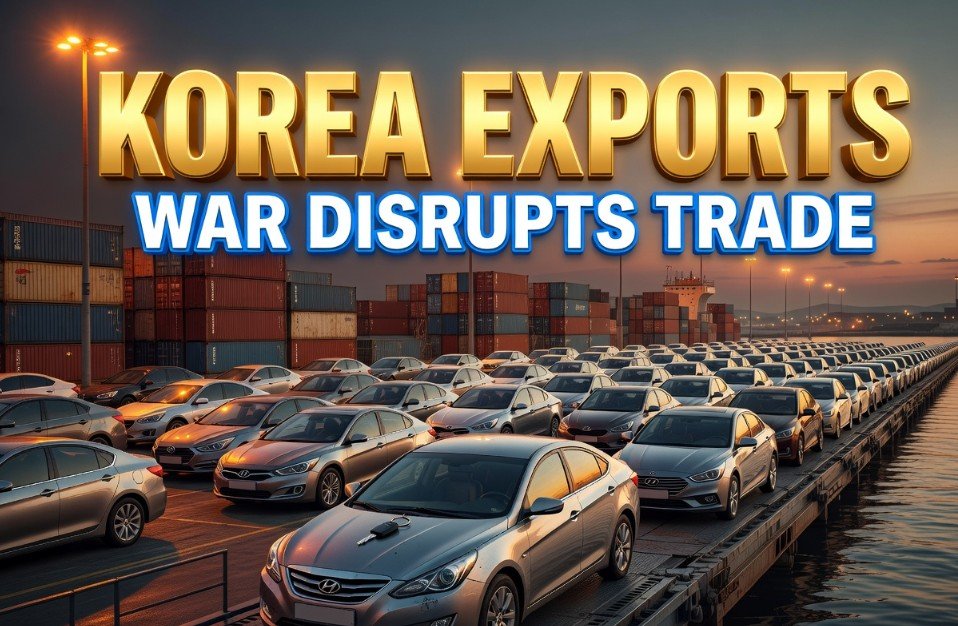
South Korea’s used car export industry posted its best year ever in 2025, pulling in $8.9 billion. But a war in the Middle East has now put that momentum in serious jeopardy, choking one of its most important trade corridors right as the peak export season begins.
Korea’s trade agency is taking urgent action this week to find new buyers fast.
A Billion-Dollar Export Run Into War-Time Trouble
Korean used car exports did not just grow last year. They exploded.
The industry hit a record $8.9 billion in 2025, up 75.1 percent from the year before. That made used vehicles roughly 12 percent of Korea’s total automobile exports, which stood at $72 billion for the year. For a segment long treated as a side act to new car sales, these numbers signaled a genuine structural shift.
South Korea shipped roughly 883,000 used cars overseas in 2025. More than a third of those went to the Middle East, a region that accounts for about 30 percent of Korea’s used car exports, according to KOTRA.
That concentration is now the industry’s most glaring vulnerability. The war in the Middle East, which has now stretched well beyond two months, has cut deep into those trade flows and is disrupting both logistics and overseas marketing activities for Korean exporters. Export volumes in February 2026 dropped to 46,193 units, down sharply from 76,387 units shipped in the same month a year earlier, reflecting the early shockwaves of the conflict along with broader market shifts.
The real danger is what lies ahead. March through September is peak season for Korean used car exports, driven by construction and travel activity across the Middle East. Losing that window could be devastating for thousands of small exporters.
KOTRA Brings the World to Incheon This Week
The Korea Trade-Investment Promotion Agency, known as KOTRA, is not waiting for the war to end. On Wednesday, the agency announced a two-day export consultation event in Incheon, starting Thursday, to help Korean exporters pivot toward new buyers and cut their dependence on the Middle East.
The event is co-hosted with the Incheon Port Authority, the Incheon Chamber of Commerce and Industry, and the Korea Transportation Safety Authority. Together, they are bringing 33 international buyers from seven countries to meet face-to-face with 61 Korean used car companies.
The seven countries represented at the event are:
- Georgia
- Cambodia
- Colombia
- Dominican Republic
- Chile
- Jordan
- Egypt
The geographic spread is deliberate. Latin America, Southeast Asia, and Eastern Europe are all represented, signaling Korea’s push to build entirely new buyer networks. The inclusion of Jordan and Egypt also shows the country is not abandoning the Middle East entirely, choosing instead to focus on markets within the region that are less affected by the Strait of Hormuz crisis than the Gulf states.
For an industry built on speed and adaptability, this consultation event is exactly the kind of move that could matter most right now.
Blocked at Sea: How the Crisis Is Hurting Exporters
The Strait of Hormuz is at the heart of this crisis. Before the war broke out, roughly 3,000 vessels passed through the strait every single month. In April 2026, that number collapsed to just 191 vessels for the entire month, according to shipping analytics data from Kpler.
Car carriers are stuck in the water, and vehicles are sitting in warehouses bleeding money every single day.
Ships destined for Dubai’s Jebel Ali port in early March have remained stranded near Mumbai on India’s west coast, unable to enter the Gulf. One Korean exporter reported paying around 40 million Korean won per month in storage fees alone for vehicles already purchased but impossible to ship.
Some exporters are pre-purchasing vehicles during the downturn, betting that demand will recover once the conflict eases. Others are exploring Africa and Latin America as alternative destinations. But the path is not simple. Industry insiders have warned that you cannot just redirect large shipments to regions that currently lack the infrastructure and demand to absorb sudden high volumes.
Here is a snapshot of the numbers that show exactly how much is at stake:
| Key Metric | Figure |
|---|---|
| Korea used car exports in 2025 | $8.9 billion (record) |
| Year-over-year growth in 2025 | 75.1% |
| Share of total auto exports | ~12% of $72 billion |
| Middle East share of used car exports | ~30% |
| Vessels through Strait of Hormuz (April 2026) | 191 (vs. ~3,000 pre-war) |
| February 2026 used car shipments | 46,193 units (down from 76,387 a year prior) |
Korean Cars Still Have a Strong Case Worldwide
Despite the current disruption, Korean used cars carry a meaningful edge in global markets that no war can take away overnight.
Korean vehicles are engineered for right-hand drive markets. That puts them ahead of Japanese competitors in the Middle East, Central Asia, and parts of Africa, where driving on the right side of the road is standard practice. Models like the Hyundai Avante MD and the Kia K3 have built real loyalty among buyers across these regions, and that trust does not disappear because of a conflict.
The eco-friendly used vehicle segment is also emerging as a new growth pillar. Hybrid SUVs and early-generation electric vehicles from Korean brands have attracted strong interest from overseas buyers. Exports of eco-friendly used vehicles helped the sector reach a cumulative record of $4.5 billion by February 2026, pointing to a broader shift in how Korean used cars are perceived internationally.
Markets like Turkey, Kazakhstan, and the UAE have already been listed among top export destinations alongside the Gulf states, proving that Korean used car demand is spreading organically. Growing interest from the Commonwealth of Independent States and Southeast Asia further signals that the industry’s best years may still be ahead, provided it builds the right market connections now.
South Korea built a $8.9 billion used car export industry in just a few years by reading demand fast and moving even faster. The same instinct is on full display this week in Incheon.
The story of Korea’s used car export industry is ultimately about thousands of small businesses, dealers, and traders who built something remarkable in a short time and are now fighting to hold it together under extraordinary pressure. The war in the Middle East did not just disrupt shipping routes. It put real livelihoods and years of hard work directly on the line. The KOTRA event in Incheon this week is a small but significant step toward rebuilding that security, and the buyers sitting across the table from Korean exporters over the next two days could end up writing the next chapter of this industry’s story. What do you think? Can Korean used car exporters successfully build new markets in Latin America and Southeast Asia fast enough to offset the Middle East crisis? Leave your opinion in the comments below.