
The European Union has committed €7.4 billion to Egypt for migration management across 2024 to 2027, but Cairo argues the deal underpays for a hosting burden it values at more than €8.5 billion a year. UNHCR, the UN refugee agency, warned in April that its cash-assistance programme for Egypt’s 1.1 million registered refugees had secured just 2 percent of its 2026 budget, leaving at least 20,000 families, roughly 87,000 people, at risk of losing the income many of them rely on for rent and food.
Both sides negotiated and both walked away with gains. The refugee families UNHCR is warning about had no seat at the table.
The Architecture of the Deal
The EU-Egypt Strategic and Comprehensive Partnership was signed in Cairo on March 17, 2024. European Commission President Ursula von der Leyen made the trip alongside the heads of government of Belgium, Greece, Italy, Austria, and Cyprus, signing the joint declaration with Egyptian President Abdel Fattah al-Sisi, whose government had been navigating IMF-backed economic adjustment and repeated currency devaluations heading into the talks. Brussels described the arrangement as covering six pillars: political dialogue, macroeconomic stability, trade, migration, security, and human capital development.
The financial architecture reflects what each pillar is worth to Brussels in practice. The total four-year commitment breaks into three tranches with different legal bases, different oversight requirements, and very different purposes, which became a flashpoint in the European Parliament almost immediately after the signing.
| Component | Amount | Form | Primary Use |
|---|---|---|---|
| Macro-financial assistance | €5 billion | Concessional loans | Budget support and economic stabilisation |
| Investment guarantees | €1.8 billion | Guarantees | Private sector and infrastructure |
| Development grants (total) | €600 million | Direct grants | Development assistance across all pillars |
| Migration management (within grants) | €200 million | Direct grants | Border control, anti-smuggling, returns, legal pathways |
The €200 million allocated for migration management is roughly double the €105 million mobilized under the EU-Tunisia deal of 2023, reflecting how much Brussels values Egypt’s record as a deterrent to Mediterranean crossings. Egyptian officials have cited the fact that boats have not departed Egyptian shores for Europe since September 2016. Independent analysis of the EU-Egypt migration partnership by the Mixed Migration Centre found limited evidence that Egyptian departures posed a significant Mediterranean risk even before the deal, noting that Sudanese nationals arriving in Italy throughout all of 2023 totalled 5,887 for the full year.
Greens/EFA member Tineke Strik, a Dutch migration scholar and European Parliament rapporteur on the external dimension of EU migration policy in 2024, argued the partnership would result in “more violence against migrants, more repression, and more dissidents fleeing the country.” French Member of the European Parliament (MEP) Mounir Satouri, the Parliament’s Egypt rapporteur, challenged the Commission over what he called European public funds disbursed without adequate accountability, submitting formal parliamentary questions to demand justification. Von der Leyen addressed the criticism at the signing ceremony in Cairo, saying the two sides would “also work on our commitment to promote democracy and human rights.”
Cairo’s Escalating Bill
Egypt’s case for more money rests on a number repeated at every international forum in 2026. At an April ministerial meeting on the Global Compact for Migration, Foreign Minister Badr Abdelatty said his country hosts “more than 10 million migrants and guests on its territory, who live within the fabric of Egyptian society and not in isolated camps.” Prime Minister Mostafa Madbouly has put the annual cost of services for that population at more than $10 billion, approximately €8.5 billion, a figure that exceeds the entire EU financial package over four years.
UNHCR’s published data produces a very different count. The agency’s February 2026 operational update put the registered refugee and asylum-seeker population in Egypt at approximately 1.1 million, with women and children accounting for close to three-quarters. The nine-million gap reflects different counting frameworks, not a measurement error. Egyptian officials include all foreign nationals, undocumented residents, and migrants living in the country without formal protection claims, while UNHCR registers only those who have formally applied for or received refugee or asylum-seeker status.
- 10 million+ — Egypt’s stated population of migrants and guests, per senior government officials in April 2026
- ~1.1 million — UNHCR-registered refugees and asylum seekers in Egypt, per the February 2026 operational update
- ~$11 per person per month — UNHCR’s available funding per refugee in Egypt in 2022
- less than $4 per person per month — the same figure by 2025, before the 2026 cash crisis deepened
Andrew Geddes, professor of migration studies and director of the Migration Policy Centre at the Robert Schuman Centre, told Euronews that the discrepancy serves political purposes as much as descriptive ones. “For the authorities in Egypt, bigger numbers help the government emphasise the scale of the burden and justify policies,” he said. “The EU has increased funding levels but from the Egypt side they are not seen as sufficient given, for example, high costs of housing a large migrant and refugee population.”
The Families Between the Deals
A Budget Running on 2 Percent
In April 2026, UNHCR warned that its cash-assistance programme for refugee families in Egypt could come to a complete halt. The agency said it had secured just 2 percent of the funding required for that programme, affecting at least 20,000 families, or roughly 87,000 people, the majority of them headed by women with school-aged children. More than half of those enrolled had already had their support reduced or cut entirely between January and March. The UNHCR April 2026 briefing on funding cuts for refugee families in Egypt described the situation as a lifeline at risk of disappearing entirely.
The collapse is partly structural. UNHCR in Egypt had roughly the same level of overall funding in 2025 as in 2022, before the Sudan crisis brought hundreds of thousands of new arrivals. As the registered population grew, the per-person allocation shrank: from about $11 per month in 2022 to less than $4 per month in 2025, covering everything from direct cash transfers to health care and protection services. At the same time, Egypt’s own economy was squeezing refugee households from the other side, with urban inflation running above 14 percent in early 2026 and Greater Cairo rents rising 10 to 18 percent year-on-year.
What the Money Covered
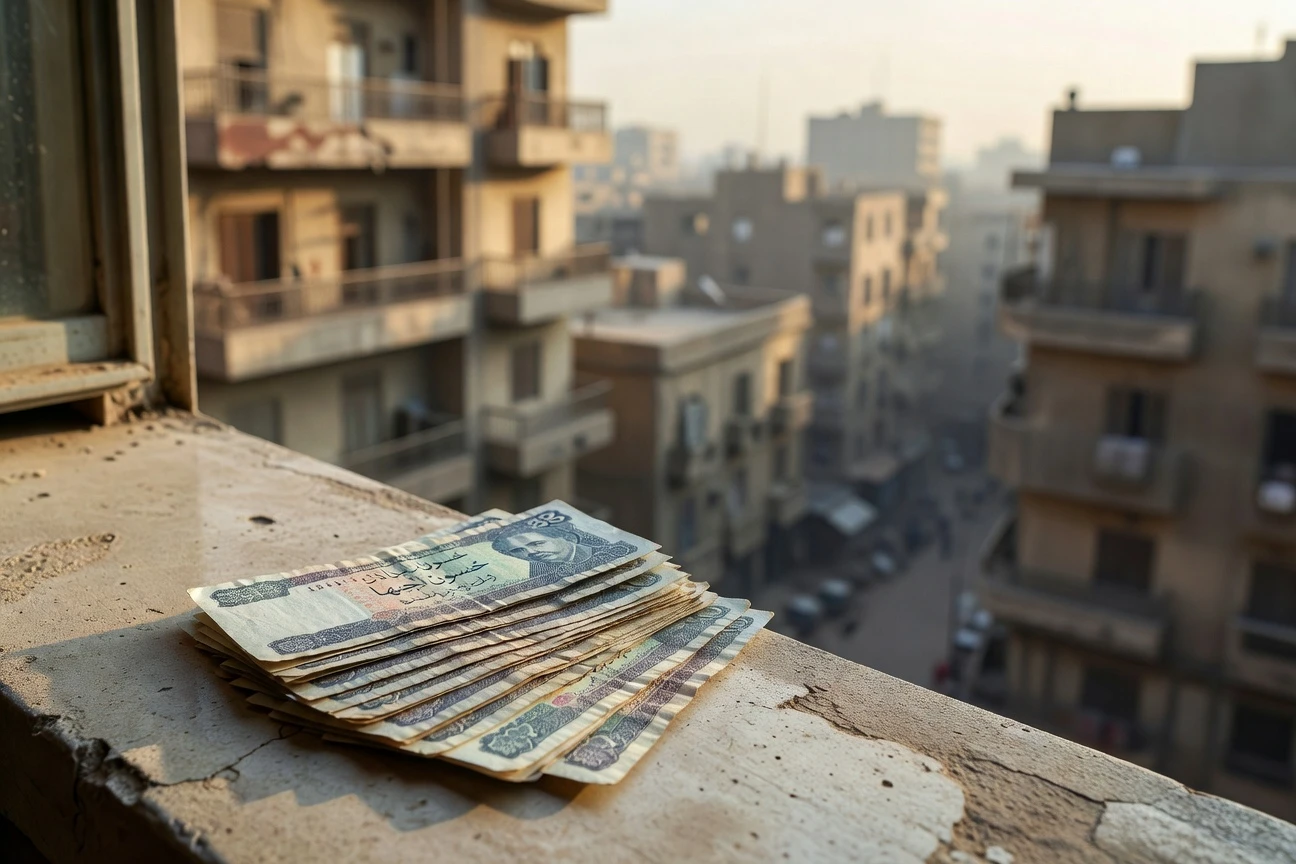
Each enrolled family receives approximately 1,520 Egyptian pounds per month, around $29 at current exchange rates, meant to cover rent, food, school fees, and medical expenses for households that largely lack legal work permits. In Greater Cairo, even the most modest studio flat in an outer district starts at around 10,000 Egyptian pounds per month. A one-bedroom apartment in the city averages about 27,000 Egyptian pounds. Egypt’s national minimum wage stands at 7,000 Egyptian pounds per month, meaning a full-time worker on that floor rate cannot cover the rent on a studio, let alone support a family. For a refugee household without legal employment, the monthly UNHCR payment covers roughly two days of that studio cost.
Even with the assistance, I have to choose between buying food and buying medicine. When I can’t afford treatment, my health deteriorates, and I end up needing even more care that I cannot pay for.
Mohamed, a 60-year-old Sudanese refugee living in Cairo, in testimony published by UNHCR in April 2026.
UNHCR spokesperson Christine Beshay told UN News the programme was “threatened with closure if we do not receive additional support in the next few weeks.” She noted that most enrolled families are headed by women and that when assistance stops, the mother is “forced to make very difficult decisions: whether to feed her children or send them to school.”
Sudan Tripled the Population, Not the Funding
Egypt’s refugee burden predates Sudan. Syrians fleeing the civil war from 2011 onward built the largest registered refugee community in the country for years, growing from 12,800 Syrians registered at the end of 2012 to more than 147,000 by the end of 2024, many now part of long-term urban communities in Cairo, Alexandria, and other cities. Palestinians, Eritreans, Ethiopians, Yemenis, Somalis, South Sudanese, and Iraqis added further layers to what was already a genuinely multi-origin refugee population before Sudan escalated.
The April 2023 war between Sudan’s military and the paramilitary Rapid Support Forces changed the numbers in a way no prior influx had. UNHCR Egypt’s registered refugee and asylum-seeker data show the Sudanese registered population in Egypt grew fourteen-fold since the war began, reaching over 846,000 in early 2026 and making Egypt the largest host country for people fleeing Sudan, as well as one of the highest recipients of new asylum applications globally. UNHCR says Egypt’s total registered refugee and asylum-seeker numbers tripled over the same period.
Egypt kept its border relatively open despite the scale of the arrivals, drawing on long-standing social and family ties between Egyptian and Sudanese communities. Unlike Jordan, Turkey, or Lebanon, it does not operate formal refugee camps; displaced people move into cities, find private-market housing, and enter an economy already under pressure from years of structural adjustment and high inflation. Annual urban inflation stood at 14.9 percent in Egypt in April 2026, according to the government statistics agency CAPMAS, ticking down only slightly from 15.2 percent in March.
Egypt has consistently framed its urban-hosting model as evidence of genuine burden-sharing rather than containment by default. Geddes noted that the Sudan displacement had “led to renewed urgency and pressure and strengthened Egypt’s argument that it is facing ongoing and escalating burdens.” In a February 2025 call with EU Commissioner for Internal Affairs and Migration Magnus Brunner, the Egyptian foreign ministry pointed to “the modest size of international support received by Egypt and its lack of proportionality with the increasing burdens it bears,” a critique it has repeated at every bilateral engagement since.
The Rights Test Brussels Cannot Ignore
In March 2026, independent experts appointed by the UN Human Rights Council published a joint alarm over what they called “an intensifying campaign of deportations, arbitrary arrests and human rights violations” targeting refugees, asylum seekers, and migrants in Egypt. The UN Human Rights Council statement of March 2026 on violations against refugees in Egypt said refugee communities were being targeted “in their homes, workplaces and even in refugee-led service centres,” and reminded Egypt that “any return or deportation order must be based on an individual assessment of protection needs and human rights obligations.” By December 2025, the registered population included 834,201 Sudanese and 117,364 Syrians, the majority women and children.
Egypt’s asylum law, signed into force on December 16, 2024, has drawn sustained criticism alongside the crackdown reports. Rights groups including Human Rights Watch say the law allows authorities to reject or revoke refugee status on grounds that include threats to national security, public order, and failure to uphold Egyptian “values and traditions,” provisions critics describe as vague enough to permit arbitrary enforcement. The law also shifts refugee status determination from UNHCR, which has run the system since 1954 under a memorandum of understanding, to a new national committee affiliated with the prime minister. Seven UN special rapporteurs warned the day after the law’s publication that it “would fall significantly short of international human rights and refugee law.” Egypt has maintained in replies to UN Special Procedures that detention cases are “temporary precautionary measures” and that it “does not return any person who is facing danger.”
Rights monitors documented a 150 percent increase in refoulement incidents involving registered refugees between 2024 and 2025, with the pace accelerating sharply from late 2025 onward. UNHCR sources estimated at least 3,000 refugees and asylum seekers were arrested in the first two months of 2026 alone. Since late December 2025, Amnesty International documented that registered refugees, including those carrying UNHCR identification cards, were collected from streets and workplaces in unmarked vans without individual protection assessments. The Egyptian government has not published official deportation figures.
A Structural Divide Written Into the Bargain
Egypt’s core demand has shifted in framing. At the April ministerial meeting, Abdelatty called for “regular migration pathways” including legal work opportunities for young people, and stressed the need to embed “burden-sharing, responsibility-sharing and international solidarity” as structural principles rather than short-term programme commitments. The argument from Cairo is that the EU-Egypt relationship should fund the country’s capacity to host over decades, not cover immediate costs through periodic disbursements that require renegotiation each budget cycle.
The arrangement as designed serves both governments without resolving the underlying arithmetic. Brussels can show domestic audiences it is managing irregular migration flows; Cairo converts its border-keeper status and growing displacement burden into economic and diplomatic concessions. Cyprus President Nikos Christodoulides, who met with el-Sisi earlier this year, said the EU should share responsibility more broadly for large refugee-hosting populations, according to an Egyptian presidency readout, reflecting a growing acknowledgment among member states that the current formula is difficult to sustain long-term.
The UNHCR funding gap operates on a separate ledger that neither the bilateral track nor Cairo’s public advocacy was designed to close. That funding comes from voluntary donor contributions to the agency, a system that tightened sharply as major donor governments cut humanitarian budgets in 2025 and 2026. UNHCR Egypt’s June 2025 report on the registered population crossing one million warned that per-capita funding had already dropped to one quarter of previous levels. By April 2026, with the cash programme at two percent of its required budget, the warning had become a crisis.
Geddes described the broader outlook plainly: the situation is “likely to remain an unsettled issue,” because neither government is structurally incentivised to close the gap between what Cairo hosts and what the aid system can pay for. The EU controls its bilateral disbursements. It does not control voluntary donor flows to UNHCR, and has so far treated the two tracks as largely separate problems.
If the next EU disbursement comes tied to a structural development framework, Cairo gets closer to the model it is pressing for and the argument enters a new phase. If it arrives as another round of short-term budget support, the same standoff resumes before the 2027 deadline on an operational backdrop considerably harder than the one that produced the current deal.
