
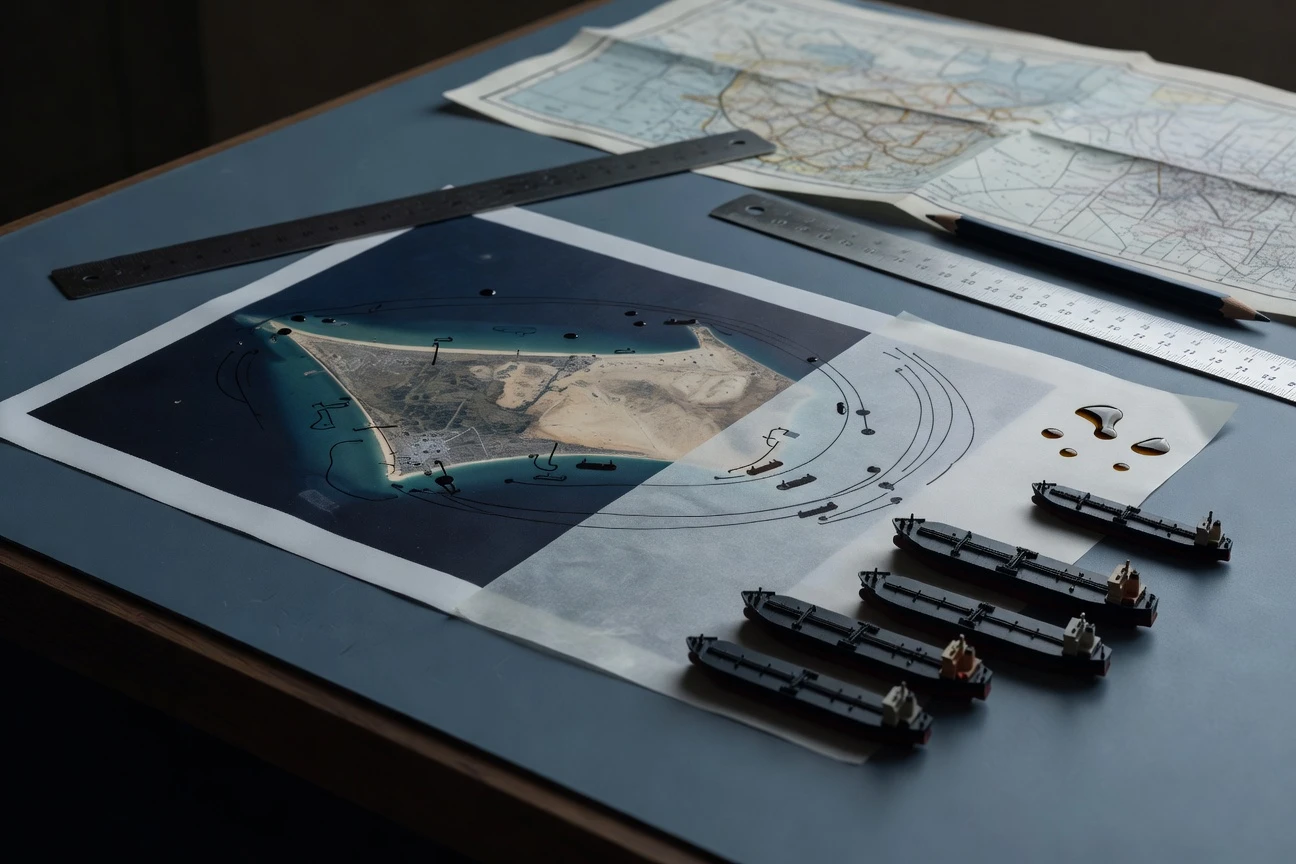
The Kharg Island tanker queue has grown from a shipping delay into a storage test for Iran’s oil system. Satellite and maritime intelligence reviewed on May 21 show roughly 26 to 27 vessels waiting off the Persian Gulf terminal, with exports moving slowly and floating storage replacing normal cargo flow.
That matters because Kharg is Iran’s main crude outlet and China is the dominant buyer. If tanks and tankers fill faster than cargoes clear Hormuz, Tehran’s choice narrows to deeper output cuts, riskier dark sailings, or barrels stranded within sight of its biggest loading arms.
The Queue at Kharg Looks Less Temporary
Windward’s May 22 maritime intelligence page put the latest picture in blunt terms: a 183-meter dark Panamax tanker that had been at the T-pier was gone by the May 21 Sentinel-1 pass, while roughly 27 vessels remained offshore east of the island. Windward, a maritime intelligence firm, said the berth clearing pointed to one cautious crude lift, not a return to normal tempo.
Two technical points matter. Synthetic aperture radar (SAR, satellite radar imaging that can spot vessels through clouds and at night) sees hulls even when transponders are off. Automatic Identification System (AIS, a maritime signal that broadcasts vessel identity and position) tells less of the story when ships choose silence. On May 21, Windward counted 12 Strait of Hormuz transits, and 11 were dark.
- 27 vessels: Windward’s offshore Kharg count for the May 21 SAR pass.
- 18 VLCCs: The share of those vessels classed as very large crude carriers, the workhorses of long-haul crude trade.
- 39.79 million barrels: Windward’s estimate of Iranian floating storage across 79 tankers.
- One confirmed lift: The firm’s assessment of crude loading since activity went quiet around May 11.
The exact tanker count varies by image timing and method. The direction does not. A queue that large beside a terminal designed to move cargo fast is a sign that ships are doing two jobs at once: waiting for permission to load or sail, and storing oil that has nowhere better to go.
Why One Island Carries So Much Leverage
Kharg is powerful because of geology, pipelines and water depth. Kpler’s March analysis of Kharg’s export role said the island sits in deep enough water for a very large crude carrier (VLCC, a tanker class built to carry roughly 2 million barrels of crude) to berth directly. Much of Iran’s mainland coast cannot do that.
Kpler, an energy data provider, estimated that the NIOC Kharg Island terminal has about 31 million barrels of storage capacity and that roughly 94% of Iran’s crude exports over the prior 12 months originated there. That concentration makes every delay at the island more than a port problem. It becomes a revenue problem, an insurance problem and a shipping risk problem in the same frame.
| Route or Buffer | What It Offers | Latest Constraint | Market Meaning |
|---|---|---|---|
| Kharg terminal | Deepwater crude loading and large tank farms | Large offshore queue and slow confirmed lift rate | Main route for Iran’s seaborne crude income |
| Jask terminal | Gulf of Oman outlet that avoids Hormuz | Effective capacity widely estimated near 300,000 barrels per day | Useful backup, but far smaller than Kharg |
| Floating storage | Tankers hold crude outside the tank farm | Ties up vessels and raises safety, sanctions and insurance risk | Buys days, then starts consuming options |
The Jask comparison is the key. Iran has a bypass route on paper, fed by the Goreh-Jask pipeline, but Kpler said the terminal had one 2 million barrel loading on March 7, the first since September 2024. That leaves Kharg carrying the export system at the moment when it can least afford congestion.
Floating Storage Buys Time, Then Consumes It
The offshore line of hulls can look like resilience. Tankers become temporary tanks. Crude keeps moving out of onshore storage. Production does not have to stop immediately. For a sanctioned exporter, that is a familiar survival tactic.
Stranded tonnage is converting from active export inventory into floating storage.
Windward’s Maritime Intelligence Operations Center wrote that assessment after comparing waiting areas near Kharg and Chabahar. The sentence lands because it describes the shift from trade to warehousing. A tanker sitting full or waiting to be filled is capital locked in steel, crew and insurance, with every extra day adding operational risk.
The darker problem is optionality. If a ship leaves dark, it may still clear the Gulf. If it stays, it keeps crude near the export point but blocks flexibility. If more cargo backs up onshore, producers face shut-in decisions that can damage fields, disrupt refinery balances and cut hard currency flow. None of those choices needs a spectacular strike to hurt.
There is also a signaling cost. A terminal that can show normal loading reassures buyers and brokers. A terminal surrounded by waiting tankers tells counterparties to demand larger discounts, extra paperwork, stronger sanctions screening or a wider insurance margin.
The Spill Images Add an Operating Risk
The queue comes after a separate warning from the water around the island. Data Desk’s review of Copernicus satellite passes tracked a coherent oil slick first visible on May 6, expanding to about 25 kilometers of oil-dampened water by May 8 and leaving remnant slicks of around 6 square kilometers detectable on May 18.
Data Desk, an investigative oil research group, said the slick’s fragments moved through waters routinely used by tankers calling at the terminal. That does not prove the terminal caused the release, and satellite imagery alone cannot assign legal blame. It does show that ships, slicks and offshore infrastructure have been occupying the same crowded patch of Gulf water.
That is why the storage story has an environmental and safety edge. Older tankers, dark movements and crowded anchorages are not a clean combination. The Office of Foreign Assets Control (OFAC, the Treasury unit that administers U.S. sanctions) has warned maritime firms that Iran-linked oil movements often use deceptive practices, including ship-to-ship transfers, falsified documents and vessel identity manipulation.
A slick near a normal terminal is a maintenance issue. A slick near a sanctioned terminal with a tanker queue becomes something larger: another reason insurers, flag states and service providers may step back just when Iran needs them to move faster.
The Buyer Problem Sits in China
Iran’s export bottleneck ends in Asia. Treasury’s April warning on China-based teapot refiners said China purchases about 90% of Iran’s oil exports, with independent refiners in Shandong Province accounting for most of those imports. That buyer concentration magnifies the Kharg queue because Iran cannot easily redirect sanctioned barrels to a broad pool of customers.
Washington has tried to make that route more expensive. On April 24, Treasury sanctions on Iran’s shadow fleet targeted 19 vessels, including tankers accused of moving Iranian crude, liquefied petroleum gas and petroleum products to foreign markets. Treasury said one Vanuatu-flagged tanker transported more than 4 million barrels of Iranian crude between January and February, ultimately discharging in China.
For traders, the pressure points are practical:
- Fewer clean counterparties are willing to touch a cargo with an Iran link.
- More vessels need dark running, ship-to-ship transfers or document workarounds.
- Chinese independent refiners face greater risk when dollar payments or U.S.-linked services enter the chain.
- Every extra day near Kharg raises demurrage, the fee paid when a ship waits beyond its allowed loading window.
That gives the tanker queue a second-order effect. It does not only slow exports from one island. It increases the cost of every workaround that kept the Iran-China trade moving through earlier rounds of sanctions.
Global Oil Can Price Risk Faster Than It Clears Cargo
The market has already learned to price Hormuz stress. EIA’s Strait of Hormuz chokepoint brief said 2024 oil flows through the strait averaged 20 million barrels per day, equal to about 20% of global petroleum liquids consumption. The same U.S. Energy Information Administration note said flows through Hormuz made up more than one-quarter of global seaborne oil trade.
Those figures explain why a cluster of ships beside one Iranian island gets global attention. The International Energy Agency (IEA, the Paris-based energy security body) said in its May oil market report that cumulative supply losses from Gulf producers already exceeded 1 billion barrels, with more than 14 million barrels per day shut in. It also said North Sea Dated averaged $120.36 a barrel in April after a monthly jump of about $16.50.
Still, price is the easy part of the adjustment. Cargo clearing is slower. A buyer can hedge crude in seconds. A ship leaving Kharg has to load, sail, avoid seizure or sanctions exposure, find a transfer point, satisfy a refinery and get paid through channels that banks will tolerate.
The queue also sits beside broader bypass limits. EIA estimates Saudi and UAE pipelines could provide about 2.6 million barrels per day of spare bypass capacity around Hormuz in a disruption. Iran’s Jask route is much smaller. That asymmetry matters: Gulf producers have partial detours, while Tehran’s main export machine still points back to the same island.
If the next few outbound cargoes clear the Gulf, the queue can bleed down into an ugly but workable export rhythm. If they do not, the May 21 count becomes less a snapshot than a gauge on Iran’s remaining oil buffer.
