It rested tenderly on the chest of King Tutankhamun when archaeologists cracked open his tomb in 1922. Today, it fills wellness shelves across the world. The Egyptian blue lotus is more than a beautiful flower. It carries 3,000 years of myth, divine power, and modern science in every single petal, and researchers are only now beginning to understand just how deep its secrets truly go.
A Flower That Built Gods and Guided the Dead
Few plants are more celebrated in Egyptian mythology than the blue lotus, a stunning water lily that stars in some of archaeology’s most significant discoveries.
Ancient Egyptians believed the world was originally covered by water and darkness. Then a large blue lotus appeared in the water, the flower opened and light appeared, ending darkness on earth. From the center of the blue lotus came the solar deities Atum and Ra.
That is not a small claim. This is a flower that ancient people believed literally created the universe itself.
The blue lotus touched every corner of ancient Egyptian life. Here is what this extraordinary plant meant to the civilization that built the pyramids:
- Symbol of rebirth: The ancient Egyptians deeply admired the blue lotus because they associated its opening petals with the rising sun. This daily rebirth of the flower mirrored the human soul’s journey from darkness to light, and as a result, it regularly appeared in funerary art, symbolizing resurrection and eternal life.
- Sacred to the gods: According to Egyptian stories, the sun god Atum was born from this flower, and the god Osiris was resurrected, mirroring how the lily opens and closes each day.
- Bridge to the afterlife: A symbol of life and immortality, the blue lotus was believed to provide a spiritual connection into the afterlife and offer communication with the divine, as mentioned even in the famous Egyptian Book of the Dead.
- Ritual instrument: The flower was notably featured in the Festival of Drunkenness honoring Hathor, goddess of love and fertility, and was believed to induce visions when soaked in wine, possibly used in ecstatic or hallucinogenic rites.
- Medicine and food: In everyday life, the sacred lily of the Nile served multiple purposes, from food and medicine to funerary ceremonies. Seeds were extracted, dried and pounded to make flour for bread. The root was also eaten because of its sweet taste, and Egyptian healers made tonic from the blue lotus to treat liver diseases.
Open the tombs of Egypt’s great pharaohs, and you will find the blue lotus everywhere: etched on walls, painted on papyri, and even laid tenderly across the mummified bodies of kings. When Howard Carter famously breached the sealed tomb of Tutankhamun in 1922, blue lotus petals were found strewn lovingly over the boy king’s gilded remains. The flower was as much a part of his journey to the afterlife as the treasures and golden death mask that made global headlines.
Temple drawings suggest the flower’s use was permitted only to the elite, such as priests and royalty, implying these plants were special and not available to ordinary citizens.
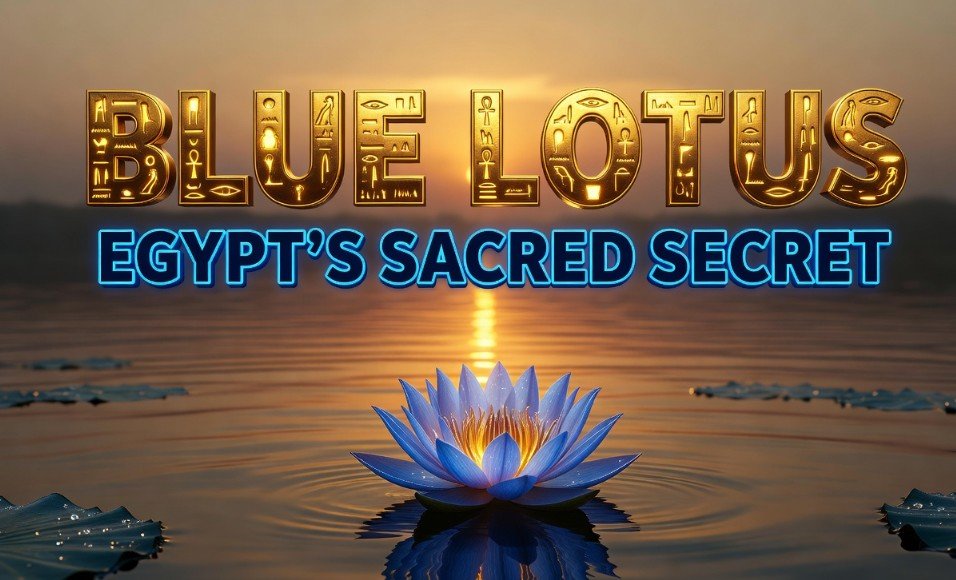
Built for Water: The Botany Behind the Blue Bloom
The authentic Egyptian blue lotus is Nymphaea caerulea. It is a water lily, not a true lotus. The “Sacred Lotus” often seen in Asian iconography is Nelumbo nucifera, a different genus entirely.
Nymphaea caerulea is an aquatic perennial known for its ethereal blue-violet flowers that rise gracefully above the water. Each bloom measures up to 4 to 6 inches across and features pointed petals surrounding a golden-yellow center.
The blue flowering species is small and round, and floats on top of lakes or bodies of water. Its flower buds rise to the surface over a two to three day period, then open at around 9:30 a.m. and close in the early afternoon at 3:00 p.m. when they reach maturity. This precise daily rhythm gave ancient Egyptians every reason to link it to the movement of the sun across the sky.
Here is a quick reference to the plant’s botanical profile:
| Feature | Details |
|---|---|
| Scientific Name | Nymphaea caerulea |
| Family | Nymphaeaceae |
| Flower Size | 4 to 6 inches across |
| Leaf Size | 8 to 16 inches in diameter |
| Bloom Hours | Approx. 9:30 a.m. to 3:00 p.m. |
| Ideal Climate | USDA Zones 10 to 12 |
| Native Habitat | Nile River, freshwater lakes across Africa |
It is an aquatic plant of freshwater lakes, pools and rivers, naturally found throughout most of the eastern half of Africa, as well as parts of southern Arabia. It can tolerate roots being in anoxic mud in nutritionally poor conditions, and can become a dominant plant in deeper water in such habitats. Most plants would perish in those conditions. The blue lotus does not just survive. It thrives.
The floating leaves provide shade to aquatic wildlife and help reduce algae growth by limiting sunlight penetration. Even its leaf serves a purpose bigger than itself.
What Science Found Inside the Ancient Sacred Bloom
The blue lotus flower owes its therapeutic effects to two main compounds: aporphine and nuciferine. These active compounds significantly affect how blue lotus interacts with your body.
The blue lotus achieved prominence in the New Kingdom between roughly 1500 and 1100 BCE as a luxury item in banquets and spiritual ceremonies. While textual evidence of its narcotic or psychoactive use is limited, some scenes from tombs and temples combined with modern pharmacological research suggest that infusions or wines steeped with blue lotus might have induced mild euphoria, relaxation, or heightened spiritual awareness.
A landmark 2025 study from UC Berkeley is now reshaping what historians believed about how the ancient Egyptians actually used this flower.
Liam McEvoy, a fourth-year UC Berkeley student majoring in anthropology and minoring in Egyptology, spent much of his time on campus studying Nymphaea caerulea. He dived deep into the world of rare plant procurement on Reddit to find the plant and studied hieroglyphic translation to search for it in the past. In collaboration with the UC Berkeley Center for the Science of Psychedelics and with the help of chemists, he compared authentic plants with samples sold in online marketplaces like Etsy.
The analysis revealed that the authentic Egyptian blue lotus contained significantly higher levels of nuciferine, a psychoactive compound, than the Etsy-sourced samples. This finding suggests that many flowers sold online as blue lotus are, in fact, visually similar water lilies but not the authentic Nymphaea caerulea. As McEvoy concluded, “The stuff being sold online is not the same, and our findings suggest the blue lotus is actually unique in comparison to other water lilies.”
McEvoy and his team discovered that while pure nuciferine dissolves in alcohol, the compound inside the blue lotus flower is locked behind a waxy, water-repellent barrier. Simply soaking it in wine would not fully release its properties.
McEvoy also wants to return to the Hearst Museum’s enormous collection of Egyptian artifacts, where he plans to conduct one more round of chemical testing on a 3,000-year-old goblet. Such a test could reveal whether there are any traces of fat molecules from an oil, which could bolster his idea. Perhaps there would even be trace amounts of the plants themselves, a discovery that would add a new chapter to the flower’s story.
Going Viral While Quietly Vanishing From the Earth
In recent years, Egyptian blue lotus flowers have gained attention for their calming properties, cultural significance, and versatility in modern herbal practices. From teas to tinctures, this ancient plant is finding a new place in contemporary wellness routines.
Today, the blue lotus is experiencing a renaissance in modern holistic practices. From essential oils to ceremonial teas and spa treatments, it is cherished for its natural aroma, calming effects, and ability to deepen meditation. Its growing popularity in wellness circles is fueled by a desire to reconnect with ancient, plant-based healing traditions in a time where natural balance is highly sought after.
Modern users commonly report the following effects from genuine blue lotus preparations:
- Mild relaxation and a sense of calm after a long day
- Mood lift and improved emotional balance
- Better sleep quality and faster sleep onset
- Heightened focus and depth during meditation
- A gentle euphoric feeling when consumed as tea or tincture
But here is the problem. The authentic Egyptian blue lotus has become incredibly rare, with the construction of the Aswan Dam on the southern Nile dramatically altering its native environment. The plant is now considered to be threatened and on the verge of being endangered.
The construction of the Aswan Dam in southern Egypt drastically altered its natural habitat, leaving the plant endangered and on the brink of extinction. The very river that gave this flower life for millennia is no longer the same river it once was.
Today, the internet is flooded with vendors offering “blue lotus” petals, tinctures, oils, and vapes, all claiming to promote everything from lucid dreams to heightened spiritual awareness. Social media influencers hail its calming effects, and herbalists market it as an exotic alternative to common relaxation remedies. Yet much of what’s being sold as “blue lotus” isn’t the same ancient flower that once adorned the Nile.
For anyone genuinely drawn to this plant, experts urge consumers to look for verified Nymphaea caerulea from growers who can confirm species authenticity. The history behind this flower is far too extraordinary to be replaced by an imitation.
The Egyptian blue lotus has survived pharaohs, fallen kingdoms, and 3,000 years of ritual use, only to now face its greatest threat from habitat loss and marketplace confusion. It bloomed from the darkness of the primordial deep in ancient mythology, and today it blooms again in the hearts of people around the world searching for something real, something ancient, something that connects them to a time when flowers could move gods. It deserves our respect, our curiosity, and our protection. What do you think about the Egyptian blue lotus and its incredible story? Drop your thoughts in the comments below.