
Egypt just made history in the desert. On May 17, 2026, President Abdel Fattah El-Sisi inaugurated the New Delta project, a $15 billion megaproject aimed at turning 2.2 million feddans of barren Western Desert into productive farmland.
This is bigger than just agriculture. It is a story about water engineering, food independence, and a country of 105 million people betting on its own future. And the most remarkable part? A huge portion of it is already built and already growing crops.
Egypt’s Biggest Agricultural Project in Modern History
The New Delta is officially the largest horizontal agricultural expansion in the history of modern Egyptian agriculture. The project stretches across approximately 9,000 square kilometers of desert west of the old Nile Delta, linking the governorates of Beheira, Giza, Matrouh, and Fayoum in northwestern Egypt.
The targeted area equals roughly 15 percent of Egypt’s current total agricultural land. To put that in perspective, Egypt is not just adding more farms. It is essentially building an entirely new agricultural region from scratch.
El-Sisi officially launched the megaproject at a ceremony in Dabaa City. Prime Minister Mostafa Madbouly attended alongside senior ministers covering defense, water resources, transport, and agriculture, as well as the Central Bank governor. The president toured pumping stations, reviewed control systems, and walked through the wheat harvest site before taking a photo with the workers on the ground.
- Total investment: 800 billion Egyptian pounds (approx. $15 billion)
- Project size: 2.2 million feddans (about 9,000 sq km)
- Cost per feddan: EGP 350,000 to EGP 400,000
- Jobs targeted: Around 2 million sustainable positions
- Water transfer route: 170 km canal with 13 pumping stations
- Private firms involved: Over 150 agricultural companies
The Engineering That Makes This Desert Bloom
Water is the single biggest obstacle in any large-scale desert farming operation. Egypt’s solution to this is a piece of engineering that has very few equals anywhere in the world.
Agricultural drainage water from the western Nile Delta, which previously flowed north and was simply lost into the Mediterranean Sea, is now being captured, treated, and redirected entirely inland. The El Hammam treatment complex on Egypt’s Mediterranean coast processes up to 7.5 million cubic meters of wastewater every single day. Completed in 2023, it holds a Guinness World Record as the largest wastewater and sludge treatment plant on Earth.
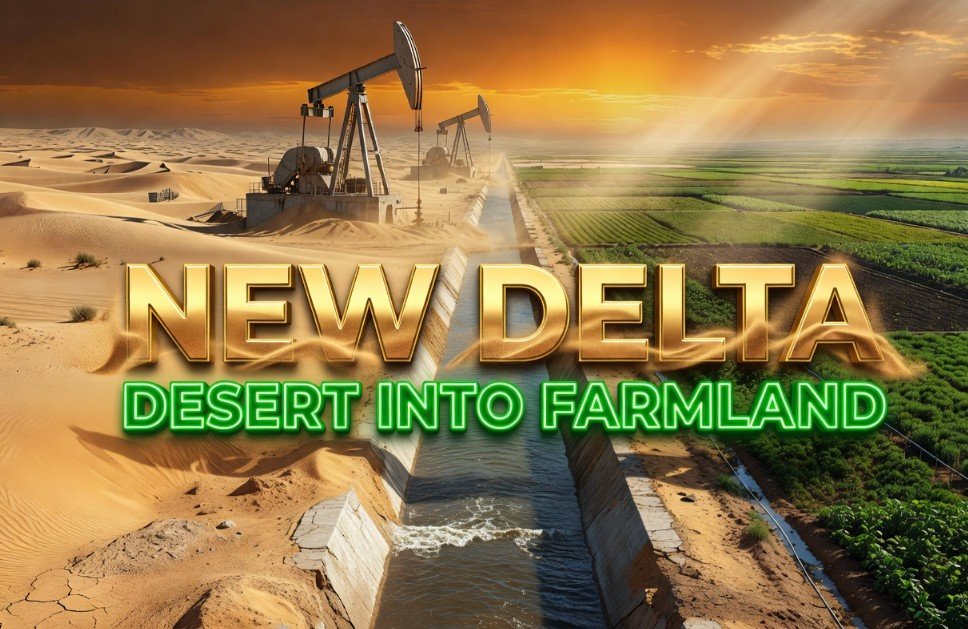
From El Hammam, that treated water travels 170 kilometers westward through a canal, pushed along by 13 pumping stations, before reaching the reclaimed desert lands near Dabaa.
The full water infrastructure spans roughly 150 kilometers of excavated and lined channels, with nearly 300 kilometers of aligned waterways running through the pumping network. A second water route with its own set of pumping stations is also under construction to cover the project’s full 2.2 million feddan footprint.
Cutting Egypt’s Massive Food Import Bill
Egypt’s food import dependency is one of the most pressing economic challenges facing the country right now. Egypt imports between 14 and 17 million tonnes of animal feed every year, and that figure does not include wheat purchases, which are separately and significantly costly.
The New Delta project is designed to change this balance, growing more food at home and reducing the heavy drain on Egypt’s foreign currency reserves. The crop plan is deliberately split across old and new land zones.
| Land Type | Key Crops | Strategic Role |
|---|---|---|
| Traditional Nile Valley | Wheat, Corn | High-yield staples for domestic food supply |
| Reclaimed Desert Land | Sugar Beet, Olives, Figs | Arid-suited crops and high-value export produce |
More than 150 agricultural companies are already operating on-site, working under agreed crop cycles in partnership with the state. Hundreds of thousands of feddans have already been cultivated, producing real harvests from land that was empty desert just a few years ago.
New Jobs, New Cities and Egypt’s Wider Vision
The New Delta is not a standalone farming project. El-Sisi stated it is expected to create around two million sustainable jobs and house approximately two million families in fully planned urban communities built within the reclaimed zones.
Water Resources Minister Hani Sewilam called the New Delta one of the largest agricultural projects in the world, a claim backed by the sheer scale of the infrastructure behind it.
Analysts view this project as an integrated national corridor combining agriculture, industry, logistics, energy, and urban expansion across Egypt’s entire western frontier.
This fits into a much larger national ambition. Egypt is targeting the reclamation of 4.5 million feddans in total, with an additional 450,000 feddans earmarked for the Sinai Peninsula. Other active development zones span Toshka, East Oweinat, Minya, Beni Suef, and Kom Ombo. In April 2026, Egypt also launched a separate mixed-use city called “The Spine,” backed by investments exceeding 1.4 trillion Egyptian pounds, developed by Talaat Moustafa Group in partnership with the National Bank of Egypt. Together, these projects signal a long-term mission to build entirely new economic geography beyond the crowded Nile Valley corridor.
The Questions That Still Need Answers
Not everyone is celebrating without reservation. Rights groups have flagged concerns about the wave of Egyptian megaprojects, pointing to the concentration of economic control inside military-run authorities and a lack of public transparency over land allocation decisions.
The detailed financial budgets for the New Delta project are not published in Egypt’s regular state budget documents. Contracts are largely managed through military-linked bodies including the Future of Egypt Authority and the Armed Forces Engineering Authority.
Environmental experts have also questioned whether pumping treated wastewater across 170 kilometers is truly sustainable over the long term in one of the world’s most water-stressed countries. Specific concerns include high energy consumption from continuous pumping, potential groundwater depletion, and the significant ongoing operational costs of running such a complex system.
El-Sisi himself acknowledged that complete food self-sufficiency is difficult even for major world economies. But he stressed that building strong domestic production capability is non-negotiable, especially as regional and international tensions continue to threaten both energy supply and global food chains.
The New Delta project represents one of the most ambitious attempts in Egypt’s modern history to feed its own people from its own land. The canals are dug, the pumps are running, the crops are already growing. Whether it delivers fully on its promise over the next decade will define a generation of Egyptian agriculture. As one of the poorest and most densely populated regions along the Nile finally looks west toward the desert for answers, the world is watching closely. What do you think about Egypt’s plan to turn desert into farmland? Drop your thoughts in the comments below.
