
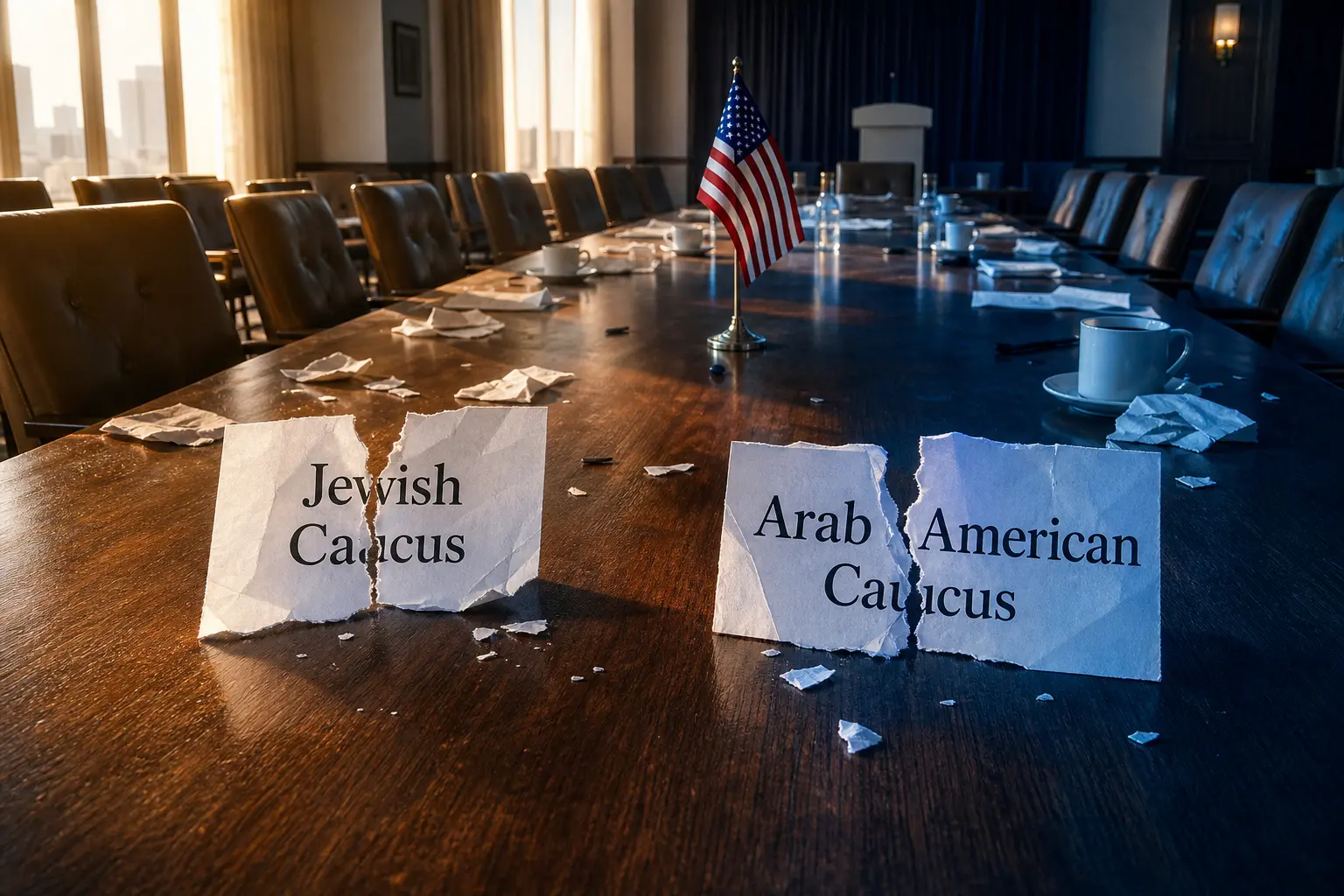
Jewish and Palestinian American Democrats traded raw charges over the words “genocide” and “from the river to the sea” at a DNC interfaith gathering in Austin on Friday, turning a unity session into an open display of the party’s deepest foreign-policy fracture weeks before midterm campaigning intensifies.
The small meeting, hosted by the DNC interfaith council with Christian, Jewish and Muslim speakers, was meant to urge members to set religious differences aside and focus on electing Democrats in November. Instead it broadcast identity-level pain that the party’s Middle East working group has spent nearly a year failing to resolve.
What was scripted as shared purpose became a live demonstration of how little common language remains. Speakers did not disagree only on policy. They disagreed on what basic phrases mean when spoken aloud inside the same coalition.
Raw Exchanges Replace the Unity Script
Amy DeLoach, first vice chair of the North Carolina Democratic Party’s Jewish Caucus, told the room that Israel is as important to her as her “next breath.”
It is fundamental to who I am. … But when I hear ’Free Palestine’ or ’I stand with Palestine,’ what I’m hearing is ’I’m against Israel.’ That’s what I hear. And I agree with you. I don’t think that’s necessarily what is meant. But as a Zionist, that’s what we hear.
DeLoach added that “from the river to the sea” signals the annihilation of Israel for many Jews even if speakers intend something else. She opposes “anything” Israeli Prime Minister Benjamin Netanyahu is doing, just as she fights Donald Trump, yet insists Israel’s right to exist remains non-negotiable. “It is my homeland,” she said.
That pairing matters for the wider party argument. DeLoach can reject Netanyahu’s conduct and still treat Israel’s survival as beyond debate. For listeners who already hear solidarity slogans as erasure, the distinction she draws does not soften the threat they perceive in the same words.
Mirvette Judeh, chair of the DNC’s Arab American Caucus and co-chair of California Democrats for Justice in Palestine, used the word “genocide” for Israeli military actions in Gaza while acknowledging the term is “offensive to some of my Jewish community members.”
Judeh said Palestinians “don’t have a voice” inside the party and have been “intentionally blocked” from advocacy, including more than 40 ceasefire resolutions in California. “My family’s land and homes are being destroyed as we speak,” she said, describing cousins taken as young children. She criticized the party for dismissing those accounts and parking them on a task force that “has not passed anything in the past two years.”
Her charge reframes the working group itself. Where defenders see patience, Judeh sees a holding pen that keeps Palestinian testimony from becoming party position. The California resolution count she cited becomes evidence of process used as a wall rather than a path.
Sam Crumpleton, a Nevada DNC committee woman and Jewish Caucus vice chair, replied that the suffering is horrific and that no one advocates for it. She rejected being told what counts as antisemitic. Crumpleton noted she has faced antisemitism since age 14 and that a cousin, Hirch, was kidnapped by Hamas on Oct. 7, 2023, held for a year and then killed. “There are cousins, there are family, there are people hurting on both sides,” she said. The shared goal remains electing Democrats, yet antisemitism and Islamophobia both exist inside the party.
Crumpleton’s reply closed a painful circle without closing the argument. Family loss on Oct. 7 and family loss in Gaza were both placed on the table. Recognition of parallel grief did not produce agreement on the words that name that grief.
Phrases That Carry Opposite Meanings
The clash centered on a short list of terms that function as identity markers rather than policy statements.
- “From the river to the sea” is heard by many Jewish Democrats as a call for Israel’s elimination and by many Palestinian advocates as a demand for equal rights across historic Palestine.
- “Genocide” is used by progressive and Arab American Democrats to describe the scale of death and destruction in Gaza; Jewish Democrats often experience it as a blood libel that erases Hamas’s Oct. 7 atrocities and Israel’s right of self-defense.
- “Free Palestine” and “I stand with Palestine” register for some as simple solidarity and for others as rejection of Israel’s existence.
- Calls to cut U.S. military aid sit at the policy edge of the same divide, pushed by the socialist wing and resisted by traditional pro-Israel Democrats.
No resolution on Middle East policy moved at the Austin meeting. The DNC instead confirmed it will deliver a formal working-group report to leadership by winter.
Once a phrase carries opposite moral loads for two blocs inside one party, drafting shared text becomes slower than ordinary disagreement over tax rates or health coverage. Each proposed sentence risks reading as surrender to one side and provocation to the other. That is why a unity session can end with a calendar promise instead of a position.
How Far Democratic Opinion Has Moved
The personal exchanges track a multi-year collapse in Democratic support for Israel that now leaves elected officials and candidates without a stable center.
| Group | Unfavorable view of Israel | Sympathies with Palestinians |
|---|---|---|
| Democrats / leaners (Pew spring 2026) | 80% | – |
| Democrats (NBC March 2026) | ~60% negative | Two-thirds |
| All U.S. adults (Pew) | 60% | – |
| Registered voters overall (NBC) | Plurality negative | 39% vs 40% Israelis |
Pew found eight-in-ten Democrats hold unfavorable views of Israel, up from 69% the prior year and 53% in 2022. Nearly half of Democrats under 50 hold a very unfavorable view. Confidence in Netanyahu among Democrats sits at rock bottom: 76% lack confidence, with 52% saying they have none at all.
NBC’s poll showed two-thirds of Democrats now side more with Palestinians than Israelis, a near-complete reversal from earlier decades. Young voters under 35 register almost two-thirds negative on Israel. Independents have moved sharply negative as well. Jewish Americans remain far more positive toward Israel (64% favorable in Pew), while Muslim Americans register near-zero favorable views.
These numbers sit against Israel’s Freedom House score of 73, still rated Free, yet the score and democratic status no longer settle the internal Democratic argument.
The age split sharpens the bind for anyone on a ballot. Older donors and institutions still organize around long-standing pro-Israel assumptions. Younger primary voters, already more negative, treat those assumptions as outdated. Candidates hear both signals in the same cycle and lack a center the polls still ratify.
The Working Group That Buys Time
The Middle East working group exists because earlier resolutions forced the issue. In August 2025 the party blocked an arms-embargo measure and Chair Ken Martin withdrew his own ceasefire-and-aid text in favor of creating the panel. The group of eight members drawn from Jewish and Palestinian advocacy backgrounds has met sporadically.
- August 2025: Resolutions clash in Minneapolis; working group created as compromise.
- December 2025: First in-person meeting at DNC winter gathering in Los Angeles.
- March 2026: Two virtual sessions largely spent defining the group’s own purpose.
- April 2026: Second in-person meeting in New Orleans; resolutions again referred back to the group with demands for progress.
- August 2026: Austin summer meeting confirms a formal report is due to leadership by winter; no policy resolution advanced.
Members have described sessions spent asking “What are we supposed to be doing?” Ideological splits inside the eight-person roster make consensus difficult. Critics call the panel a stalling device that keeps the party from aligning with its own voters. Defenders say hard conversations take time and that the goal is messaging that can win elections rather than pure policy purity.
By winter the report will land after most 2026 primaries and deep into general-election season. Candidates will already have staked positions under primary pressure from both AIPAC-aligned spending and progressive challengers.
The roster design almost guarantees delay. Eight members chosen from opposing advocacy backgrounds can surface every objection early, which slows any single draft. Sporadic meetings stretch that friction across a full year. The Austin confirmation of a winter due date keeps the structure intact without converting it into a vote the room could not pass.
Primaries Already Force the Choice
The language fight in Austin is not abstract. Progressive candidates have used Israel-Gaza criticism to pressure incumbents; pro-Israel super PACs have spent heavily in response. North Carolina, New Jersey and multiple Chicago open seats saw the issue dominate 2026 primaries. Some Democrats who once took AIPAC money later announced they would reject it and cosponsor arms restrictions.
- North Carolina primaries put the same Jewish-caucus intensity on display that DeLoach voiced in Austin.
- New Jersey contests pulled national donor attention into local Israel-Gaza framing.
- Chicago open seats turned progressive arms-restriction demands into early litmus tests.
- Candidates who once accepted AIPAC support later reversed course under primary heat.
Crowd reaction on X mirrors the room: progressive voices frame the DNC as captured by the Israel lobby and complicit in genocide, while others warn that antisemitism and endless purity tests fracture the coalition needed to win. Both flanks feel the party is not hearing them. That dual grievance is the second-order cost of the stall.
Post-2024 reviews already showed Gaza as top issue for some 2024 defectors among Biden voters who stayed home or switched. Arab and Muslim voters shifted hard. Jewish Democrats remain a reliable and high-turnout bloc that still backs the party at historic rates even while opposing Netanyahu. Losing either edge hurts in close districts.
Market and diplomatic context continues to shift around the party. An earlier easing of Israel-Gaza market tensions showed how external developments can move prices faster than internal party language. At the same time the Netanyahu coalition freezes on Cairo mediators keep the underlying conflict live, denying Democrats a quiet period in which to paper over differences.
The Winter Report Arrives After The Primaries
Timing is now part of the mechanism. The working group’s winter delivery comes after most 2026 primaries have already forced candidates to choose language under pressure. By the time leadership receives a formal report, mailers and debate lines will be set.
That sequence favors improvisation over coordination. Progressive challengers and AIPAC-aligned spenders do not wait for a DNC panel to define acceptable phrasing. They define it in real time, district by district. The Austin meeting’s promise of a later report therefore manages national process while leaving local candidates exposed to the same zero-sum vocabulary heard in the room.
Defenders of the panel still argue that rushed purity loses general elections. Critics answer that a year of sporadic sessions, including meetings spent defining purpose, already tested patience. Both claims can be true inside one cycle: messaging discipline may help in November, and delay may still look like avoidance to voters who shifted after 2024.
Both Coalitions Still Decide Close Races
The electoral math does not let either flank become optional. Jewish Democrats remain high-turnout and broadly loyal even when they oppose Netanyahu. Arab and Muslim voters, after hard shifts tied to Gaza, can decide narrow margins where they cluster. Post-2024 defection patterns already flagged the cost of treating either group as background noise.
Favorability gaps underline the tension rather than resolve it. Jewish Americans’ 64% favorable view of Israel and Muslim Americans’ near-zero favorable reading describe two durable realities inside the same party brand. Candidates who flatten those realities into one slogan inherit distrust from whichever side hears erasure first.
Austin made the tradeoff audible. DeLoach’s homeland language, Judeh’s genocide language, and Crumpleton’s account of a cousin killed after Oct. 7 all claim moral urgency. A winter report can catalogue those claims. It cannot rank them without reopening the fracture the unity session was meant to calm.
What Candidates Inherit
Every Democratic candidate now inherits a base in which large majorities view Israel unfavorably and a donor and activist class that still includes strong pro-Israel voices. The interfaith meeting did not create the split. It simply refused to hide it. The working group’s winter report may produce talking points. It will not erase the lived experience DeLoach, Judeh and Crumpleton described in the same room.
November will test whether voters punish the indecision more than they reward the attempt at listening. The language that felt existential inside the Austin meeting will travel onto mailers, debate stages and social feeds. Candidates who try to split the difference will hear both sides accuse them of betrayal. That is the concrete midterm liability the unity event accidentally advertised.
The party still needs every part of its coalition. The Austin session showed how hard that will be when the words themselves have become zero-sum.
