
Walk a single square kilometre of Downtown Cairo and you pass one of the densest concentrations of historic banking architecture anywhere on earth, a century of Beaux-Arts, neo-Mamluk, and stripped classicism rolled into a walkable stretch. The banks were built to perform solvency in stone, with rotundas, scrollwork, and looping logos mounted like crowns, and the performance is still readable from the pavement a hundred years on. Few visitors notice. The buildings were built to be noticed by everyone else, by depositors, by rivals, by the street, and they performed the role so seriously that the facades themselves became arguments about who could be trusted with money.
Read together, the buildings form a short walking library of financial self-presentation: a Beaux-Arts corner, a Frenchman’s neoclassical rotunda, a stripped colonial facade, a Lasciac clock tower in neo-Mamluk brick, and a terracotta doorway hiding behind an Italian eclectic front. Each one argues a different case, and the case is the same.
The Confidence That Built Them
Downtown Cairo was not built to look like this. The district took its shape under Khedive Ismail after his visit to Paris in 1867, when he commissioned European architects to design a modern city centre modelled on Haussmann’s renovations, the stretch that became known as the Paris of the East. Italian architects dominated the next generation of commissions. Antonio Lasciac, who worked in Cairo from the 1890s onward, designed palaces, insurance offices, and government buildings in an eclectic mix of neo-Renaissance, neo-Gothic, and neo-Mamluk styles, according to Bernard O’Kane’s 2020 survey of his work published in the journal Arts et Savoirs.
Banks arrived into this district with a problem no other building type shared. A ministry could rely on its name. A palace could rely on its owner’s name. A bank had nothing but the building, and so it borrowed every language of trust the era had on offer: classical columns for permanence, Beaux-Arts garlands for institutional weight, neo-Mamluk arched windows for cultural rootedness, stripped classicism for modernity. The National Bank of Egypt was founded in 1898 with £1 million in capital, according to the bank’s own history page and the FDIC’s resolution filing, and it became the country’s largest bank by assets, deposits, branches, and employees. Banks needed to convince the street. The facades were where they did the convincing.
The result, over the next three decades, was a working architectural argument. Each institution picked a register and committed. The Central Bank of Egypt building went up in 1903 in a rusticated Neo-Baroque style by Dimitri Fabriculus. The Egyptian Exchange moved into a neoclassical building on Al-Sharifin Street in 1928. Banque Misr’s Mohamed Farid headquarters, designed by Antonio Lasciac, opened in 1927 in the neo-Mamluk mode Lasciac had spent decades refining. The strip of stone that holds them is short enough to walk in an afternoon, and dense enough to constitute a working library of historic financial architecture.
- 1898: National Bank of Egypt founded as the country’s oldest commercial bank
- 1903: Dimitri Fabriculus designs the Central Bank of Egypt building in Neo-Baroque style
- 1927: Antonio Lasciac completes the Banque Misr headquarters on Mohamed Farid Street
- 1928: The Egyptian Exchange relocates to its current Al-Sharifin Street home
- 1947: The Central Bank building is stripped of its colonial facade and given a third floor
The Beaux-Arts Survivor on Al Borsa
Two blocks east of the stock exchange, on Al Borsa Al Gadida Street, a corner building still carries the full Beaux-Arts vocabulary of the era that commissioned it. The current tenant is Abu Dhabi Islamic Bank, but the facade belongs to an earlier century: scrollwork climbing the corner piers, stone garlands at the second-storey level, shield motifs, and a cornice heavy enough to suggest the building has been here since the district was laid out.
Beaux-Arts was the safe choice for institutions that wanted to look older than they were, and Cairo’s early 20th century bankers picked it the way their Parisian counterparts did, with full commitment and no restraint. Corner facades like this one, with every square foot of stone given over to ornament, were the architectural equivalent of a balance sheet that printed itself in capital letters. The result is the kind of corner facade that in another city would be a national landmark. In Downtown Cairo, it is one stop on a longer walk.
A Frenchman’s Rotunda for the Market
The Cairo Stock Exchange took its current form on Al-Sharifin Street in 1928, financed by a company founded by brokers after the previous venue on Maghrabi Street closed. The exchange’s own museum credits the building to the French architect Georges Parcq, and the credit is visible from across the street.
Parcq delivered a neoclassical facade anchored by a row of Ionic columns, the same column order that classical banks and exchanges across Europe used to signal institutional permanence. The exchange was not, strictly, a bank, but trading floors have always needed to look as trustworthy as vaults, and Parcq deployed the full vocabulary of one. Above the columns, a vast rotunda swells upward from the roof, a dome borrowed straight from the great European exchanges of the 19th century, the architectural language of money at its most self-assured. The rotunda reads as a dome from the street below, a clear statement that the activity inside deserves the kind of building cities reserve for their tallest ambitions.
The Arabic inscription set along the upper facade is composed with the confidence of something that has never considered being ignored. The interior, today used in part as a museum of the exchange’s own history, carries the same heavy classical vocabulary inward. Few 1928 commercial buildings anywhere are still recognisable from the same angle the architect intended. Parcq’s facade has been in continuous public view for nearly a century, and the rotunda is still legible as a dome.
The exchange’s history page notes that the institution has governed two venues, Cairo and Alexandria, under the same board since the late 19th century. The Al-Sharifin Street building was meant to bind that history to a single architectural statement. It still does. The rotunda has been Cairo’s quietest argument about the seriousness of its own capital markets for almost a hundred years.
Stripped for a New Egypt
The Central Bank of Egypt sits at the corner of Sherif Street and Qasr El Nil, and the building carries the longest architectural memory of any bank on this stretch. Cluster Cairo’s architectural study of the building dates the original structure to 1903 and credits the design to Dimitri Fabriculus in a rusticated Neo-Baroque style. The stone exterior was ornamented, the study notes, by a pediment above the main portal, cornices, balustrades, columns, and an intricate parapet, the full bag of tricks a colonial-era bank could deploy to look permanent.
In 1947, after British troops evacuated Egyptian cities, the state refurbished the building and added a third floor. The refurbishment stripped the facade of its overworked detail, leaving the more austere lines that define the building today. The new face of the building dressed it in the modernist register of the new republic, but the bones underneath were still Fabriculus’s 1903 limestone.
The new understated design was not only contemporary for the period, but also symbolized the beginning of a new era for the bank.
Cluster Cairo’s 2021 study of the CBE building frames the refurbishment as more than a renovation. Today, the stripped facade runs unbroken around both street frontages, a single horizontal sweep of limestone carrying the corner without interruption. The CBE now occupies an entire block, the building’s weight distributed across the whole intersection. The argument it makes is one of scale rather than detail, which is itself an argument about how the institution wants to be seen.
The Neo-Mamluk Thesis on Mohamed Farid
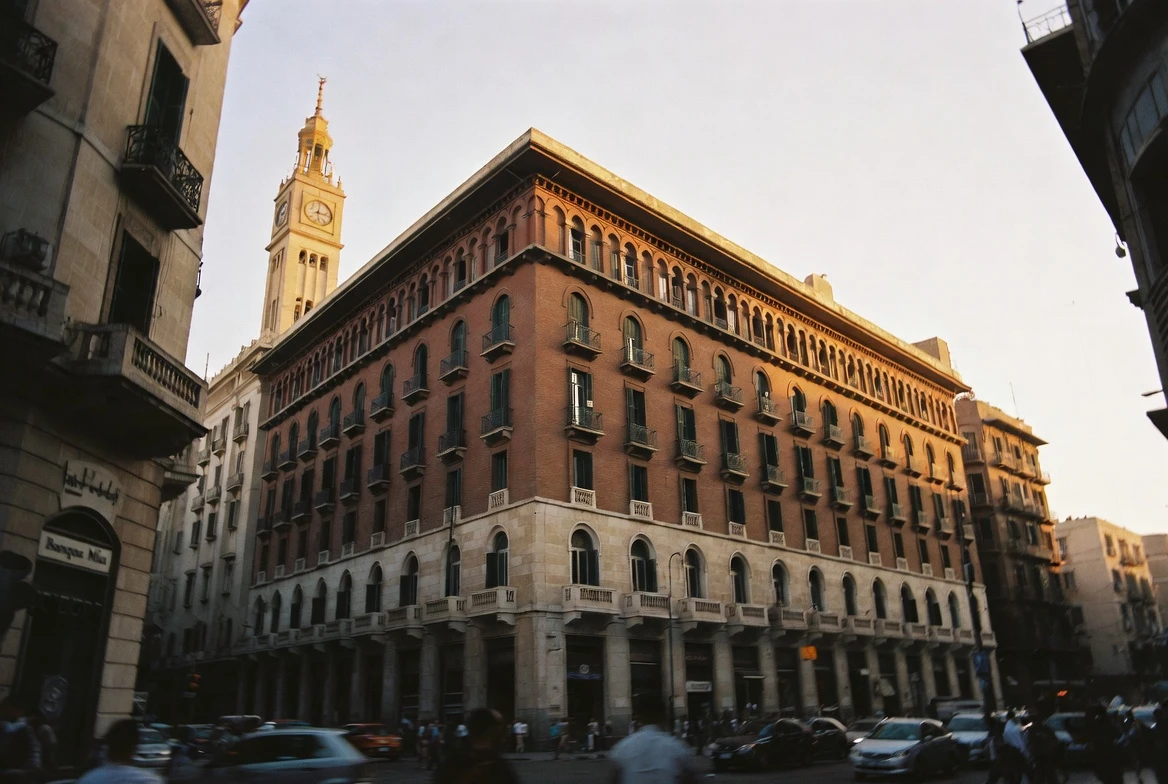
If one building on this walk earns the title of thesis statement, it is Banque Misr on Mohamed Farid Street. The bank’s head office opened in 1927, designed by Antonio Lasciac, the Italian architect who dominated Cairo’s eclectic commissions at the turn of the century. O’Kane’s 2020 paper calls the building the most impressive surviving work of Lasciac in neo-Mamluk style, tracing the architect’s long engagement with Cairo’s Mamluk decorative vocabulary across decades of practice.
The facade earns the description. Cream stone classical framing at street level gives way to deep red brick above, with Moorish arched windows and wrought-iron balconies climbing to a roofline clock tower.
The combination should not work, and yet it does. A 2025 architectural study of the Banque Misr building complex, published in the Benha Journal of Engineering Science and Technology, lists six floors and treats the original Lasciac structure as the benchmark for how later additions to the complex should integrate with the heritage context. The bank commissioned the building in the same year the Egyptian Exchange was building its rotunda on Al-Sharifin, and the two projects read as a single argument about what Egyptian financial architecture should look like. The Beaux-Arts vocabulary that the buildings on Al Borsa Al Gadida had borrowed from Paris was not enough for either institution. They wanted their own reference point.
Undoubtedly the most impressive surviving work of Lasciac in neo-Mamluk style is the Bank Misr building on Mohamed Farid Street in Cairo (1927).
Bernard O’Kane’s 2020 paper makes the case that Lasciac’s neo-Mamluk decorative motifs were not borrowed from passing references but from detailed study of Cairo’s Mamluk monuments, reflecting the architect’s long service on Egypt’s Comité de conservation des monuments de l’art arabe. The argument gives the building a different weight than the contemporary European-style banks: it is a claim about cultural inheritance as much as institutional permanence.
Behind the building, a glass-and-steel tower has risen in recent decades, taller, newer, and louder than the original. The contrast only sharpens what the 1927 building is doing. The newer tower will not age into the kind of navigational landmark the Lasciac facade has become. Few 1927 buildings anywhere still do the work this one does, which is to give pedestrians a piece of the district they can use to find their way around by. The Banque Misr building has been that piece since the year it opened.
Twin Limestone Sentences on the Same Street
The National Bank of Egypt predates almost every other institution on this walk. Founded on June 25, 1898 with a capital of £1 million, it is the country’s oldest commercial bank, a status confirmed by both the bank’s own history page and the FDIC’s resolution filing for the institution.
The bank’s physical presence in Downtown takes two forms, and the two buildings sit close enough to read against each other. The first is a mid-20th century bureaucratic beige sprawl on Sherif Street that lets sheer mass do the arguing. The second is a quieter limestone building next door to Banque Misr on Mohamed Farid, delivering the same institutional claim in a more compact sentence: a grand arched entrance flanked by corbelled balconies, symmetrical to a fault. The two buildings read as one institution’s confidence in two registers. One shouts; the other states. Both are unmistakably banks, and both are unmistakably the same bank.
The FDIC filing notes that the bank has functioned purely as a commercial institution since 1961, when Egypt separated it from the central banking role it had held since 1951. The Wikipedia entry on the institution lists it as the country’s largest bank by assets, deposits, branches, and employees, a position it has held for decades. The two buildings in Downtown are not the bank’s headquarters, but they are the institution’s most architecturally legible statements in this district, with both facades announcing the same bank in two distinct voices.
The Doorway That Glows Terracotta
Just up the street from the CBE on Qasr El Nil, a building almost hides behind its own unassuming doorway. The current tenant is Nasser Social Bank, founded in 1971, but the facade belongs to a different century. The building was originally the Italian Egyptian Bank, designed in 1906 by the architect I. Mattioli, whose name appears in the photographic record of the Alinari collection.
When the afternoon sun hits the terracotta tile of the upper facade head-on, the building glows in a way the surrounding limestone banks do not. The doorway at street level is small and easy to miss, but the building rewards a second look with a decorative program the neighbouring CBE never attempted. The contrast between the two adjacent buildings, the understated limestone of the central bank and the warmer, more domestic Italian eclectic vocabulary of the Mattioli facade, captures the full range of what financial architecture in this district has meant.
| Building | Built | Architect | Style |
|---|---|---|---|
| Central Bank of Egypt | 1903 (refurbished 1947) | Dimitri Fabriculus | Neo-Baroque, stripped modernist |
| Nasser Social Bank | 1906 | I. Mattioli | Italian eclectic, terracotta facade |
| Banque Misr | 1927 | Antonio Lasciac | Neo-Mamluk with Mamluk motifs |
| Cairo Stock Exchange | 1928 | Georges Parcq | Neoclassical, Ionic columns |
| National Bank of Egypt | 1898 (founded) | – | Mid-20th century beige and limestone |
Frequently Asked Questions
Which is the oldest bank in Downtown Cairo?
The National Bank of Egypt, founded on June 25, 1898 with a capital of £1 million according to the bank’s own history and the FDIC’s resolution filing. The bank remains the country’s largest by assets, deposits, branches, and employees, per the bank’s own statements. Its two most visible Downtown buildings, however, are mid-20th century constructions in the institutional-beige and quiet-limestone registers rather than 1898 originals.
Who designed the Banque Misr headquarters on Mohamed Farid Street?
The Italian architect Antonio Lasciac, who also designed several of Cairo’s other eclectic landmarks including the Said Halim Palace and the Assicurazioni Generali building. The 1927 Banque Misr headquarters is described in Bernard O’Kane’s 2020 survey of Lasciac’s work, published in Arts et Savoirs, as the most impressive surviving example of the architect’s neo-Mamluk style, drawing on Cairo’s Mamluk decorative vocabulary.
When did the Cairo Stock Exchange move to its current building?
In 1928, when the exchange relocated from a previous venue on Maghrabi Street in Cairo to a new neoclassical building on Al-Sharifin Street. The Egyptian Exchange’s own museum credits the design to the French architect Georges Parcq, whose facade features a row of Ionic columns and a roofline rotunda modelled on 19th century European exchanges.
What style is the Central Bank of Egypt building?
The original 1903 building, designed by Dimitri Fabriculus, was a rusticated Neo-Baroque design with a pediment, cornices, balustrades, columns, and an intricate parapet. After the state took over the building in 1947, a third floor was added and the overworked colonial facade was stripped to a more austere modernist line, a change Cluster Cairo’s 2021 architectural study describes as the building being dressed in the modernist register of the new republic.
Can visitors tour these bank buildings?
The facades are public and viewable from the street at any time. The buildings are operating financial institutions, not museums, and the interiors are not generally open to casual visitors. Downtown Cairo is walkable in a half-day, and most of the key facades sit within a few blocks of each other around Sherif Street, Qasr El Nil, and Mohamed Farid Street, which makes the architectural circuit easy to plan on foot.
