
An Israeli strike on Saturday killed three members of the Lebanese Armed Forces, including a brigadier general, on a road between Kfar Tebnit and Khardali in the Nabatieh district of southern Lebanon. The deaths came three days after the United States, Israel, and Lebanon signed a joint agreement in Washington designating the Lebanese army as the exclusive security authority over new “pilot zones” in that same part of the country.
The Lebanese Armed Forces has not participated in the fighting since March 2. Its vehicle was moving inside territory that, under the deal, is supposed to come under Lebanese army exclusive control, with no operational coordination system between Beirut’s military and the Israel Defense Forces (IDF) capable of preventing such strikes.
The Kfar Tebnit Strike
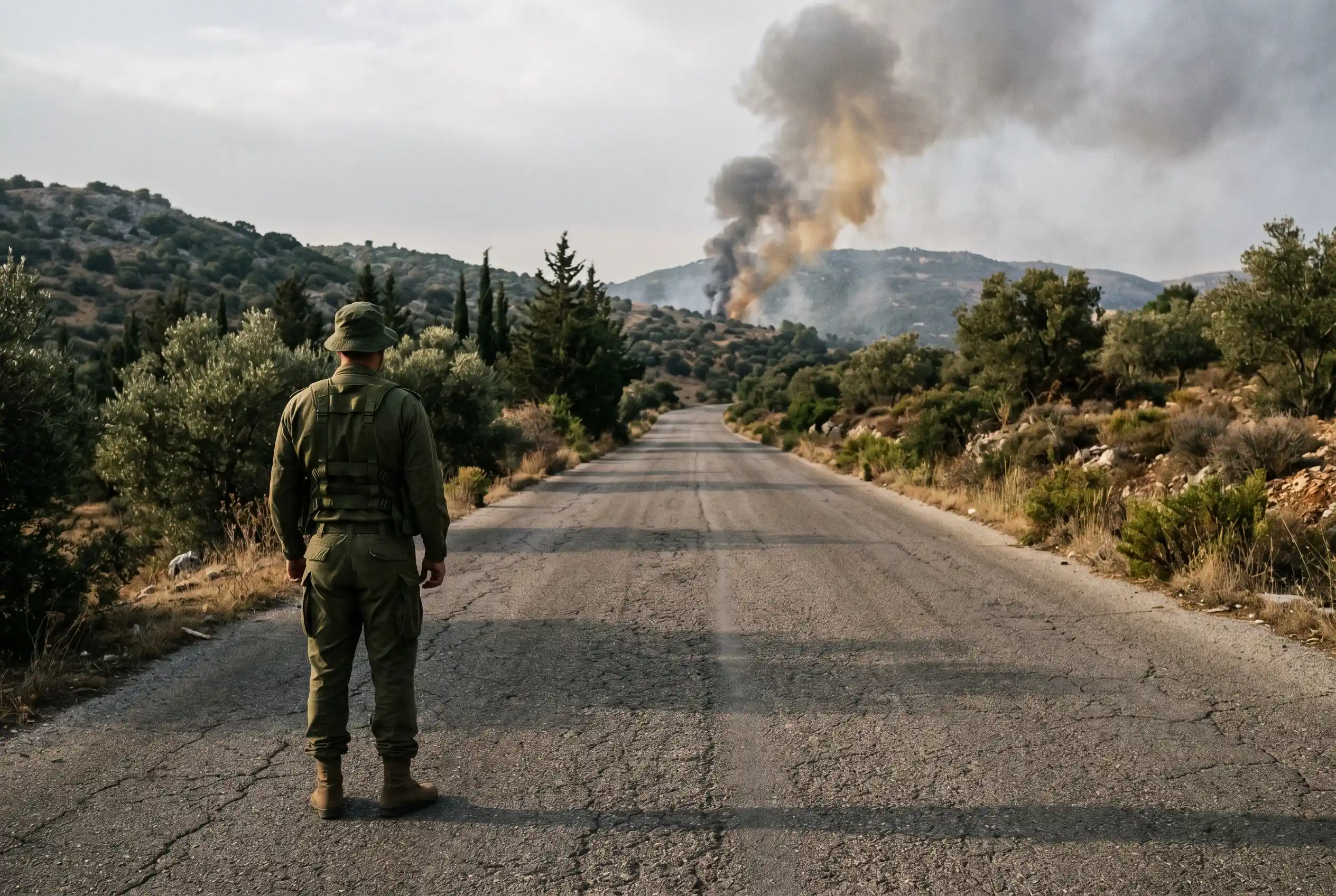
The Lebanese Armed Forces said the vehicle was on the road between Kfar Tebnit and Khardali when Israeli fire hit Saturday morning. A brigadier general, a captain, and a private soldier died. The army published photographs of the charred wreckage on its X account and condemned the attack as “an aggressive and barbaric raid,” saying in its statement that “continued, deliberate, and repeated Israeli aggression against Lebanon, its people and its army only strengthens our resolve.”
Throughout the conflict that began March 2, Lebanese army units kept their distance from the fighting. Hezbollah had launched rockets into northern Israel on that date following the killing of Iran’s supreme leader by Israeli and US forces on February 28. Israel answered with air strikes and a ground invasion of the south. The Lebanese army arrested Hezbollah members in some instances, positioning itself as the partner international mediators needed for any post-conflict security arrangement, a state force that could eventually move into territory Hezbollah vacated.
On June 3, an IDF strike in the southern town of Deir ez-Zahrani hit a Lebanese army vehicle and wounded two soldiers, prompting a formal protest from Beirut. The Washington pilot-zone agreement was signed later that same day, giving the Lebanese army a formal mandate to be inside the southern Lebanon territory the vehicle was traveling through. Three days after that signing, a brigadier general was dead on a road the deal designated as Lebanese army territory.
The IDF’s Account of the Strike
Israel’s military confirmed hitting the vehicle and opened a formal investigation. Its statement said troops had identified a vehicle “moving suspiciously” toward Israeli forces near the village after receiving “concrete indications” that Hezbollah planned attacks on soldiers in that area. The vehicle was in “an active combat and evacuated area,” the military said, and was struck after troops assessed it as a threat. An initial inquiry confirmed two officers and a soldier of the Lebanese Armed Forces were inside at the time of the strike.
The IDF’s statement added that “troop movements in the area require coordination with the IDF” and repeated its standing position: its forces “are operating against the Hezbollah terrorist organisation, not against the Lebanese Army.”
That coordination requirement is effectively unenforceable under current conditions. Israel has issued rolling evacuation orders across southern Lebanon as its forces push north, declaring large stretches of the country active war zones. IDF Chief of Staff Lt. Gen. Eyal Zamir told officers at the Haifa Naval Base on June 3, hours before the Washington deal was announced, that “there is no ceasefire for our forces” in Lebanon. Israeli Defence Minister Israel Katz confirmed the following day that military operations would continue regardless of any ceasefire declaration. Inside those declared zones, the Lebanese army has no real-time channel to alert the IDF of vehicle movements before a strike occurs. The IDF’s own statement Saturday acknowledged troops were on active Hezbollah alert in that area, meaning any vehicle there entered a threat-assessment process that moves faster than any coordination protocol between the two armies.
Before Saturday, that gap was a theoretical problem. What the Washington agreement changed was giving the Lebanese army a formal mandate inside precisely those zones, without any new mechanism to make movement there operationally safer.
The Pilot-Zone Framework
What Washington Agreed
The fourth round of US-mediated talks, held at the State Department on June 2 and 3, produced a joint statement from all three governments. The State Department’s trilateral joint statement committed Israel and Lebanon to “swiftly advance the creation of pilot zones in which the Lebanese Armed Forces will take exclusive control of the territory to the exclusion of all non-state actors.” The US separately pledged to “support the Lebanese Armed Forces, with the aim of improving their capacity and enabling the effective exercise of sovereignty throughout Lebanese territory.”
Lebanese Prime Minister Nawaf Salam announced on June 4 that the army would begin deploying into the pilot zones immediately, calling it the first step toward full Israeli withdrawal. The two parties agreed to reconvene the political and security tracks during the week of June 22. Three days after Salam made that announcement, a Lebanese army brigadier general was dead on a road inside the territory his prime minister had just committed him to control.
| Framework | Date Agreed | Lebanese Army’s Designated Role | Status on June 6 |
|---|---|---|---|
| April 17 cessation of hostilities | April 17, 2026 | Not formally designated | Never observed by either side |
| Washington pilot-zone agreement | June 2-3, 2026 | Exclusive territorial control; deployment ordered June 4 | Hezbollah rejected; IDF continuing operations |
The Contradiction on the Ground
The pilot-zone framework’s logic requires that the Lebanese army can move freely through the territory it is designated to control. Saturday’s strike tested that assumption where the framework is most exposed. The vehicle was on a road inside the geography the deal assigns to Lebanese state authority; the passengers were not combatants. GlobalSecurity.org’s June 6 operational report on the Lebanon front noted that the killing of uniformed Lebanese Armed Forces personnel “marks an escalation against the very force the US-brokered pilot-zone framework designates to exercise exclusive control of the buffer areas south of the Litani,” and described the State Department’s joint framework as “formally intact but operationally hollow.”
Israeli and Lebanese negotiators placed the Lebanese army at the center of the ceasefire architecture partly because the United Nations Interim Force in Lebanon (UNIFIL) had already demonstrated its limits in active combat territory. UNIFIL has lost seven peacekeepers since the war began in March, including a Serbian peacekeeper who died June 5 from wounds sustained in a Marjayoun mortar strike the day before. The Lebanese army was supposed to bring local legitimacy and a command structure that UNIFIL lacks. Saturday placed that calculation under pressure it did not face when the deployment order was issued Thursday.
President Aoun’s Condemnation
Lebanese President Joseph Aoun called the strike “a flagrant violation of Lebanese sovereignty and international law,” placing it in the context of “ongoing escalation that threatens stability and security in the south, despite the efforts Lebanon is exerting in the Washington negotiations.” Aoun commanded the Lebanese Armed Forces before his election as president earlier this year. His language after Saturday’s deaths was more pointed than Beirut’s usual statements of concern: losing a brigadier general from a vehicle carrying no weapons on a road inside territory his government had formally just claimed as its own made a measured response politically untenable.
It’s not your country, it’s our country. They are using Lebanon as a bargaining chip in their negotiation with the United States. It’s unacceptable.
Those words, from Aoun’s CNN interview aired Friday, were directed at Tehran. Iranian Foreign Minister Abbas Araghchi answered on X within hours of Saturday’s deaths. “One would think it’s Iran that has occupied a fifth of Lebanon, displaced a quarter of Lebanese and is bombing his country on a daily basis,” Araghchi wrote, closing with: “Save Lebanon from your real foe, Mr. President.” More than 3,500 people have been killed in Lebanon since March 2, with more than 1 million displaced; both governments cite those figures while pointing at different causes for them.
For Aoun’s government, the timing is politically acute. His administration committed to the Washington deal and to the army’s pilot-zone deployment as the clearest available evidence that Lebanese state sovereignty can reassert itself in the south. Saturday’s deaths force Beirut to justify continued cooperation with a framework that is not keeping its own forces safe in the territory it assigns them.
Hezbollah Holds the Variable
Every ceasefire framework negotiated since March carries the same structural gap: Hezbollah was not party to any of the talks and has rejected every deal signed without its participation. The Washington agreement reproduced that pattern in compressed form:
- The deal required a “complete cessation of Hezbollah fire and the evacuation of all Hezbollah operatives” from the area south of the Litani River as the ceasefire’s core condition.
- Hezbollah secretary-general Naim Qassem publicly rejected the agreement within 24 hours, saying compliance would mean “surrender, defeat and achieving the enemy’s goals.” He described the direct negotiations with Israel as “shameful” for Lebanon and called the deal “a roadmap to annihilate part of the Lebanese people.”
- Drone attacks on northern Israeli communities continued Saturday morning. The IDF reported a Hezbollah unmanned aerial vehicle crashing in southern Lebanon near Israeli troop positions; no Israeli injuries resulted.
- The IDF cited “concrete indications” of planned Hezbollah fire from the area near the village as part of its justification for Saturday’s strike, confirming the group maintained active operations in that zone when the Lebanese army vehicle moved through it.
The April 17 cessation of hostilities, the first formal framework agreed between Israel and Lebanon, similarly failed almost immediately. Both sides accused each other of violations and fighting in the south ran through May. The IDF announced on June 5 that it had killed Hezbollah’s chief engineer, Abed Harb, in a recent strike. The Washington agreement was the fourth attempt at a formal framework in roughly three months; the April truce had lasted in name only, with the United States eventually proposing the pilot-zone model as a compromise after the Lebanese side threatened to suspend the June talks entirely.
In territory where both Hezbollah operatives and Lebanese army personnel are present, or where the IDF believes both may be, the policy of distinguishing between them cannot operate at strike speed. Israeli forces now hold roughly a fifth of Lebanese territory, having pushed further north than at any point since the 1982-to-2000 occupation. Saturday’s IDF evacuation orders covered five additional villages, Aaramta, Machghara, Kafr Houna, Sejoud, and Ansariyeh, extending the zone where the Lebanese army is now formally deploying without a functioning coordination channel with the IDF.
The political and security tracks are scheduled to reconvene in Washington the week of June 22. The Lebanese Armed Forces is deploying into territory where it has no coordination channel with the military that killed three of its members on Saturday morning.
