
Israeli arms exports hit a record $19.2 billion in 2025, the fifth consecutive annual high and a jump of almost 30 percent from $14.8 billion the year before, according to figures Israel’s Defense Ministry released this week through SIBAT (the International Defense Cooperation Directorate, the body that licenses and tracks weapons sales). Government-to-government contracts made up roughly $10 billion of the total, itself a record.
The number arrived with a wrinkle the ministry mostly skated past. The same multi-front war that drove buyers to combat-tested Israeli kit is also the war that got Israeli firms banned from European arms shows, gave rivals their own battlefield to test gear in Ukraine, and pushed up the shekel in a way that ate into exporters’ margins. The record is real. So is the erosion underneath it.
A Fifth Straight Record, Built on $10 Billion in State Deals
The headline figure crosses the $19 billion line for the first time. It caps a five-year run of records and reflects, in the ministry’s telling, both surging demand and a deliberate loosening of the rules. Director-General Amir Baram, the ministry’s top civil servant, approved reforms last year that eased the licensing process and widened the list of countries Israeli firms are cleared to sell to.
State-to-state deals did most of the heavy lifting. The roughly $10 billion in government-to-government (G2G) sales, contracts brokered directly between Israel and a buyer government rather than through a private firm, accounted for more than half of all exports. Big-ticket business dominated too: 53 percent of the total sat in individual deals worth over $100 million each.
Where those weapons went shifted hard from one year to the next. The regional split for 2025, against the prior year, looked like this.
| Region | Share of 2025 exports | Approx. value | 2024 share |
|---|---|---|---|
| Europe | 36% | $6.9 billion | 54% |
| Asia-Pacific | 32% | $6.1 billion | 23% |
| Middle East & North Africa | 15% | ~$2.9 billion | 12% |
| North America | 13% | ~$2.5 billion | – |
| Latin America | 2% | ~$0.4 billion | – |
| Sub-Saharan Africa | 2% | ~$0.4 billion | – |
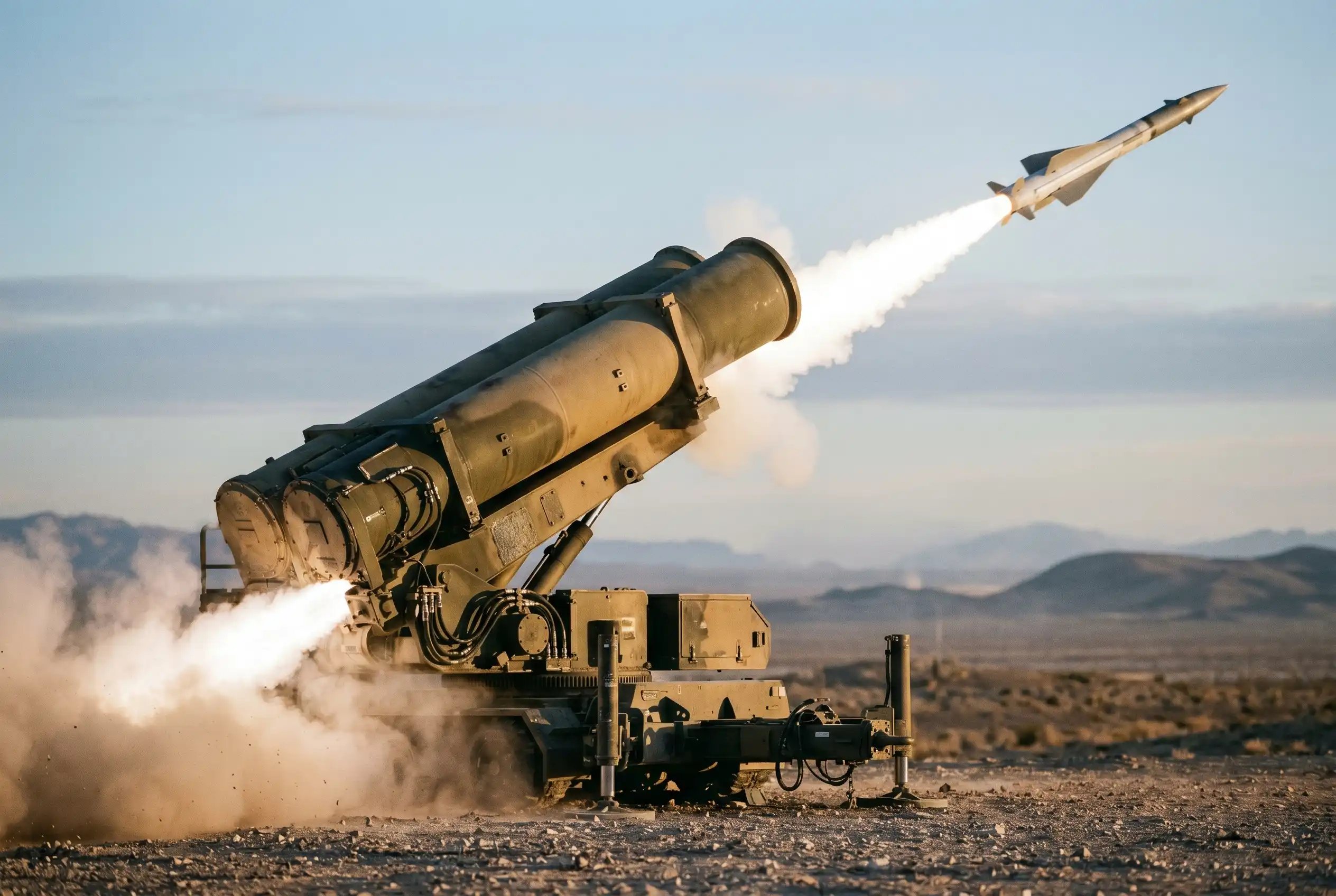
Step back from the single year and the trajectory is steep. The Stockholm International Peace Research Institute, the Swedish think tank known as SIPRI that tracks the global weapons trade, puts Israel as the world’s seventh-largest arms exporter, with a 4.4 percent share of transfers in its most recent five-year window, up from 3.1 percent in the prior period. The country’s own long-run arms-export trend data shows how far that line has climbed since the mid-2010s.
Europe Keeps Buying While Its Governments Slam the Door
Europe stayed the single largest customer in 2025 at 36 percent of sales, or $6.9 billion. That happened in the same year European capitals went out of their way to make Israeli arms firms unwelcome.
On the eve of the export figures, the Defense Ministry said France had barred Israel from the Eurosatory defense exhibition in Paris, one of the biggest arms fairs anywhere, blocking a national pavilion and government representatives. It followed earlier French moves to stop Israeli companies showing offensive weapons at its shows. Madrid went further on policy: Spain’s ban on weapons-carrying ships and planes bound for Israel using its ports and airspace turned a diplomatic objection into a logistics problem.
Yet the buying continued, and the year-on-year drop in Europe’s share is less a boycott story than a base-effect one. Europe bought about $7.9 billion of Israeli gear in 2024, a number inflated by a single $4.6 billion sale of the Arrow 3 long-range missile-defense system to Germany. Strip out that one mega-contract and the underlying European demand in 2025 looks steady. Ministry officials said plainly they were still seeing strong appetite from the continent, sanctions and expo bans notwithstanding. The protests are loud at the top and quiet at the procurement desk.
The War That Sells the Weapons Is Arming Rivals
For two decades Israel’s sales pitch leaned on a phrase its competitors could not easily match: combat-tested. Its systems had been used in real fighting, not just trials. The recent multi-front war, including two major rounds against Iran, gave that pitch fresh ammunition, and the ministry credited “unprecedented operational achievements” for the demand.
Here is the irony the ministry’s own officials flagged. The combat-proven advantage is fading precisely because so much hardware is now being used in combat somewhere else. Russia’s invasion of Ukraine handed Western and other suppliers a live proving ground of their own, so Israel is no longer one of the only places a buyer can point to and say the gear has seen a real war.
Two more drags showed up in the same briefing:
- European production ramp-up. Governments across the continent have expanded munitions and weapons output for export, crowding the market Israel relies on most.
- A stronger shekel. The currency’s appreciation against the dollar over the past year cut directly into exporters’ profitability, since costs are in shekels and many contracts price in dollars.
The competitive squeeze is not only commercial. Israel’s traditional regional leverage rests partly on being the indispensable supplier, and that edge erodes when buyers have alternatives. Egypt’s turn to Chinese fighters and air-defense batteries near the Israeli border is one sign of how quickly the supplier map can be redrawn.
Asia and the Gulf Pick Up the Slack
If Europe held flat, Asia-Pacific is where the growth came from. Sales to the region nearly doubled by the ministry’s count, from around $3.4 billion in 2024 to $6.1 billion, lifting Asia-Pacific to 32 percent of all exports from 23 percent. India, long Israel’s biggest single arms customer, anchors much of that demand, and SIPRI’s figures show India alone taking more than half of recent Israeli transfers.
The Gulf is the other rising buyer. Middle Eastern and North African states took 15 percent of 2025 sales, up from 12 percent, a group that now includes the United Arab Emirates, Bahrain and Morocco after they normalized ties with Israel under the 2020 deals known as the Abraham Accords normalization agreements. During the recent fighting, Israel sent an Iron Dome air-defense battery and personnel to the UAE, which used them to shoot down Iranian missiles aimed at Emirati territory.
Ministry officials expect that relationship to translate into more hardware. Once the war with Iran winds down, they estimate, exports to Gulf states will climb further, turning a wartime favor into a peacetime order book.
Which Weapons Sold the Most?
The category mix tells you what the world is buying off Israel right now, and it is mostly defense against things falling out of the sky. Air-defense systems, missiles and rockets again led the list, though their share of the total slipped as other lines surged.
- Air defense, missiles and rockets: 29% of exports
- Surveillance systems and optoelectronics: 22%, up sharply from 6% a year earlier
- Manned aircraft and avionics: 11%
- Radar and electronic-warfare systems: 11%
- Command, control, communications and computing (C4) systems: 7%
- Cyber and intelligence systems: 2%
The jump in surveillance and optoelectronics, nearly a fourfold rise in share, is the standout, and it tracks with the appetite for drones, sensors and targeting gear that a year of fighting has advertised. The remainder covered drones, launchers and firearms, satellites and space equipment, naval systems, ammunition and services.
The cyber line is small for a country famous for it. Intelligence and cyber tools came to just 2 percent of sales, and the ministry would not say which countries bought them. That reticence has a backstory: Israeli surveillance technology has drawn years of scrutiny over allegations that some governments used it to spy on dissidents and journalists.
Where the Export Money Goes Next
Arms exports are no longer a side business for Israel’s defense establishment; they help pay for it. The ministry was explicit that sales feed the military’s own buildup and give the country foreign-policy leverage, and it cast the record as proof of a working strategy.
The sharp increase in Israeli defense exports, particularly the record figure in G2G deals, reflects in practice the implementation of the Defense Ministry’s strategy to expand Israeli defense exports as a tool to ensure the IDF’s force buildup in an era of challenging budgets, to influence foreign policy, strengthen the defense industry and create additional budgetary sources for the defense budget.
Defense Minister Israel Katz framed the run as a vote of confidence from abroad. “The very fact that even during a third year of fighting, Israel continues to break records in defense exports is proof of the high regard in which the defense establishment is held around the world,” he said in remarks the ministry provided.
Baram, the director-general, was the more cautious voice. He said the force-buildup budget “relies heavily” on exports but warned the country “must not be satisfied with that,” pressing for more spending on research, development and production lines to secure independence in munitions and interceptors. That dependence cuts both ways at home, where the war’s economic toll is real and about one in three Israeli workers now earns less than before the fighting began. The export machine is funding a defense budget that a strained civilian economy can no longer easily carry, and it is doing so on the strength of a war whose end the ministry is already pricing into next year’s forecasts.
