
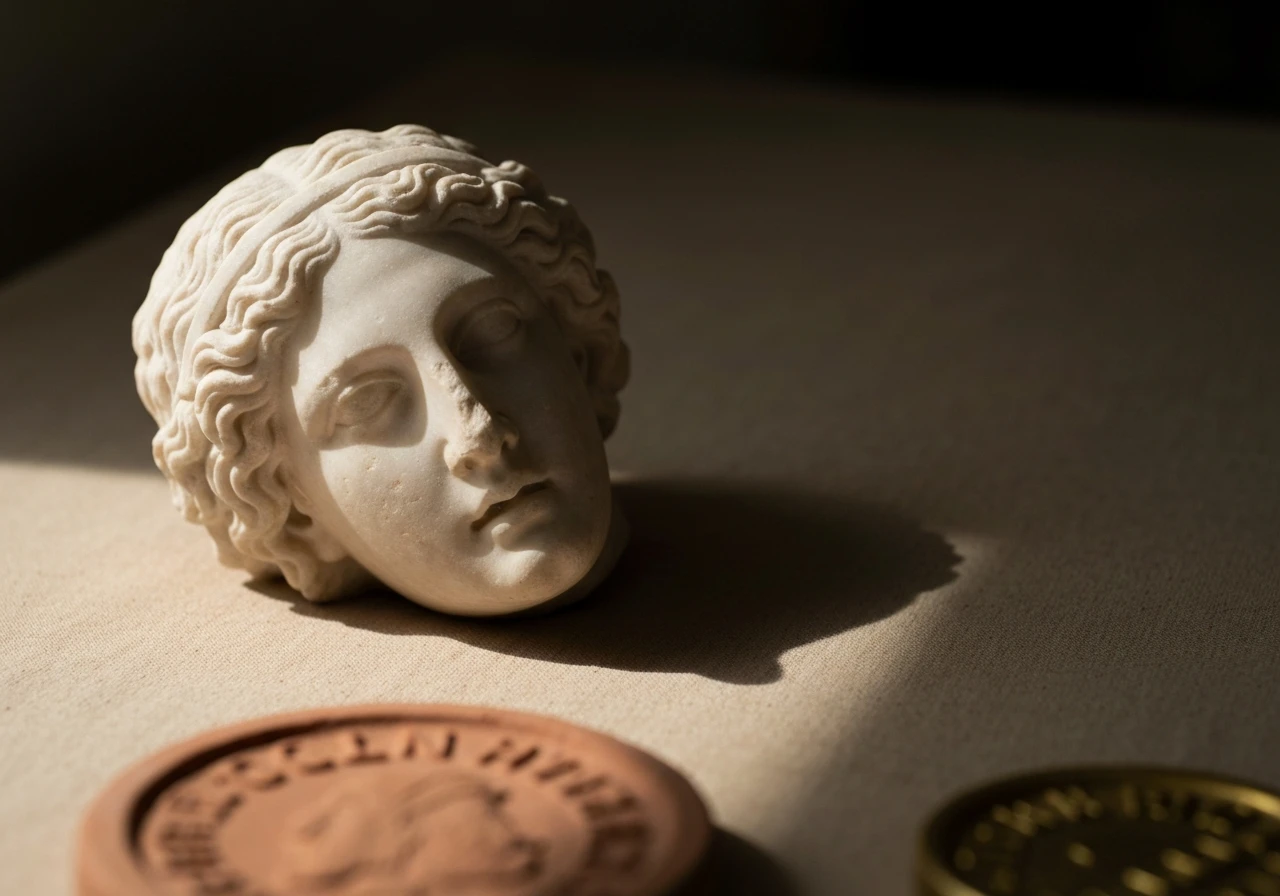
Egyptian archaeologists have unveiled a marble head of Aphrodite, the ancient Greek goddess of love and beauty, pulled from a Roman-era necropolis at Beni Suef, roughly 80 miles south of Cairo. Announced on May 31, the find sits beside a buried basilica, Pharaonic burial goods and Roman coin molds, the latest haul in a state campaign to revive the country’s tourism trade.
The carved face will travel well on social feeds. The antiquities ministry timed this week’s reveal for reasons that run past art history, though: the foreign currency that visitors carry through Egypt’s gates, now that another of the country’s big earners has stalled.
What the Excavations Surfaced at Ehnasiya and Matariya
The Aphrodite head, measuring about 9.5 by nearly 10 inches, came out of the ground at Ehnasiya, the site known by its Roman name Heracleopolis Magna, once one of ancient Egypt’s most important cities. Its curly hair and detailed features track the classical Greek and Roman traditions that flowed into the Nile valley after Rome absorbed Egypt.
Nearby, Mohammed Abdel-Badei, head of the antiquities department at the Supreme Council of Antiquities, described stone blocks weighing up to 45 tons that once carried the columns of a Roman basilica, three of them still standing where they were raised. Diggers also logged inscriptions tied to Senusret III, a Middle Kingdom ruler of the 12th Dynasty (1837 to 1819 B.C.), along with terracotta molds believed to have cast coins during the Roman period.
A second dig, in Cairo’s Matariya district on the old ground of Heliopolis, produced a near-complete set of funerary furniture. The pattern of paired discoveries echoes other recent state digs, including a Roman-era necropolis in the western Nile Delta announced earlier in the cycle.
| Site | Location | Headline finds | Period |
|---|---|---|---|
| Ehnasiya (Heracleopolis Magna) | Beni Suef, about 80 miles south of Cairo | Marble Aphrodite head, Roman basilica, coin molds, Senusret III inscriptions | Middle Kingdom through Roman |
| Matariya (Heliopolis) | Northeast Cairo | Gilded coffin of a military figure, copper mirror, alabaster kohl jars, five pairs of suspected gold earrings | Pharaonic |
A Discovery Calendar Built Around Visitors
Egypt does not announce its digs at random. The reveals cluster around the events the tourism ministry wants the world looking at, and the biggest of those came late last year with the November 2025 opening of the Grand Egyptian Museum beside the Giza pyramids, home to the full Tutankhamun collection.
That museum, the GEM (Grand Egyptian Museum, the largest archaeological museum tied to a single civilization), gave the country a marquee anchor. Each fresh find since then has worked as free marketing for it, a steady drip of marble faces and gilded coffins that keep Egypt in the global feed without the cost of an ad campaign.
The Matariya coffin belonged to a military figure, the kind of human detail that travels. Buried with him were a copper mirror, alabaster containers for kohl eyeliner and five pairs of yellow metal earrings believed to be gold. It is exactly the sort of intimate, photographable object the ministry leans on when the goal is to convert curiosity into a plane ticket, and the timing is the point.
The Foreign-Currency Gap Behind the Marble
Strip away the romance and the reveal is an economic instrument. Egypt is short of hard currency, its pound has weakened sharply against the dollar, and the government needs the dollars, euros and pounds that tourists spend to keep imports flowing and debts serviced.
Suez Canal Income Has Cratered
The squeeze is sharpest at the Suez Canal. The waterway booked a record near $9.4 billion in the 2022 to 2023 fiscal year, then saw revenue fall to roughly $6 billion as Houthi attacks in the Red Sea pushed shipping lines around the Cape of Good Hope. That gap, visible in the Suez Canal Authority monthly revenue data, is billions of dollars a year the state can no longer count on.
Tourism is being asked to carry more of that load. So is broader infrastructure spending, including a multibillion-dollar bet on airport modernization meant to push more arrivals through Cairo.
Tourism Is Taking More of the Strain
The visitor numbers have been climbing from a battered base, and the foreign-exchange yield is the reason the antiquities pipeline matters so much.
- 19 million tourists visited Egypt in 2025, a 21% jump on the prior year, per the prime minister’s office.
- 6.1 million arrived in the first four months of 2026, up from 5.7 million in the same stretch of 2025.
- 30 million visitors a year is the target Cairo has set for 2030.
- $15.3 billion was the rough tourism take in 2024, a sum the state cannot afford to see slip.
You can read the full record 2025 tourist figures from the State Information Service. A weaker pound has quietly helped, making an Egyptian holiday cheaper for anyone holding harder money, even as it strains the domestic economy.
Each fresh find since the museum opened has worked as free marketing, a steady drip of marble faces and gilded coffins that keep Egypt in the global feed without the cost of an ad campaign.
A Recovery Still Carrying Old Scars
The upside is real, but so is the fragility underneath it. Egyptian tourism has been knocked flat more than once in a single generation, and the memory shapes how much weight any single record can bear.
The sector’s recent history reads as a list of shocks it has had to climb out from:
- The 2011 uprising and the political turmoil and violence that followed, which gutted arrivals for years.
- The coronavirus pandemic, which froze global travel and emptied the Nile cruise boats.
- The economic fallout of the Russia-Ukraine war, which cut into two of Egypt’s largest source markets.
- Regional tension around the war in Gaza, which has kept some travelers cautious about the wider neighborhood.
Against that backdrop, the 21% growth rate is impressive and precarious at once. A single security scare or regional flare-up can reverse a year of gains, which is why the state keeps the discovery announcements coming. It needs the soft-power story to stay louder than the risk story.
Heracleopolis Was an Economic Hub Long Before This Week
There is a neat symmetry the ministry will not say out loud. Among the Ehnasiya finds were molds used to craft coins when Egypt sat inside the Roman Empire, between 30 B.C. and A.D. 395. The city was a commercial and economic center then, minting the money that moved through a Mediterranean trade system.
Two thousand years later, the same ground is being mined for value again, only now the currency is the visitor and the export is the image of the past itself. The marble head that drew Greek and Roman craftsmanship into a Nile-valley town is being asked to draw Asian charter flights and European tour groups into the same region.
That is the second-order story sitting under the headline. The Aphrodite face is a beautiful object and a genuine archaeological prize. It is also, for a government counting its dollars, a working asset, and the screens above arrivals halls will measure whether the strategy is paying.
Frequently Asked Questions
Where was the marble Aphrodite head found?
At Ehnasiya, in Egypt’s Beni Suef province, about 80 miles south of Cairo. The site is also known by its Roman name, Heracleopolis Magna, and was one of ancient Egypt’s most prominent cities. The head turned up in a Roman-era necropolis alongside the remains of a basilica.
Can tourists see these new artefacts yet?
Not immediately. Freshly excavated objects typically go through cleaning, conservation and study before any public display, and the antiquities authority has not named a museum or date for showing the Beni Suef and Matariya finds. Egypt’s headline attraction for now is the Grand Egyptian Museum near Giza.
When did the Grand Egyptian Museum open?
It was inaugurated on November 1, 2025, and opened to the public days later. Located about two kilometers from the Giza pyramids, it houses the complete Tutankhamun collection and has become the centerpiece of Egypt’s cultural tourism pitch.
How many tourists is Egypt aiming for?
The government has set a target of 30 million visitors a year by 2030. Egypt drew a record 19 million in 2025 and 6.1 million in the first four months of 2026, so reaching the goal implies sustained double-digit growth for several more years.
Why does tourism matter so much to Egypt’s economy right now?
Tourism is one of Egypt’s main sources of foreign currency, and it has grown in importance as Suez Canal revenue fell from a near record $9.4 billion to roughly $6 billion after Red Sea shipping disruptions. The hard currency tourists spend helps the state pay for imports and service its debt.
