
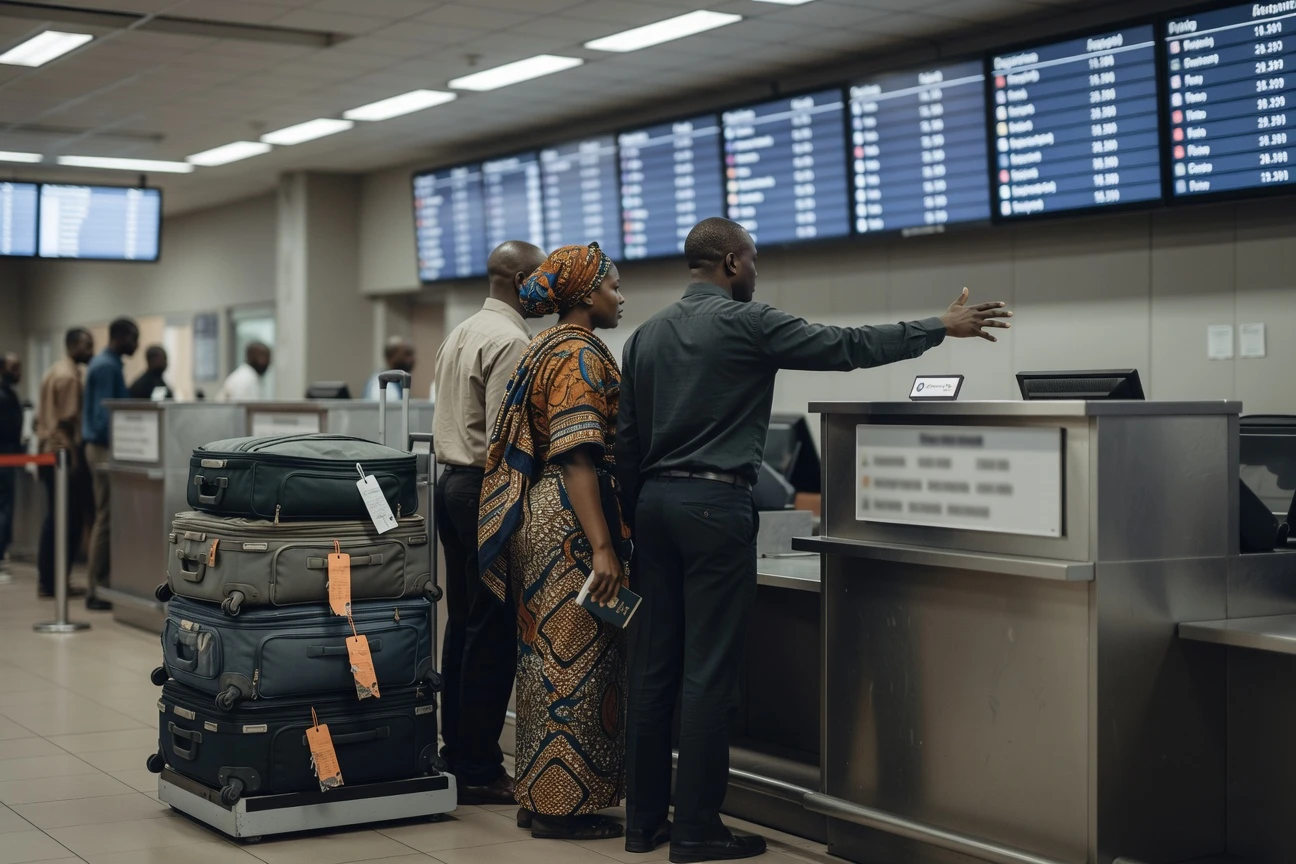
About 219 passengers who landed in Lagos on May 19 without their checked bags spent Tuesday blocking the Egypt Air check-in counter at Murtala Muhammed International Airport, refusing to let a Cairo-bound flight board until the carrier’s General Manager came down from Victoria Island and explained where their luggage had gone. The flight, due out around 2:00 pm, finally pushed back at 4:00 pm.
The sit-in is the visible part of a quieter mismatch on the Lagos route: a Boeing 737-800 with a cargo hold sized for European city pairs flying a market where passengers routinely travel with three suitcases of trade goods, foodstuffs, and gifts. Nigeria’s aviation regulator gave the airline 21 days to fix the gap, and on Tuesday the 21 days had not yet run out.
What Triggered the Sit-In at Murtala Muhammed
The trigger was not the missing bags. It was the silence. Passengers told THISDAY no email update arrived in the week between landing and the Tuesday confrontation, and that ground staff and a station manager were rebuffed when they tried to mediate. The crowd insisted on Amr Basha, Egypt Air’s General Manager in Nigeria, in person.
One woman in the queue said she was due to fly onward to the United States on Wednesday and could not see how a bag delivered to Lagos that afternoon would reach her in time. Several passengers alleged discrimination in how the airline communicated with Nigerian customers compared with other markets. Michael Achimugu, the Nigeria Civil Aviation Authority’s Director of Public Affairs and Consumer Protection, took the call from inside the terminal and asked Basha to come and address the crowd alongside NCAA officials.
The numbers behind the standoff:
- 219 passengers said to be affected by short-landed luggage from a single inbound rotation.
- 7 days between arrival and the airport protest, with no email updates cited by passengers.
- 2 hours of departure delay before the outbound flight finally left for Cairo.
Why a 737-800 Keeps Leaving Lagos Bags Behind
Egypt Air flies the Lagos rotation with a narrow-body Boeing 737-800. The aircraft seats roughly 160 to 189 passengers depending on configuration and offers about 45 cubic metres of belly cargo across its forward and aft holds, of which the operator must net out crew bags, mail, and any commercial freight on the booking. That belly space is competitive on a London-to-Paris run. On a Lagos run, the picture changes.
The Nigerian leisure and trader passenger profile is denser per ticket than the European norm. Multiple checked bags at or near the 23-kilogram ceiling are common, and onward connections through Cairo to Jeddah, Dubai, Guangzhou, and the United States amplify the loadout further. When the booked passenger count is high and the bag count per passenger is high, the hold reaches volume limits before it reaches weight limits.
The Operational Workaround
Achimugu described the carrier’s response candidly. Egypt Air, he explained, waits for short-landed luggage from successive flights to accumulate, then dispatches an Airbus A330 widebody to pull both the queued bags and a fresh batch of passengers in one sweep. The economics work for the airline; the bag never flies alone on a dedicated freighter.
Capacity Gap at a Glance
The comparison below uses publicly disclosed manufacturer and operator figures for typical configurations.
| Metric | Boeing 737-800 | Airbus A330-200 |
|---|---|---|
| Typical two-class seats | 160 to 189 | 247 to 293 |
| Lower-deck cargo volume | ~45 cubic metres | ~136 cubic metres |
| Lower-deck pallet positions | Bulk loose only | Up to 26 LD3 containers |
| Typical narrow-body bag bin reach | Pinched on heavy markets | Comfortable on heavy markets |
The volume jump from a 737-800 to an A330 is roughly threefold, which is why African carriers running long-haul leisure markets often upgauge in peak season rather than add frequency. Egypt Air’s choice is to keep the daily Lagos slot on the narrow-body and call in a widebody when the bag debt mounts.
The 21-Day Window That Shields the Airline
Part 19 of the Nigeria Civil Aviation Regulations of 2023 sets a hard line on lost luggage. On international flights the airline has 21 days from arrival to deliver a missing checked bag. After that window closes, the bag is legally presumed permanently lost and the carrier owes full Warsaw or Montreal Convention compensation. Inside the window, the airline is technically in compliance even if the customer is furious.
That timing matters. The Lagos passengers landed on May 19. Tuesday’s protest was on May 26, day seven. Day 21 falls on June 9. Achimugu put the position plainly in his phone interview with THISDAY.
When you really consider the delay in bringing the luggage, the airline has not contravened any regulation because it has about 21 days to deliver passengers’ luggage which it has not passed. However, the Manager assured that the airline will bring all the luggage tomorrow and the next day.
Michael Achimugu, NCAA Director of Public Affairs and Consumer Protection, speaking to THISDAY by telephone on Tuesday. The position holds Egypt Air to its own commitment of a Wednesday and Thursday delivery without escalating to a formal breach.
The Short-Landed Cheque Almost Nobody Got
Twenty-one days is the headline number. It is not the only number that applies. The same Part 19 sets a separate obligation for the moment the bag fails to land with the passenger, the so-called short-landed baggage rule. The NCAA reissued the directive in a July 2025 enforcement notice on short-landed baggage compensation, warning carriers of sanctions for non-payment.
The entitlements are concrete:
- $170 in first-need compensation for international passengers whose checked bag fails to arrive with them, payable on the spot.
- ₦10,000 in first-need compensation for domestic passengers in the same situation.
- Additional reimbursement against receipts for essential items bought during the wait.
- Delivery to the passenger’s stated address at no cost once the bag is located.
Few of the Lagos 219 mentioned receiving the $170. The complaint that drove the sit-in was not strictly the money; it was the absence of any contact at all. Passenger rights advocates have argued for years that the Templars guide to passenger rights and airline obligations in Nigeria is widely ignored at the moment of first contact because most passengers do not know to demand it before leaving the arrivals hall. Once the traveller is out of the terminal, the first-need claim becomes an email argument rather than a transaction at the desk.
A Recurring Lagos Story With Different Liveries
Egypt Air is not alone in the pattern. Foreign carriers serving Lagos with narrow-body equipment have run into the same volume math on Qatar Airways, Royal Air Maroc, and Kenya Airways rotations in recent years, and the NCAA has fielded similar complaints across all of them. The structural fix, more frequency or upgauged equipment, runs into a separate Nigerian aviation problem.
Trapped Funds Still Bite
Egypt Air’s General Manager has publicly cited blocked ticket-sale revenues in Nigeria as a constraint on how aggressively foreign carriers add capacity into Lagos. The International Air Transport Association reported earlier in the cycle that Nigeria had built up one of the largest backlogs of trapped airline funds on the continent before the central bank began clearing the queue. Even where funds have been released, carriers remember and provision capacity conservatively. A narrow-body daily is the conservative answer.
Why Passengers Carry So Much
The other half of the equation is the passenger. Cairo is rarely the final stop for a Lagos traveller. It is a connecting point for hajj, umrah, Gulf labour migration, China sourcing trips, and increasingly United States onward connections. Each of those segments has its own bag-load logic: cooking ingredients and household goods in one direction, electronics and trade samples in the other. The Lagos passenger’s three bags are not three bags of personal effects; they are a small import-export operation. The 737-800’s hold was not sized for that.
What Other Carriers Have Faced
Comparable disputes have made airline news on a regular cadence. Coverage of the Qantas business-class points complaint showed how quickly passenger trust erodes once communication breaks down, and the Pegasus Kutaisi route suspension showed how a structural cost decision at headquarters can leave a local market with no advance warning. The Lagos sit-in fits the same family: a head-office logistics choice arriving at the customer as silence.
Frequently Asked Questions
What Does Nigeria’s 21-Day Baggage Rule Cover?
Under Part 19 of the Nigeria Civil Aviation Regulations of 2023, an international airline has 21 days from a passenger’s arrival to deliver a missing checked bag. After day 21 the bag is treated as permanently lost and the carrier owes full compensation under the Montreal Convention. The clock starts on the date the passenger lands, not the date the airline locates the bag.
How Much Can a Passenger Claim for Short-Landed Luggage?
International passengers are entitled to $170 in first-need compensation when their checked bag fails to arrive with them at the destination. Domestic passengers receive ₦10,000. Both figures are paid by the airline at the arrival airport. Additional reimbursement is available against receipts for essential purchases made while the bag is missing.
Why Was an Egypt Air Boeing 737-800 the Issue on the Lagos Route?
The 737-800 is a narrow-body with belly cargo volume sized for short-haul European traffic. Nigerian passengers routinely travel with multiple heavy checked bags for onward connections through Cairo. When the aircraft fills with passengers it often runs out of hold volume before it runs out of weight allowance, so bags are off-loaded for a later rotation.
Can a Passenger Sue an Airline for a Delayed Bag in Nigeria?
Yes, once the 21-day window has closed without delivery. The carrier is then liable under the Montreal Convention’s standard limits, currently around 1,288 Special Drawing Rights per passenger, which translates to roughly $1,700 at the prevailing IMF rate. A passenger inside the 21-day window can still file a formal complaint with the NCAA’s Consumer Protection Directorate.
What Should a Lagos Passenger Do Before Leaving the Arrivals Hall?
File a Property Irregularity Report at the airline’s lost-and-found desk before exiting customs, demand the $170 first-need compensation in writing at the same desk, photograph the boarding pass and bag tag, and record the agent’s name. The first 30 minutes inside the terminal are the strongest moment for getting first-need compensation paid on the spot rather than negotiated by email.
If Egypt Air’s promised Wednesday and Thursday deliveries land as Basha pledged, the airline will close the incident inside the regulator’s window and the protest becomes a customer-service footnote. If the bags slip past day 21 on June 9, the same dispute restarts under Montreal Convention rates and the NCAA’s enforcement teeth, and the Lagos route’s narrow-body economics get a second, more expensive look.
