
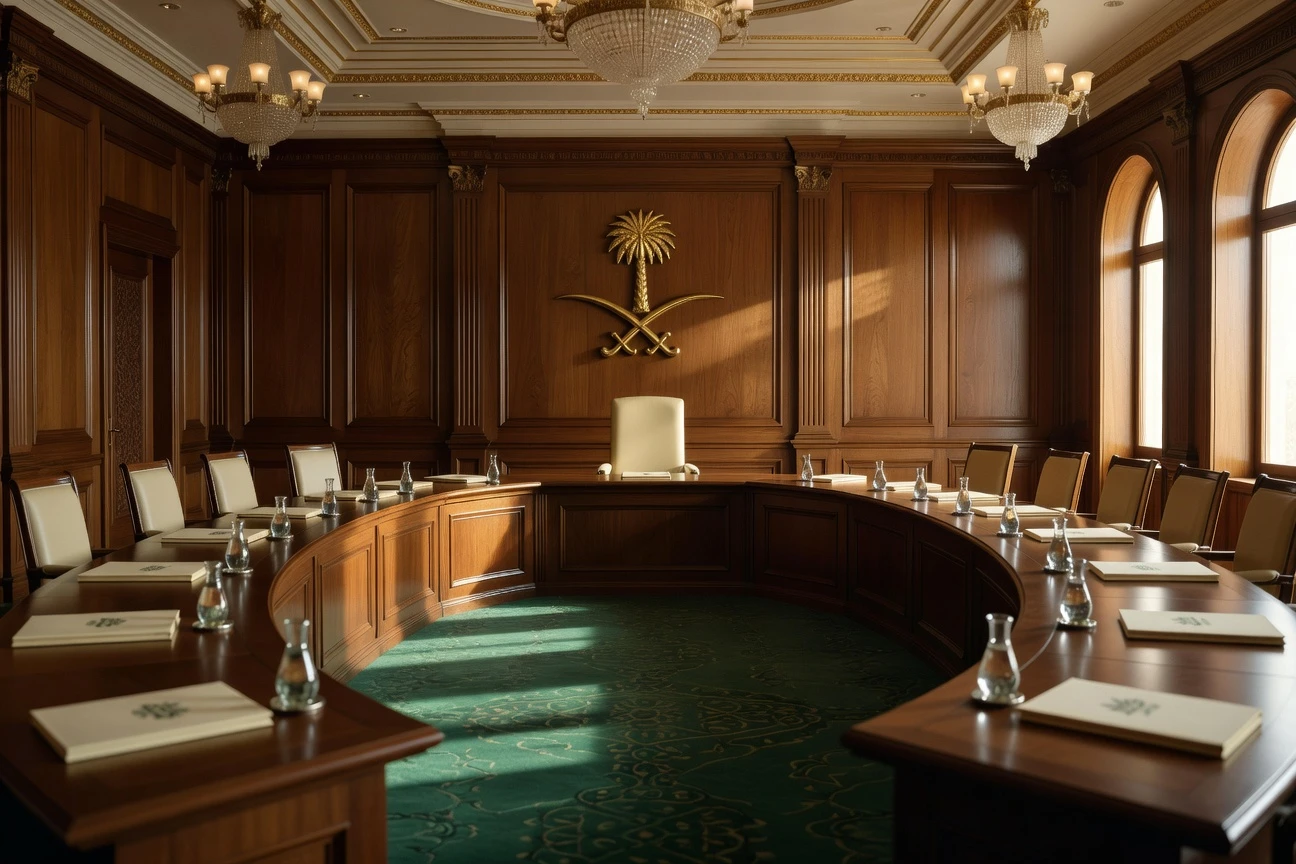
Saudi Arabia’s Council of Ministers pledged on Tuesday that the Kingdom will never hesitate to take all measures necessary to protect its security, preserve its stability, and ensure the safety of citizens and expatriates, language delivered after weeks of regional turbulence and an emergency Gulf Cooperation Council (GCC, the six-state Arab Gulf bloc) interior ministers’ meeting in Riyadh. The session, chaired by Custodian of the Two Holy Mosques King Salman in Jeddah, opened with praise for the armed forces and closed with the formal adoption of the GCC Railway framework, the creation of a new top-tier partnership council with Spain, and eight separate foreign-cooperation memoranda.
That longer docket reads as one of the most substantive economic-diplomacy sessions of the year. The Council endorsed executive regulations for the Law on the Protection of Whistleblowers, Witnesses, Experts and Victims, signed off on the completion of Riyadh Metro’s four iconic stations, and logged Hajj 2026 readiness data showing the Makkah Route Initiative now serving 1.2 million pilgrims across 10 source countries in its eighth year.
Jeddah Cabinet Frames a Security Pledge Against a Wider Backdrop
The security clause carried weight beyond a routine ritual. The Cabinet endorsed the outcomes of the emergency GCC interior ministers’ meeting in Riyadh, where ministers affirmed that Gulf security is indivisible and pressed for tighter coordination on current challenges. That language has carried operational meaning since February, when Iranian missile and drone strikes hit Saudi territory and Riyadh, alongside the United Arab Emirates, reportedly responded with covert strikes on Iranian soil during the late-March escalation.
Minister of Media Salman Al-Dossary said the Council praised the advanced capabilities of the armed forces in defending the homeland and safeguarding its assets and resources, per the Saudi Press Agency readout of the Cabinet session. In a Saudi Cabinet statement, that phrasing typically signals fresh procurement, fresh basing decisions, or fresh readiness signaling rather than a generic compliment.
The session also logged two phone calls from Crown Prince and Prime Minister Mohammed bin Salman to UAE President Sheikh Mohamed bin Zayed Al Nahyan and Emir of Qatar Sheikh Tamim bin Hamad Al Thani. The readout placed both conversations under “regional and international developments aimed at strengthening security and stability,” diplomatic shorthand for a triangulated Gulf posture that has tightened sharply since the spring flare-up. The inclusion of expatriates alongside citizens in the security pledge was a deliberate touch in a Kingdom whose foreign workforce numbers in the millions and whose pilgrimage operation depends on calibrated cross-border movement.
The Eight MoUs and the New Council With Spain
The Council’s longer list of authorizations sketches the shape of Saudi outbound cooperation for the second half of the year. Eight separate memoranda of understanding (MoUs, formal cooperation frameworks short of treaty status) were either signed, authorized for signature, or approved at Tuesday’s session, with counterparts spanning Asia, Africa, the Maghreb, the Gulf, and Europe.
| Counterpart | Subject | Saudi Lead Agency |
|---|---|---|
| Malaysia | Civil defense and civil protection | Ministry of Interior |
| Morocco | Museums cooperation | Museums Commission |
| Kuwait | Export development | Government of Saudi Arabia |
| Tunisia | Arabic-language cooperation | King Salman Global Academy for Arabic Language |
| Djibouti | Customs cooperation and mutual assistance | Zakat, Tax and Customs Authority |
| India | Customs cooperation and mutual assistance | Zakat, Tax and Customs Authority |
| Thailand | Legal and judicial cooperation | Ministry of Justice |
| Djibouti | Civil aviation cooperation | General Authority of Civil Aviation |
A separate cooperation agreement between the Saudi Authority for Intellectual Property and the World Intellectual Property Organization in Geneva targets improvements to business services in IP offices. The grouping says something about where Saudi outbound capital and engineering capacity is being aimed: South and Southeast Asian customs and civil cooperation, African and Maghreb cultural and infrastructure ties, Gulf neighbour trade, and one new top-tier European partnership.
The marquee item is the Saudi-Spanish Strategic Partnership Council, which the Cabinet described as an important step toward elevating bilateral relations and expanding cooperation horizons in economic and investment sectors through joint initiatives with tangible outcomes. Strategic Partnership Councils are Riyadh’s preferred high-tier diplomatic format, used previously with India, France, and the United Kingdom, and they typically carry annual ministerial follow-ups and a working-level mandate that survives shifts in headline focus.
Riyadh Metro Closes Its Four-Station Loop
The Cabinet logged the completion of operations at the main stations of the Riyadh Metro project, a domestic milestone dated to Friday’s opening of the Western Station, the fourth and largest of the network’s iconic hubs. The Royal Commission for Riyadh City confirmed full passenger operations from the Western Station on May 15, 2026.
The four iconic stations now operational:
- King Abdullah Financial District Metro Station, anchoring the financial-district interchange
- STC Al Olaya Metro Station, the central business corridor hub
- Qasr Al Hokm Metro Station, serving the historic city core
- Western Station, the 112,000 square metre LEED Gold flagship designed for 60,000 passengers per hour
The session readout treated the completion as an extension of the accelerating progress witnessed by the public transport ecosystem in the capital, framing language that connects the metro to Vision 2030’s modal-shift targets. The 22-station Orange Line alone stretches roughly 41 kilometres across western Riyadh, and the Royal Commission has already awarded an 8.4-kilometre Red Line extension that will add five further stations.
GCC Railway Framework Moves From Promise to Calendar
The session’s most consequential outbound infrastructure item arrived in a single line: Council approval to implement the decision of the 46th session of the GCC Supreme Council, held in Bahrain, with regard to adopting the general agreement for connecting the GCC states with the GCC Railway Project. That formal adoption converts a corridor that has been discussed in some form since the 2000s into a binding inter-state framework.
The Riyadh-to-Doha leg, separately greenlit in the same session, will run roughly 785 kilometres and is engineered for trains exceeding 300 kilometres per hour, putting the two Gulf capitals roughly two hours apart by rail. The framework agreement is the political instrument that pulls the rest of the corridor (Kuwait City, Manama, Abu Dhabi, Muscat) into a single coordinated procurement and signalling envelope.
For Saudi planners, the rail project sits inside the same Vision 2030 logistics envelope that already funds Riyadh Metro, the King Salman International Airport expansion, and the country’s port modernization push. The customs MoUs with India and Djibouti slot into the same trade-corridor logic, knitting Gulf rail capacity to Indian Ocean port traffic.
Doha’s side of the line carries its own significance. Three years after the lifting of the 2017 to 2021 Gulf blockade, formal rail integration is a measurable proof-of-life for GCC reconciliation, and the adoption arrived in the same week the Cabinet recorded the Crown Prince’s phone call to the Emir of Qatar.
Hajj 2026 Prep and the Makkah Route’s Eighth Year
The pilgrimage season opens within weeks, and the Cabinet used Tuesday’s session to log progress against the 2026 Pilgrim Experience Program. More than 860,000 pilgrims had already arrived in the Kingdom as of mid-May, with authorities preparing for an expected 1.5 million total for the season.
The operational pillar getting the most ministerial airtime was the Makkah Route Initiative, now running for an eighth consecutive year:
- 1.2 million pilgrims served since the program launched in 2017
- 10 participating countries, with Senegal and Brunei Darussalam joining for this season
- 17 international entry points covered by pre-clearance processing
- Eight straight years of continuous implementation under the Ministry of Interior
Travellers processed through the initiative complete immigration, visa, biometric, and baggage steps at their departure airport, then move from the landing gate in Jeddah or Madinah directly to coded accommodation by dedicated bus. The 2026 roster also includes Morocco, Indonesia, Malaysia, Pakistan, Bangladesh, Türkiye, Côte d’Ivoire, and the Maldives. The throughput is also a feeder for the Kingdom’s record airport passenger volumes, which crossed 140 million in 2025.
The Cabinet commended the Ministry of Interior and other agencies, with follow-up by the Supreme Hajj Committee, for the throughput. The framing matters because the pilgrimage is also the Kingdom’s largest annual security operation: the same armed forces and civil defense agencies praised in Tuesday’s national security clause are the agencies running the holy-sites perimeter through next month.
Whistleblower Regulations, Customs Authority, and 24 ISEF Awards
Three domestic items closed the docket. The Council approved executive regulations for the Law on the Protection of Whistleblowers, Witnesses, Experts and Victims, the implementing detail that converts the underlying statute into administrable procedure. The regulations slot into a broader transparency push that has also tightened anti-corruption and corporate disclosure rules across the past 18 months.
The Cabinet also endorsed an amendment to the organizational structure of the Kingdom’s water bottling plants framework and authorized the Minister of Finance, in his capacity as chairman of the Zakat, Tax and Customs Authority, to sign customs cooperation and mutual-assistance agreements with Djibouti and India.
On the recognition side, the Council commended Saudi students for winning 24 awards at the 76th Regeneron International Science and Engineering Fair (ISEF) 2026, held in Phoenix, Arizona, from May 9 to 15. The tally broke down to 12 grand awards (one first place, four second, five third, two fourth) plus 12 special awards, leaving the Kingdom in second place globally for a third consecutive year and lifting its cumulative ISEF total to 209 medals since 2007.
What Tuesday’s readout leaves on the table is a test arriving in days, not months. Hajj operations begin shortly, the rail framework now needs national-level procurement decisions across six capitals, and the Saudi-Spanish Council needs its first working ministerial. If those land cleanly through the summer, the session will read as the moment economic diplomacy lapped the security cycle. If they slip, the opening security clause will be the line that ages best.
