
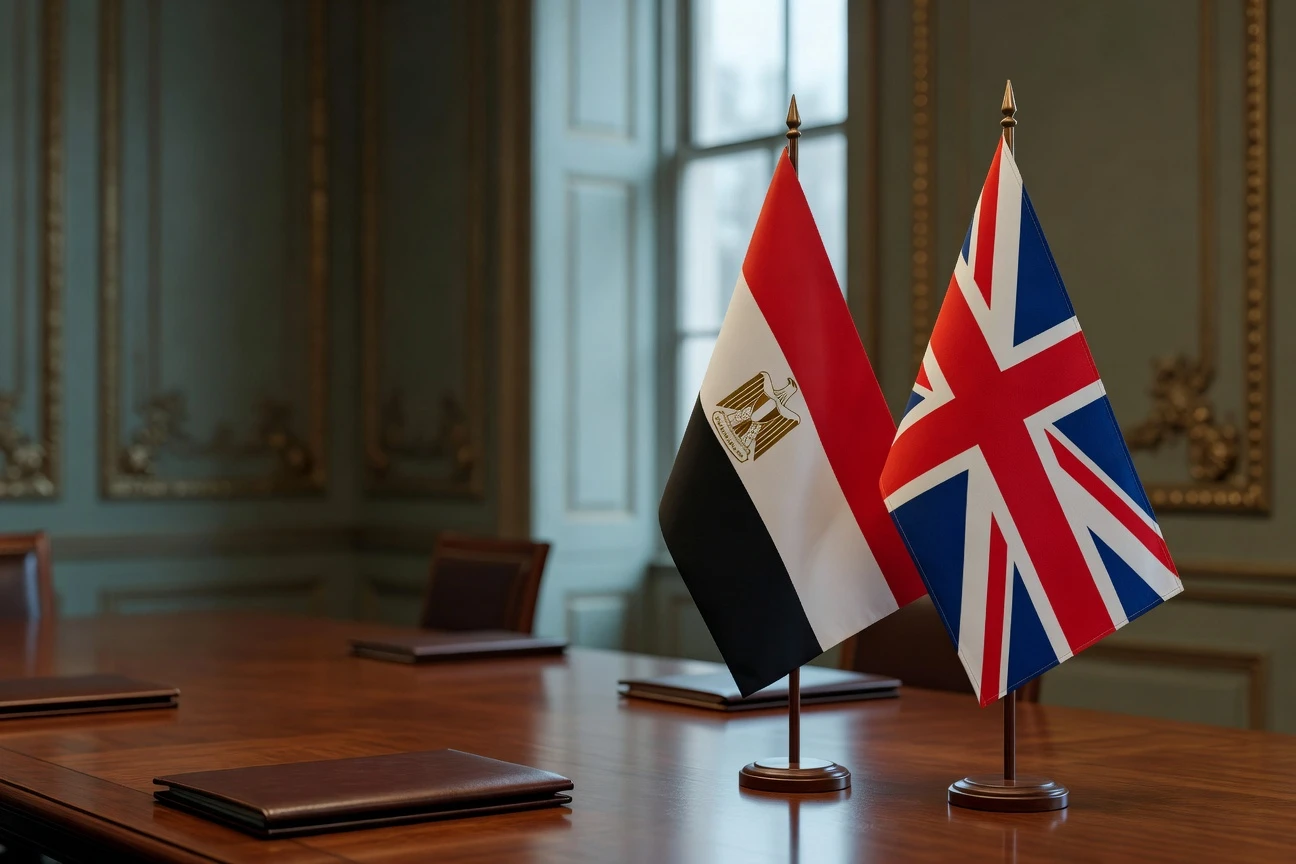
Egypt’s Foreign Minister Badr Abdelatty sat down with Britain’s Baroness Jenny Chapman, the UK Minister of State for International Development and Africa, in London on Tuesday, May 19, with two files open on the table: how to push more British capital into Africa through Cairo, and how to keep a Sudan ceasefire plan alive after the map it was drawn on has changed.
The meeting landed on the same day Chapman used a stage at Woolwich Works to call for a fundamental reset of UK development policy, framing aid as “a pragmatic investment in shared global stability” rather than charity. For Cairo, that reset is an opening. For Khartoum, where two armies are still trading territory months after Quartet mediators thought a truce was within reach, it is a reminder of how slowly diplomacy moves when the front line does not.
London Talks Land on Two Agendas, One Continent
Abdelatty’s London stop was scheduled around the Global Partnerships Conference, a two-day gathering co-hosted by the UK, South Africa, the Children’s Investment Fund Foundation, and British International Investment, the UK government’s development finance arm. The Chapman meeting sat inside that broader push, with Cairo represented as the partner most able to convert UK ambition into projects on African soil.
According to the readout from Egypt’s State Information Service, Abdelatty pressed Chapman on three threads: more British investment into Egypt off the back of the country’s recent structural reforms, joint Egypt-UK delivery of priority projects across Africa, and the diplomatic process around Sudan. Egypt’s diplomats have spent the past 18 months selling Cairo as the practical bridge between European capital and African demand, particularly in construction, energy, and water infrastructure.
The Sudan portion of the meeting tracked Cairo’s familiar position. Abdelatty briefed Chapman on Egypt’s work inside the four-state mediation grouping (the US, Saudi Arabia, the United Arab Emirates, and Egypt), arguing for a humanitarian truce as the gateway to a wider ceasefire and a political process “led and owned by the Sudanese people.” He reiterated Egypt’s rejection of any parallel governance arrangement that could fracture Sudanese state institutions, language aimed squarely at the political structures the Rapid Support Forces (RSF, the paramilitary group fighting the regular army) has been building in territory it controls.
Chapman’s Reset Sets the Backdrop
Hours before sitting with Abdelatty, Chapman opened the Global Partnerships Conference with a line her team had clearly workshopped for the headline cut.
Development is a pragmatic investment in shared global stability. It is not an optional moral luxury. Doing more of the same will not cut it.
Chapman, the UK Minister of State for International Development and Africa, was speaking to a room that included Rwandan, South African, and Egyptian officials, plus the senior leadership of British International Investment. Her core figure, that 28 African countries now spend more on debt servicing than on healthcare, sits underneath a wider $1.3 trillion annual financing gap the African continent faces to meet the United Nations Sustainable Development Goals.
For a UK government that has been quietly pulling back its overseas aid envelope, the reset is partly rhetorical cover and partly genuine strategy: less grant aid, more blended finance routed through partners with execution capacity on the ground. That is precisely the role Cairo is auditioning for. Egyptian state contractors have built and operated infrastructure in Tanzania, Uganda, and the Democratic Republic of Congo over the last decade, and the foreign ministry has been explicit that UK Export Finance backing for Egyptian contractors in third markets is one of its desired deliverables.
The Africa-into-Egypt-into-Africa play has been visible elsewhere too. Cairo’s recent Egyptian African Economic Conference pitched the same architecture to a wider audience, and Abdelatty’s BRICS-window trade-and-investment push with India in New Delhi used a comparable script.
The Quartet’s Plan Versus the Map It Was Drawn For
The Quartet framework Abdelatty briefed Chapman on was designed around a Sudan that no longer fully exists. The detailed initiative US presidential adviser Massad Boulos announced in February proposed a three-month humanitarian truce, followed by a comprehensive ceasefire, then a transition led by Sudanese civilians. Sudan’s government formally rejected the roadmap on February 24 in remarks delivered before the UN Security Council. The RSF, in contrast, signalled conditional acceptance.
What the Plan Asks For
The text the Quartet circulated leans on three pillars: a verifiable cessation of hostilities, unhindered humanitarian access, and a structured political track that excludes the RSF from a future security architecture while preserving Sudanese institutional continuity. Egypt’s contribution has been heaviest on the third pillar, where Cairo’s red lines about state cohesion mirror the army’s.
What the Map Now Says
The fall of El Fasher, the last major Darfur city under army control, on October 27 reshaped what “facts on the ground” means. Roughly 62,000 people fled the city in the four days that followed. The UN Security Council convened an emergency session on October 30. Reports of mass killings, ethnically targeted violence, and the killing of around 500 people at the Saudi Maternity Hospital have been documented by multiple humanitarian agencies. Famine has been declared in El Fasher and in Kadugli, in South Kordofan, with a further 20 areas across Darfur and Kordofan rated at risk.
| Quartet Plan Assumption | Situation on the Ground, May 2026 |
|---|---|
| Army holds enough territory to negotiate from strength | RSF controls most of Darfur and Kordofan, including El Fasher |
| Humanitarian truce as first confidence step | Two declared famines; cholera deaths above 3,000 |
| Parallel governance is hypothetical risk | RSF building administrative structures in held territory |
| Both sides accept mediation | Army rejects roadmap; RSF conditionally accepts |
That mismatch is why Egypt’s diplomatic energy has shifted toward humanitarian corridors and aid access, the one element of the plan still operative without a battlefield reset.
Cairo’s Red Lines, Drawn Again
Abdelatty’s pitch in London repeated language he has used in every Sudan-track meeting since the war’s third anniversary in April. Egypt’s position, condensed:
- Sudanese sovereignty and territorial integrity remain non-negotiable for Cairo, and no border change or breakaway entity will be recognised.
- The Sudanese Armed Forces, whatever their conduct, are the constitutional institution of the state and must be part of any political settlement.
- The RSF cannot be granted political legitimacy as a parallel governing authority in any territory it holds.
- Humanitarian truce comes before, not after, a comprehensive ceasefire, and aid corridors should not be contingent on military progress.
- External actors arming or financing either side should be named and pressured, a point Cairo has not put publicly but has raised in private channels.
What is new is the audience. Britain, post-reset, is positioning itself as a humanitarian financier rather than a security broker, and Chapman’s portfolio gives her authority on aid envelopes rather than military pressure. For Egypt, that division of labour is workable: London can underwrite humanitarian access while Cairo, Riyadh, Abu Dhabi, and Washington hold the political file.
The Africa Trade Lane Behind the Diplomacy
Sudan was the headline item, but the Egypt-UK trade architecture was the file that carried the longer-term stakes. Abdelatty pressed for a sharper push on three commercial threads: UK Export Finance cover for Egyptian construction firms bidding into African tenders, green-transition co-financing, and an expansion of British International Investment’s pipeline into the Egyptian private sector.
The frame has analytical heft behind it. Cairo’s African Development Bank dialogue, the UK’s recent capital-mobilisation memorandum of understanding with the African Development Bank, and the Global Partnerships Conference all converge on the same thesis: that scaling private capital into African infrastructure requires intermediary economies with the contracting depth, the political relationships, and the logistical reach to deliver. Egypt is one of three or four candidates for that role, alongside South Africa, Morocco, and Kenya.
Where this gets uncomfortable for Cairo is its own debt math. Egypt’s external debt sat above $155 billion at the most recent central bank disclosure, and the country is mid-way through an International Monetary Fund support programme. The pitch to London is partly that Egyptian contractors can deploy British capital efficiently in third markets, and partly that the same British capital, deployed inside Egypt, helps stabilise a country whose macro picture remains delicate.
Chapman’s reset language reads as receptive on the first leg of that pitch, and noncommittal on the second. The UK Treasury has not signalled appetite for direct sovereign exposure to Egypt outside existing UK Export Finance facilities.
Where the Next Pressure Falls
The London meeting did not produce a communique, a financial package, or a calendar of follow-up. It produced alignment of language, which in diplomatic terms is the precondition for the rest.
Two test points sit in the near distance. The UN General Assembly opening in September will be the next moment the Quartet formally reports to the international community on Sudan progress, and the gap between the February roadmap text and the November battlefield map will need to be reconciled in public. Before that, the African Development Bank’s annual meetings, set for late May, will signal how seriously the UK-AfDB capital mobilisation track is being financed.
If the AfDB meetings produce a real envelope and the UN General Assembly produces a Sudan text with humanitarian-corridor teeth, Cairo’s pitch in London will have converted. If the AfDB meetings remain rhetorical and the army-RSF stalemate hardens into partition by autumn, the Egypt-UK file shifts from development cooperation to crisis management, and the Quartet framework Abdelatty defended on Tuesday becomes a document about a Sudan that already broke.
