Scientists in Poland have unlocked long-buried secrets of a mummified Egyptian boy using cutting-edge scanning methods. New research reveals the boy’s identity, age and possible origins in Egypt’s ancient world, offering a fresh window into life from more than two thousand years ago. Inside his wrappings, researchers also discovered what may be a papyrus document that could hold his name. The breakthrough comes after decades of mystery around the child’s past and how he came to rest far from his homeland.
Breakthrough Scanning Sheds New Light on Ancient Mummy
For more than a century, a mummified Egyptian child lay in a diocesan museum collection in what is now Wrocław, Poland, largely untouched by scientific inquiry. It was first brought to the city in 1914 by then‑bishop Adolf Bertram as part of a wider collection of antiquities. After World War Two, the city became Polish and museum records were largely lost, leaving the origins of the mummy shrouded in uncertainty.
In 2023, Bishop Józef Kupny commissioned a team from the University of Wrocław to investigate the child’s remains using modern scientific tools. The results were published in an academic paper and reveal remarkable details about the boy who lived during Egypt’s Ptolemaic period from the fourth to first century BCE.
Radiologists and archaeologists employed high‑resolution scans at a hospital in Lublin to peer beneath centuries of aged linens and cartonnage. The scans confirmed the mummy is of a young boy who died at about eight years of age, giving researchers one of the clearest biological profiles of a child from antiquity.
Origins and Physical Details Unearthed by Modern Science
The child’s mummy, including its wrappings and funerary mask material, stands about 123 centimeters tall. Scanning showed that much of the original bandaging around the face had worn away, making his features visible beneath a layer of brownish‑black embalming substances.
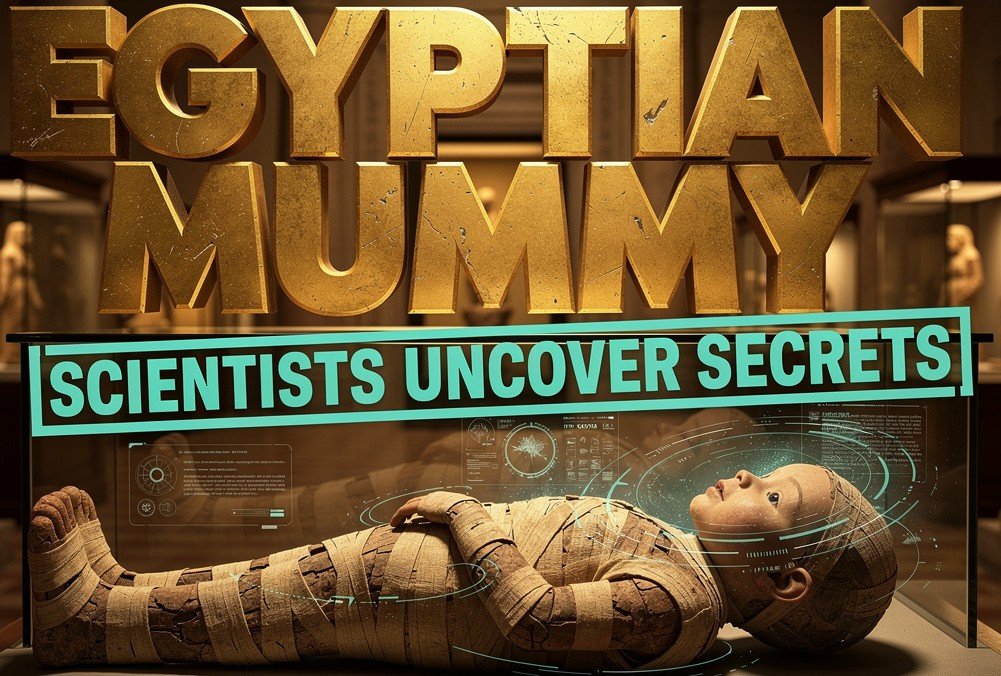
Analysis of the cartonnage and stylistic elements suggests the boy likely originated from the southern region of Upper Egypt, possibly around the necropolises near Kom Ombo or Aswan. These areas were active cultural centers in the Ptolemaic age, which blended Egyptian traditions with Hellenistic influences following Alexander the Great’s conquests.
At the heart of this discovery is an intriguing object identified on the child’s chest during scanning. Researchers believe it might be a piece of papyrus that could contain his name or other personal details. The find has set off excitement across archaeological and Egyptological circles. However, scientists caution that further delicate work is required to confirm the nature of the object without damaging the fragile papyrus or surrounding material.
Challenges and Methods Behind the Research
Studying ancient mummies often poses challenges, especially when records are incomplete or damaged. In this case, many of the museum’s original accession documents were lost during wartime upheaval, leaving researchers with few written clues about how or when the mummy arrived in Europe. The team therefore relied heavily on scientific analysis rather than archival records to piece together the boy’s story.
The use of radiological imaging in this project is part of a broader trend in archaeology, where non‑invasive methods are replacing older techniques that often damaged priceless remains. Advanced radiography and CT scanning allow researchers to study internal structures like bone development, tissue remnants and foreign objects embedded within wrappings without unwrapping or physically disturbing the mummy.
Experts around the world have used similar approaches to study other preserved bodies, including high‑profile cases like pharaohs and other Egyptian elites. These modern tools bring us closer to understanding ancient life without risking the integrity of the artefacts.
What This Means for Egyptology and Public Museums
The discovery has implications far beyond this single mummy. It shows how scientific collaboration can breathe new life into historical collections, especially those with incomplete provenance. For museums worldwide, this case highlights the value of revisiting old collections with fresh tools and perspectives.
For Egyptologists, knowing that the child came from Upper Egypt during the Ptolemaic period opens new avenues for research into how children were mummified and treated in death, and how cultural practices spread across regions under Greek and later Roman influence. Findings like the papyrus could reshape understanding of personal naming or funerary texts among children in ancient Egypt.
The fact that a child’s remains traveled from an Egyptian necropolis to a museum in Central Europe highlights the complex global history of archaeological artefacts. It also raises ethical and scholarly questions about how such objects are studied, preserved and interpreted in a modern context where cultural heritage is increasingly shared across borders.
Polish scientists are now planning further work on the mummy, including refining methods to safely remove and analyze the papyrus fragment, which may finally reveal the boy’s name. Their work reinforces how modern science can shine a light on lives from thousands of years ago.
As research continues, this unmoved child from the sands of ancient Egypt reminds us of the deep and ongoing human quest to understand the past and our enduring connections across time and place.