
FIFA has quietly stripped Michelob ULTRA branding from its 2026 World Cup Player of the Match award when the recipient is Muslim, swapping the beer sponsor’s logo for neutral FIFA World Cup branding on the presentation backdrop. A spokesperson told SPORTbible the unbranded trophy and backdrop are ‘available upon request by the selected player’ for religious considerations. The accommodation first surfaced publicly after Morocco forward Ismael Saibari won the award for scoring the tournament’s fastest goal to that point, against Scotland.
It is the most systematic application of a rule FIFA put on paper before Qatar 2022, after Egypt goalkeeper Mohamed El-Shenawy declined the same prize at the 2018 World Cup because of its Budweiser sponsorship. Football’s commercial machinery has been bending around the same objection for more than a decade, beginning with the Premier League’s phase-out of its champagne man-of-the-match bottle.
What Changed on the 2026 Podium
The 2026 adjustment is small but visible from the stands. Where the backdrop ordinarily carries the Michelob ULTRA logo, the neutral version displays only the words Superior Player of the Match alongside the FIFA World Cup emblem. The trophy is presented without the beer company’s mark. FIFA has used the neutral version for at least eight Muslim recipients, with Saibari winning the award after scoring the tournament’s fastest goal against Scotland.
- 104 Player of the Match awards handed out across the 48-team tournament
- 36 Player of the Match awards presented as of June 21
- 8 Muslim players confirmed to have received the unbranded version
Per SPORTbible’s tally, the eight players confirmed to have received the unbranded presentation are Ismael Koné of Canada, Qatar goalkeeper Mahmoud Abunada, Ivory Coast’s Yan Diomande, Iran’s Ramin Rezaeian, Egypt’s Emam Ashour, Jordan’s Ali Olwan, Saibari, and Switzerland’s Johan Manzambi. Stadium Astro’s separate reporting also identified Mohamed Salah and Achraf Hakimi as recipients. The adjustment was introduced without any formal FIFA statement.
The award itself is unchanged in name. After each match, fans vote online for the standout player, and AB InBev, the brewing group that owns Michelob ULTRA, presents the trophy. Winners so far include Lionel Messi, Erling Haaland, Harry Kane, Michael Olise and the United States’ Folarin Balogun, who has two. The unbranded version is one optional branch inside the same machinery.
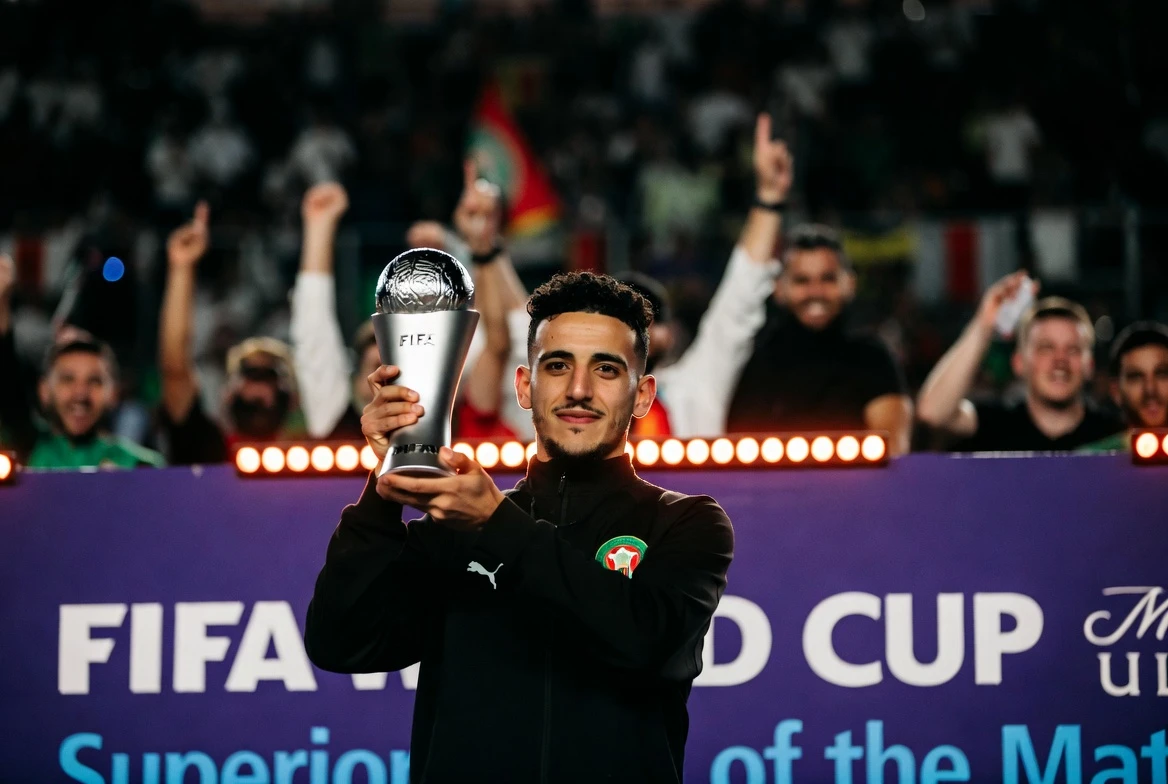
Why FIFA Calls It Available on Request
FIFA has framed the change as a request-based option rather than a fixed rule. A FIFA spokesperson laid out the mechanism in three sentences for SPORTbible. FIFA has not elaborated on which party raises the request, how it is logged, or how it is communicated to the trophy presenter on the night.
AB InBev presents the Superior Player of the Match trophy to a standout player after every FIFA World Cup 2026 match, as determined by a fan vote. To respect religious considerations, a non-branded award and backdrop are available upon request by the selected player. The same non-branded elements are applied when the player is under legal drinking age.
A FIFA spokesperson provided the statement to SPORTbible.
The request is the trigger, not an automatic exemption for any Muslim player. In practice, the option appears to be activated routinely by or for those named on the unbranded list. The quiet character of the change is itself the design. Coverage in Muslim-majority outlets has framed the move as a small but meaningful gesture. Michelob ULTRA remains the award’s headline sponsor and brand identity, while a non-branded award is on standby for any winner who asks.
El-Shenawy, the 2018 Refusal That Started the Pattern
The 2026 accommodation has a clear origin. At the 2018 World Cup in Russia, Egypt goalkeeper Mohamed El-Shenawy was named Player of the Match after a standout performance in a losing effort against Uruguay. When the trophy was brought to him on the pitch, he declined to accept it because of its Budweiser sponsorship. The beer brand was the prize’s official sponsor at the time. A photograph of El-Shenawy appearing to raise his hand in refusal circulated widely online.
El-Shenawy is Muslim, and the consumption and promotion of alcohol are forbidden in Islam. Egypt team director Ihab Leheta confirmed to the Associated Press that the goalkeeper did not accept the trophy. The image became the clearest single flashpoint in a tension that had been simmering across football for years.
The El-Shenawy moment did not, on its own, trigger a formal FIFA policy change. What it did was broadcast the conflict at the scale of a World Cup. The same tournament, run with Budweiser branding, also produced social-media moments of Muslim players, journalists and viewers noting the contradiction between a global sport and its alcohol sponsors. The 2026 system handles that contradiction at the trophy presentation itself.
Qatar 2022, the Year Players Turned the Trophy
By the next World Cup in Qatar in 2022, FIFA had already folded the accommodation into its rule book. The handbook reads, per the FIFA rule book clause on religious accommodations: ‘Alternative, culturally appropriate, arrangements have and will continue to be made for players with bone fide objections on religious grounds.’ A spokesperson for AB InBev, which brews Budweiser, pointed to that clause when asked about the workaround: the same trophy without the Budweiser logo, and Budweiser removed from the backdrop.
At Qatar 2022, France’s Kylian Mbappé handled the question himself. He posed facing backwards with the trophy in three of France’s four matches so the Budweiser logo would not be visible in photographs. Mbappé, then 23, had already been careful about what brands he was seen promoting, in a dispute with the French Football Federation earlier that year over image rights. Other Muslim players followed the same workaround. Photographs circulated of Cameroon’s Vincent Aboubakar, Tunisia’s Wahbi Khazri, and Morocco goalkeeper Yassine Bounou turning the trophy around.
- 2018 World Cup in Russia: El-Shenawy declines the Player of the Match trophy because of its Budweiser sponsorship
- 2022 World Cup in Qatar: FIFA’s rule book contains the ‘bone fide objections on religious grounds’ clause; Mbappé, Aboubakar, Khazri, and Bounou rotate the trophy to hide the Budweiser logo
- 2026 World Cup in North America: Michelob ULTRA takes over as sponsor; neutral backdrop and unbranded trophy available on request for Muslim players
The 2022 workaround was player-driven, ad-hoc, and visible. Players rotated the trophy themselves to keep the sponsor’s logo out of frame, generating its own quiet media cycle. The 2026 approach shifts the workaround one level up, into the trophy itself, with the backdrop and the award both arriving without the beer brand.
The Qatar tournament also produced the most open commercial collision between FIFA and its beer sponsor of recent years. Days before the opening match, FIFA banned the sale of Budweiser inside stadium grounds, citing local conditions in Qatar. The ban cut the value of a sponsorship arrangement that had already drawn criticism from human-rights groups. AB InBev retained the Player of the Match prize through the tournament and into 2026, where Michelob ULTRA, another of its brands, is now the official sponsor. The accommodation rule from 2022 stayed on the books and migrated into the new sponsor’s presentation.
The Premier League Wrote the Original Template
FIFA is the latest body to apply a workaround English football codified more than a decade ago. Until the early 2010s, the Premier League’s man-of-the-match prize was a bottle of champagne. Manchester City’s Yaya Touré, then among the league’s biggest stars, politely refused to accept the bottle on religious grounds during a televised interview. The league phased out champagne from the prize and replaced it with a small trophy for every player, per the Premier League phase-out of the champagne bottle.
The accommodation carried into trophy celebrations across the English game. When it comes to raising a glass, non-alcoholic champagne is now the default. The shift has been mirrored inside clubs, with Muslim players taking part in fasting during Ramadan even on match days and clubs arranging training and meals around the calendar.
The Premier League’s Muslim population has grown from one known player in 1992, the Spanish midfielder Nayim at Tottenham, to roughly 40 Muslim players across the modern squad list. The cultural pressure that produced the champagne phase-out is now a baseline. Newcastle’s Demba Ba and Papiss Cissé, both devout Muslims, marked goals with a knees-to-the-ground prayer celebration in the same era, including during a 2012 match against Aston Villa. The same decade also surfaced an unresolved tension between gambling-shirt sponsors and observant Muslim players, which the league has yet to resolve the same way.
- Premier League award: Champagne man-of-the-match bottle phased out, small trophy now standard for every player
- Trophy celebrations: Non-alcoholic champagne used as the default in English trophy lifts
- Changing rooms: Liverpool’s squad moved a Muslim team doctor’s kit before alcohol sprays at the 2012 League Cup final
- Match-day rituals: Clubs adjust meals and training around Ramadan even on match days
Why the Beer Sponsor Stays Put
FIFA’s 2026 design keeps the headline sponsor intact. The neutral backdrop and unbranded trophy are a fork inside the same arrangement, not a replacement of it. Michelob ULTRA’s name still appears on the trophy during the majority of presentations and across FIFA’s social-media posts. The same brand-protection logic runs across the tournament: players with Beats headphones have taped up the logo before matches, and stadium naming-rights brands that are not FIFA sponsors have had to cover their signage.
Commercial value drives the choice. Beer-and-sport pairings are among the deepest sponsorship categories in global football, and FIFA’s contract with AB InBev runs through this tournament. A request-based workaround costs the federation little while keeping both the partner and the player base intact. FIFA has built the same flexible structure into other corners of the 2026 commercial stack, including PIF’s 2026 World Cup Official Tournament Supporter deal with Saudi Arabia’s sovereign wealth fund. The accommodation for Muslim players is one branch of that calibration, and the alcohol sponsor keeps the rest.
Frequently Asked Questions
Why did FIFA remove the Michelob ULTRA logo from the Player of the Match award?
A FIFA spokesperson told SPORTbible that a non-branded award and backdrop are ‘available upon request by the selected player’ to respect religious considerations. Islam prohibits the consumption and promotion of alcohol, and many Muslim players maintain distance from the brand on faith grounds.
Which Muslim players received the unbranded version at the 2026 World Cup?
SPORTbible identified eight recipients: Ismael Koné of Canada, Qatar goalkeeper Mahmoud Abunada, Ivory Coast’s Yan Diomande, Iran’s Ramin Rezaeian, Egypt’s Emam Ashour, Jordan’s Ali Olwan, Morocco’s Ismael Saibari, and Switzerland’s Johan Manzambi. Stadium Astro’s separate reporting also named Mohamed Salah and Achraf Hakimi.
What happened with Mohamed El-Shenawy at the 2018 World Cup?
After Egypt lost to Uruguay, El-Shenawy was named Player of the Match but declined to accept the trophy because it was sponsored by Budweiser. Egypt team director Ihab Leheta confirmed the refusal to the Associated Press, and the image of his raised hand circulated widely online at the time.
How did Qatar 2022 handle the alcohol sponsor?
FIFA’s rule book for the 2022 tournament included the clause: ‘Alternative, culturally appropriate, arrangements have and will continue to be made for players with bone fide objections on religious grounds.’ Kylian Mbappé posed backwards with the trophy in three of France’s four matches so the Budweiser logo would not show.
What did the Premier League change about its champagne award?
The league phased out champagne from the man-of-the-match prize after Yaya Touré and other Muslim players refused it on religious grounds. All players now receive a small trophy instead, and non-alcoholic champagne is the default in English trophy celebrations.
Is Michelob ULTRA still the Player of the Match sponsor at the 2026 World Cup?
Yes. AB InBev, the brewing group behind Michelob ULTRA, presents the trophy at every match of the 2026 tournament. The unbranded version is an option within the same sponsorship, not a replacement of it.
