
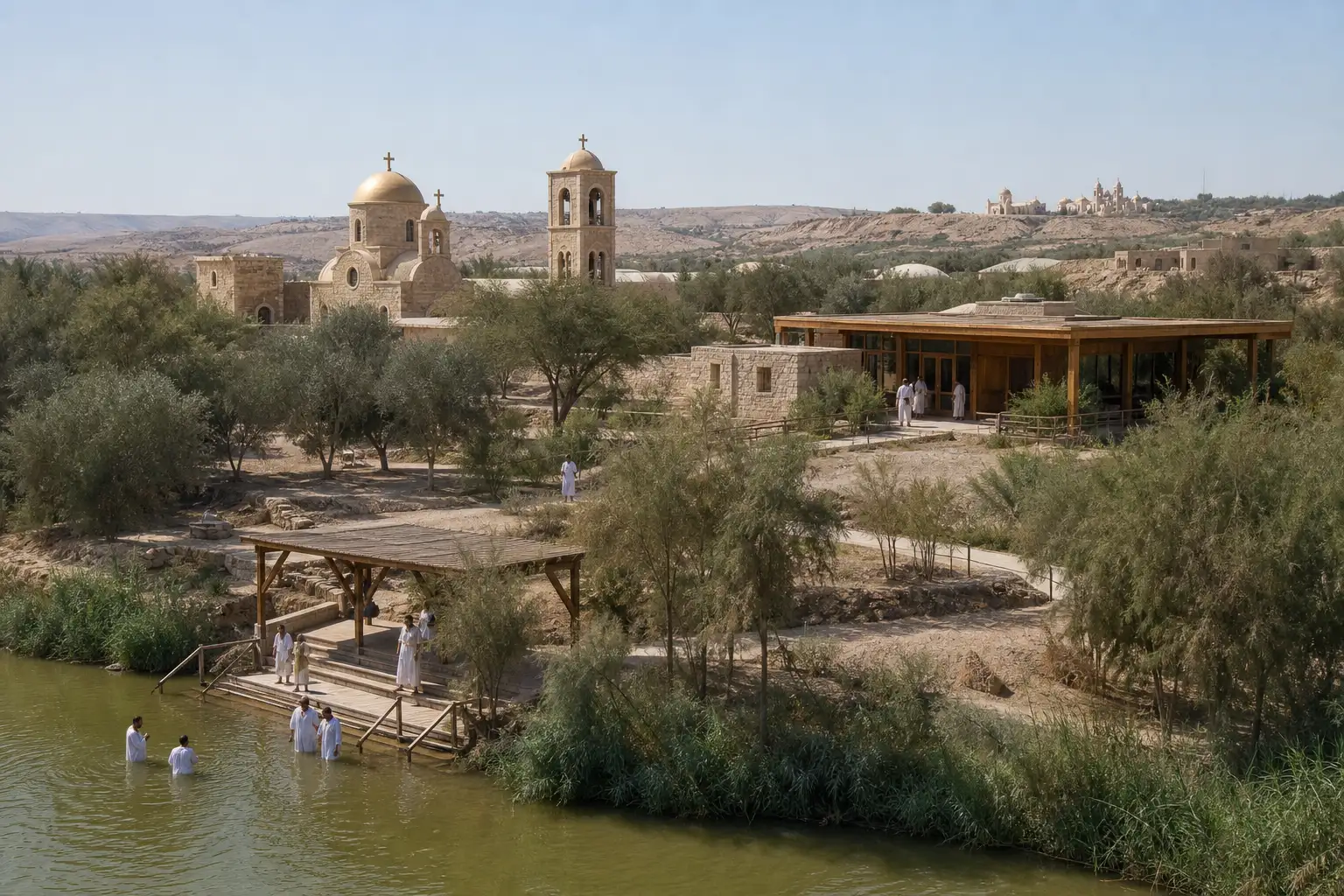
Jordan signed roughly $120 million in agreements in mid-August 2026 for four projects on 1,400 dunams beside the Baptism Site of Jesus Christ, locking in a museum, pilgrims village, roads and a green corridor ahead of the 2030 bimillenary. The packages sit under a new high-level national committee chaired by Prime Minister Jafar Hassan and backed by King Abdullah II and the Council of Church Leaders.
Officials and church figures describe the work as more than a one-year party. They frame it as permanent capacity that can shift the east bank of the Jordan River from a secondary stop into a sustained pilgrimage circuit.
The package is deliberately timed. Construction aims to finish in early 2029 so the site has a full year to settle before peak commemorative demand. The governance model is equally deliberate: one committee holds sole reference authority, and every ministry must route work through it.
Four Projects, One 1,400-Dunam Package
Agreements were signed at the Prime Ministry after the committee’s first meeting. The package covers land adjacent to the UNESCO-listed Al-Maghtas site, not inside the core protected archaeological zone.
| Project | Estimated Cost | Key Features |
|---|---|---|
| Jesus Christ Baptism Museum | $50 million | 5,500 m² cultural narrative space |
| Pilgrims and Visitors Village | ~$40 million | plazas, visitor center, modest hotel, restaurants, shops, church, services |
| Infrastructure works | $27 million | roads, water, desalination, irrigation, electricity, solar, lighting |
| Green Corridor | $3 million | biodiversity, vegetation, walking trails (RSCN design) |
The cost split shows where planners put the weight. The museum and village together account for most of the $120 million. Infrastructure and the green corridor supply the supporting frame: water, power, access and a landscape that still reads as wilderness.
Preliminary works on the museum and village are slated to start at the end of the first quarter of 2027. Main construction follows at the end of the second quarter. Both target completion in the first quarter of 2029, leaving roughly a year of buffer before 2030 peak demand.
- February 2026: an international design competition selects the multi-disciplinary team led by Níall McLaughlin Architects.
- Mid-August 2026: agreements for the four projects are signed after the committee’s first meeting.
- End of first quarter 2027: preliminary works on the museum and village begin.
- End of second quarter 2027: main construction follows.
- First quarter 2029: both projects target completion, with roughly a year of buffer before 2030.
Tharwat Al-Masalha, chairman of the Board of Trustees of the Baptism Site Development Corporation, told Christian Daily International that village funding has been secured from Abu Dhabi and that the Church of Jesus Christ of Latter-day Saints has agreed to cover 50 percent of the museum cost. An international design competition selected the multi-disciplinary team led by Níall McLaughlin Architects in February 2026; the winning scheme still faces UNESCO impact review.
That funding mix matters for delivery risk. Half the museum bill and the village backing sit with identified external partners rather than an open pledge. The remaining exposure is the infrastructure tranche and the share of museum cost not covered by the Latter-day Saints commitment, plus whatever conditions the UNESCO review attaches to the winning scheme.
The Committee That Now Runs Everything
Prime Minister Hassan directed all government entities to route communications and tasks through the high-level national committee. It is the sole reference authority for the anniversary.
- Set general directives and policies
- Oversee planning and preparation of celebrations
- Approve strategic plans and monitor implementation
- Coordinate with local churches and international partners
Membership mixes ministers, religious and community leaders, and private-sector figures. Tourism Minister Emad Hijazeen stressed that four years is short for infrastructure plus a full visitor journey from pre-arrival booking to on-site prayer spaces and digital information. The plan also ties surrounding local communities into the tourism product so the build generates jobs rather than just day-trip traffic.
Archbishop Christoforos Atallah, president of the Council of Church Leaders in Jordan, said the initiative originated in Jordan and received the king’s direct support. He called the 2030 date a milestone for placing the kingdom more firmly on the global Christian pilgrimage map while insisting the spiritual core must stay central.
The committee structure is meant to stop the usual scatter of ministries working on parallel clocks. One channel sets policy, signs off plans and holds partners to the same calendar. For a project that mixes roads, worship space, hotel beds and a heritage review, that single funnel is the practical safeguard against drift.
Wilderness Rules Still Bind the Build
The Baptism Site “Bethany Beyond the Jordan” (Al-Maghtas) carries a UNESCO World Heritage listing and integrity rules that treat the place as wilderness. A construction moratorium covers the property itself. New structures in the buffer zone require heritage impact assessments. Visitor access funnels through a single gate and marked paths so the green Zor along the river keeps its character.
Father Rif’at Bader, director general of the Catholic Studies and Media Center, said the planned hotels will stay modest, not high-rise or luxurious, so pilgrims can remain near the churches without overpowering the setting. Existing churches, including the Grand Latin Church opened in early 2025, already complete much of the religious landscape. The new village and museum add reception, overnight stays and interpretation.
Jordan is part of the Holy Land, it has exceptional beauty not only because it is the site of a basic event, namely the Baptism of Jesus Christ on the banks of the Jordan River, but also because other events recounted in the Gospel took place on this land.
Andrea Tornielli, editorial director of the Vatican’s Dicastery for Communication, made that point as Vatican media, including L’Osservatore Romano, covered the committee launch in multiple languages. Bader used the attention to press for early promotion: churches, dioceses and pilgrimage organizers must hear the Jordanian narrative now if the ambition of millions is to become reality.
The design brief and the heritage rules pull in the same direction. Modest height, marked paths, a single gate and a green corridor drawn by the RSCN all serve one test: whether larger groups can arrive without turning the riverbank into a conventional resort strip. The Grand Latin Church already anchors the worship side; the village and museum are meant to handle arrival, overnight stay and explanation without rewriting that balance.
From One River Spot to a Full Christian Circuit
Archbishop Atallah and Minister Hijazeen both reject a single-site focus. The pilgrim itinerary is meant to run through Madaba, Mount Nebo, Machaerus, Tell Mar Elias and onward to Petra, Ajloun, Um Qais and other places of religious and historical value. The goal is an integrated destination that tells the story of Christianity in Jordan rather than a quick stop at the river.
- Madaba and Mount Nebo on the mosaic and Moses arc
- Machaerus and Tell Mar Elias on the prophetic and early-church arc
- Petra, Ajloun and Um Qais as extended historical and landscape stops
- Local villages tied into services, guides and small business around each node
That wider framing matches long-standing efforts to market Jordan’s wider sacred trail from river to Nebo and the Dead Sea. Local development sits inside the same logic: link villages around the sites to the visitor economy so the anniversary leaves lasting employment and small-business gains.
A circuit also changes the economics of a visit. A single river stop favors day trips and low spend. A multi-day path through Madaba, Nebo and the north creates room for guides, meals, transport and beds in more than one governorate. That is the employment argument behind the village as well as the museum.
What the Numbers Say
Current annual visitors to the Baptism Site have hovered near or above 200,000 in recent recovery years after earlier figures around 81,000 in 2016. The west bank of the river and sites such as Yardenit have historically drawn larger volumes. The new museum alone carries a design-period projection of 400,000 to 450,000 visitors a year based on growth trends.
| Measure | Figure |
|---|---|
| Annual visitors in 2016 | around 81,000 |
| Recent recovery years | near or above 200,000 |
| Museum design-period projection | 400,000 to 450,000 a year |
| 2030 commemorative language | millions of pilgrims (peak-event claim) |
Father Bader and others now speak of millions of pilgrims in 2030 itself. That figure is a peak-event claim, not a new permanent baseline. Reaching and then holding elevated numbers after the anniversary will depend on marketing to Western churches, air links (Royal Jordanian already serves multiple U.S. cities), and the quality of the overnight and spiritual experience. The museum design competition and annual visitor target make the lower permanent target explicit; the millions language is the stretch goal for the commemorative year.
Regional tourism still carries the scars of recent conflicts. Officials treat the 2030 window as a reset opportunity that also showcases Muslim-Christian coexistence, a message King Abdullah has repeated in earlier interviews about protecting the Christian presence in the region.
Read side by side, the figures describe a ladder rather than a leap. Moving from roughly 81,000 to above 200,000 was the recovery step. The museum projection roughly doubles that recovered base. The millions language applies to one commemorative year and still needs churches abroad, air seats and a finished overnight product to have any chance of landing.
Israel Is Preparing Too
Israel’s Foreign Ministry has formed its own working group for the same 2030 bimillenary, led by a special envoy to the Christian world and aimed at dialogue with churches and facilitation of pilgrim access across the Holy Land. High-engagement posts on the announcement framed it as preparation for millions of visitors. The parallel effort turns the anniversary into a quiet contest over which side of the river, and which national narrative, captures the bulk of long-haul Christian traffic.
Jordanian voices, including Senator Michael Nazzal, push the archaeological and traditional case for the east bank as the authentic location, citing church construction, Vatican and Orthodox recognition, and early Christian history. The practical effect of the $120 million package is capacity and services that make the Jordanian side easier to visit for multi-day stays rather than a short river stop.
Narrative and capacity will travel together. Recognition arguments matter to pilgrimage organizers who care about authenticity. Beds, roads, interpretation and a coherent circuit matter to the same organizers when they choose where groups sleep and how many nights they book. Jordan’s package is built to answer the second test while its officials and church leaders keep pressing the first.
Partners and Voices Behind the Push
The anniversary effort is not a single-ministry file. Village funding from Abu Dhabi, a half-share of museum cost from the Church of Jesus Christ of Latter-day Saints, design leadership from the Níall McLaughlin team and political cover from the king and the Council of Church Leaders all sit on the same ledger.
Vatican media attention added an external amplifier. Coverage in multiple languages, including through L’Osservatore Romano, gave Jordanian officials and Father Bader a wider audience at the committee launch. That attention is useful only if it converts into diocesan itineraries and operator packages before 2030.
Archbishop Atallah’s point that the initiative originated in Jordan is central to the domestic story. The committee, the land package and the circuit framing are presented as a national project with church partnership, not as an imported campaign. King Abdullah’s backing and the coexistence message supply the regional frame around that domestic core.
How Churches Abroad Shape the Outcome
Infrastructure can be finished on a construction calendar. Pilgrim flows cannot. Father Bader’s public case is that churches, dioceses and pilgrimage organizers must hear the Jordanian narrative early, while programs for 2030 are still being written.
Several levers already named in the plan point outward rather than toward the riverbank:
- marketing aimed at Western churches and dioceses
- air links, including Royal Jordanian service to multiple U.S. cities
- a full visitor journey from pre-arrival booking to prayer spaces and digital information
- a multi-site itinerary that justifies more than a single overnight
Without those pieces, the museum’s permanent target of 400,000 to 450,000 visitors a year is the realistic ceiling suggested by the design work, and the millions language for 2030 stays aspirational. With them, the east bank has a chance to hold groups for a circuit rather than release them after a short stop opposite the west bank sites that have long drawn larger volumes.
Capacity That Outlasts the Calendar
The real second-order change is the conversion of temporary anniversary energy into fixed assets: a story-led museum, modest overnight beds, better roads and water, shaded trails, and a coordination body that already exists. Once those open in 2029, the site can absorb larger groups year after year without waiting for another round-number date.
Success still turns on execution that respects the wilderness character UNESCO protects, on churches abroad actively promoting the itinerary, and on local communities seeing tangible income. Father Bader’s Father Rif’at Bader’s call for early global promotion is already public. Compared with the scale of major annual religious pilgrimages elsewhere, Jordan’s target remains ambitious yet grounded in a single, controllable heritage zone rather than an entire city.
By the time the first museum doors open, the question will no longer be whether Jordan prepared for 2030. It will be whether the permanent infrastructure and the wider trail keep the pilgrims coming in 2031 and after.
