
A new joint study on Arab countries’ accession to the WTO was launched in Geneva on 6 July 2026, drawing together every Arab experience with the multilateral trading system since 1995.
Titled “Best practices in WTO accession for Arab Countries: Lessons from past and ongoing accessions in the Arab world,” the publication aims to give policymakers and stakeholders in the Arab world a practical roadmap for accession and post-accession reforms. The study addresses the legal, economic and political challenges that Arab governments face in accession negotiations, and identifies approaches to advance those negotiations.
By the numbers
- 22 members of the Arab League
- 14 are WTO members
- 5 Arab states acceded to the WTO since 1995 via Article XII of the Marrakesh Agreement
- 7 Arab states are currently negotiating accession
- 165th WTO member number reached by Comoros when it joined on 21 August 2024
What the Study Lays Out
It was co-published by the WTO Secretariat, the Islamic Development Bank (IsDB), the Arab Monetary Fund (AMF) and the Islamic Centre for Development of Trade (ICDT), according to the joint publication’s download and chapter listing. The methodology draws on high-level consultations, extensive interviews and comprehensive policy analysis across both acceding governments and members that joined after 1995.
The publication emerged from the WTO’s Second High-Level Dialogue on Arab Accessions in February 2022, then passed through the 12th China Round Table on WTO Accessions in 2024 and a dedicated session at the 13th China Round Table on WTO Accessions in Muscat in May 2025. The cut-off date for data included in the report is 31 January 2026, per the 6 July 2026 announcement of the joint Arab accession study. That data window predates the start of the Middle East conflict referenced in the same announcement. The publication is structured to function as a practical reference for both acceding governments and existing Arab WTO members.
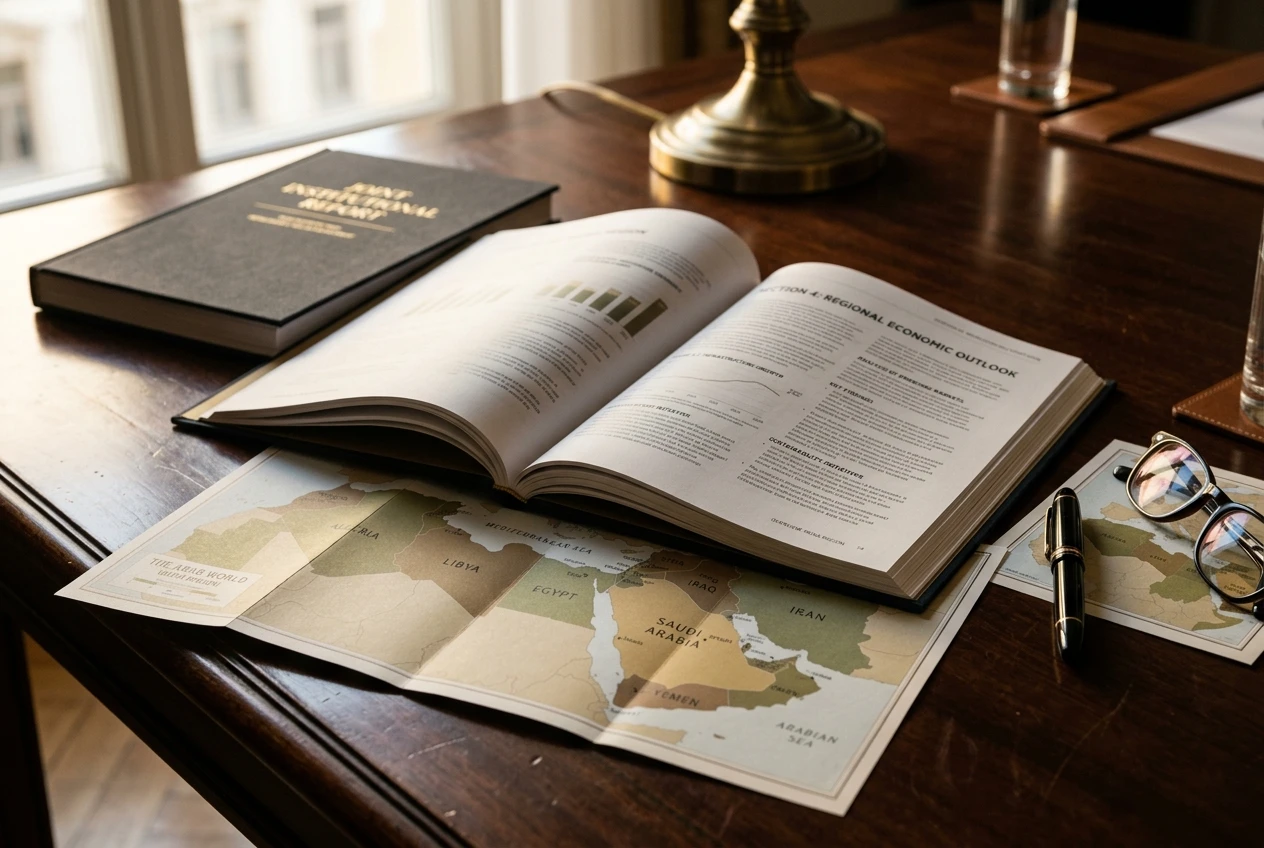
The Arab Bloc’s WTO Footprint
Of the 22 members of the Arab League, fourteen are WTO members today, with the publication focused on the non-member side of that split. The report sets the rest of the membership, alongside the seven negotiating accession, as its analytical frame.
Five Arab states acceded to the WTO since 1995 under Article XII of the Marrakesh Agreement: Jordan, Oman, Saudi Arabia, Yemen and Comoros. Comoros, the Indian Ocean archipelago that became the WTO’s 165th member on 21 August 2024 according to the Comoros accession record and timeline, joined in 2024. The publication draws on the post-1995 experience of those five alongside the seven current accession processes to inform the report’s analysis.
The multilateral trading system can serve as an anchor for domestic economic reforms, supporting sustained growth, diversification, regional integration, and stability.
WTO Director-General Ngozi Okonjo-Iweala used that framing in the Per Jacobsson Lecture, delivered in Washington D.C. in October 2024. The study reuses her language in its own introduction. It positions the multilateral trading system as an anchor for domestic economic reform in the Arab world. The framing lines up with the report’s argument that accession can expand economic and development prospects across the region.
Seven Negotiations Still Open
Seven Arab states are currently negotiating their accession to the WTO, the new study reports: Algeria, Iraq, Lebanon, Libya, Somalia, Sudan and Syria. Their working parties convened in different years and progress has been uneven across the group, with no completion date projected in the publication.
For these governments, accession under Article XII of the Marrakesh Agreement runs in three parallel tracks: bilateral market access negotiations on goods and services, plurilateral talks on specific WTO rules, and multilateral discussions in an accession working party, per the Article XII page in the WTO accessions portal. An accepted accession package has to clear the working party, the General Council or Ministerial Conference, and then be ratified or signed by the acceding government. The new study recommends these governments commit to aligning their policies, laws and regulations with WTO rules, establish sound regulatory institutions, and sustain expertise on WTO issues. The joint report also points to the need for ongoing technical assistance and capacity-building, in the negotiations and after membership takes effect.
That recommendation covers more than the seven. The publication does not single out any of the seven by name when calling out challenges, handling them as a group in the report’s coverage.
Several of these tracks have stretched across multiple rounds of working-party meetings without an end in sight. The publication frames those long trajectories as accumulated institutional experience for Arab governments, on both the acceding side and the members’ side. For the seven, the report’s argument is that the architecture of accession is what they sign up to, rather than any specific timeline.
Infrastructure Gaps the Study Flags
Beyond the legal and political hurdles of accession, the study examines how Arab economies actually participate in world trade. It finds significant disparities in regional transport infrastructure, naming customs procedures, logistics costs and the quality of corridors for overland and maritime transport as the recurring weak links. Many Arab economies still rely on transport networks they have not yet built out, and the report treats those gaps as the practical bottleneck for accession and post-accession plans. Per the WTO’s announcement, the recommendation is for governments to commit sustained infrastructure investment, including transportation networks, ports, airports and energy projects, to expand export opportunities and attract inward investment. Those investments are framed in the report as part of what makes WTO accession pay off after membership takes effect.
- Disparities in regional transport infrastructure
- Recurring weak links in customs procedures
- Logistics costs tied to corridor quality
- Overland and maritime transport corridors needing investment
- Investment recommendations in transportation networks, ports, airports and energy projects
This focus on infrastructure sits alongside the study’s emphasis on domestic reform and economic diversification as part of the accession process. The publication frames those reforms as the foundation of competitive market conditions and a business-friendly environment in the Arab world. The report also points to the need for ongoing technical assistance and capacity-building in accession negotiations and in the implementation of WTO rules. The joint study is positioned to serve both acceding governments and existing Arab WTO members working through the post-accession years.
Why This Report Lands Now
The report was launched against a regional backdrop that has shifted substantially since the data were collected. The WTO’s announcement cites conflict and instability in several Arab economies as the pressure point behind the timing.
The cut-off date for data in the report is 31 January 2026, several months before its release, a timing the WTO specifically notes predates the start of the Middle East conflict referenced in the announcement. That choice limits what the report can directly say about the operational impact of conflict on each accession track. The result is a study built around the architecture of accession as it stood in late January 2026, with limited operational commentary on the conflict-affected months that followed. Negotiators will need a separate picture for the conflict-affected years. The publication still positions deeper integration into the multilateral trading system as a way to expand economic and development prospects for Arab economies.
For the seven Arab governments still negotiating, the report’s argument is that WTO accession can also serve to lock in reforms that outlast a political cycle. The WTO framing places the multilateral trading system as one of the regional anchors for stability, alongside growth, diversification and regional integration. The publication does not claim accession can resolve armed conflict or political fragmentation directly.
From a 2022 Dialogue to a 2026 Roadmap
The study emerged from the WTO’s Second High-Level Dialogue on Arab Accessions in February 2022 as a practical step to support Arab accessions. It was then discussed at the 12th China Round Table on WTO Accessions in 2024. A dedicated session at the 13th China Round Table on WTO Accessions, held in Muscat in May 2025, reviewed progress on translating the study’s findings into support mechanisms for Arab acceding governments. The publication was developed across a consultative process that included those roundtables and closed with the 6 July 2026 release.
On the WTO’s framing, the report consolidates practical experience into a structured reference for governments and stakeholders who are working through ongoing and future accession pathways in the Arab region. The full text is downloadable from the WTO publications portal, with separate downloads for the introduction, executive summary, four substantive sections and three annexes covering questionnaires and regression results. Section four of the publication is titled the conclusion and way forward for the joint study.
- February 2022: Second High-Level Dialogue on Arab Accessions held at the WTO.
- 2024: Study discussed at the 12th China Round Table on WTO Accessions.
- May 2025: Dedicated session at the 13th China Round Table on WTO Accessions in Muscat.
- 31 January 2026: Cut-off date for data included in the report.
- 6 July 2026: Joint Arab accession study launched in Geneva.
Frequently Asked Questions
How many Arab League countries are currently WTO members?
Per the 6 July 2026 joint study, fourteen of the 22 Arab League members sit inside the multilateral trading system today. The rest of the membership is not yet inside the WTO, and the publication lists seven members as active accession negotiators.
Which Arab countries have joined the WTO since 1995?
Five Arab states acceded to the WTO since 1995 under Article XII of the Marrakesh Agreement: Jordan, Oman, Saudi Arabia, Yemen and Comoros. Comoros was the most recent, becoming the 165th WTO member on 21 August 2024 according to the WTO’s accession record.
Which Arab countries are still negotiating WTO accession?
Seven Arab states are currently negotiating accession: Algeria, Iraq, Lebanon, Libya, Somalia, Sudan and Syria. Each has a separate working party, and the publication does not name a completion date for any of them.
What does WTO accession actually require?
To join, an applicant government works through three parallel negotiation tracks defined in Article XII of the Marrakesh Agreement: bilateral talks on goods and services market access, plurilateral discussions on specific WTO rules, and multilateral exchanges inside an accession working party. After the working party and the General Council or Ministerial Conference sign off, the government notifies acceptance of its Protocol of Accession to become a member. The new study’s recommendations layer on top, including aligning national laws with WTO rules and setting up dedicated regulatory institutions.
When was the WTO accession study on Arab countries published?
The publication “Best practices in WTO accession for Arab Countries: Lessons from past and ongoing accessions in the Arab world” came out on 6 July 2026. It is freely downloadable from the WTO publications portal and is split into an introduction, executive summary, four substantive sections and three annexes covering questionnaires and regression results.
