
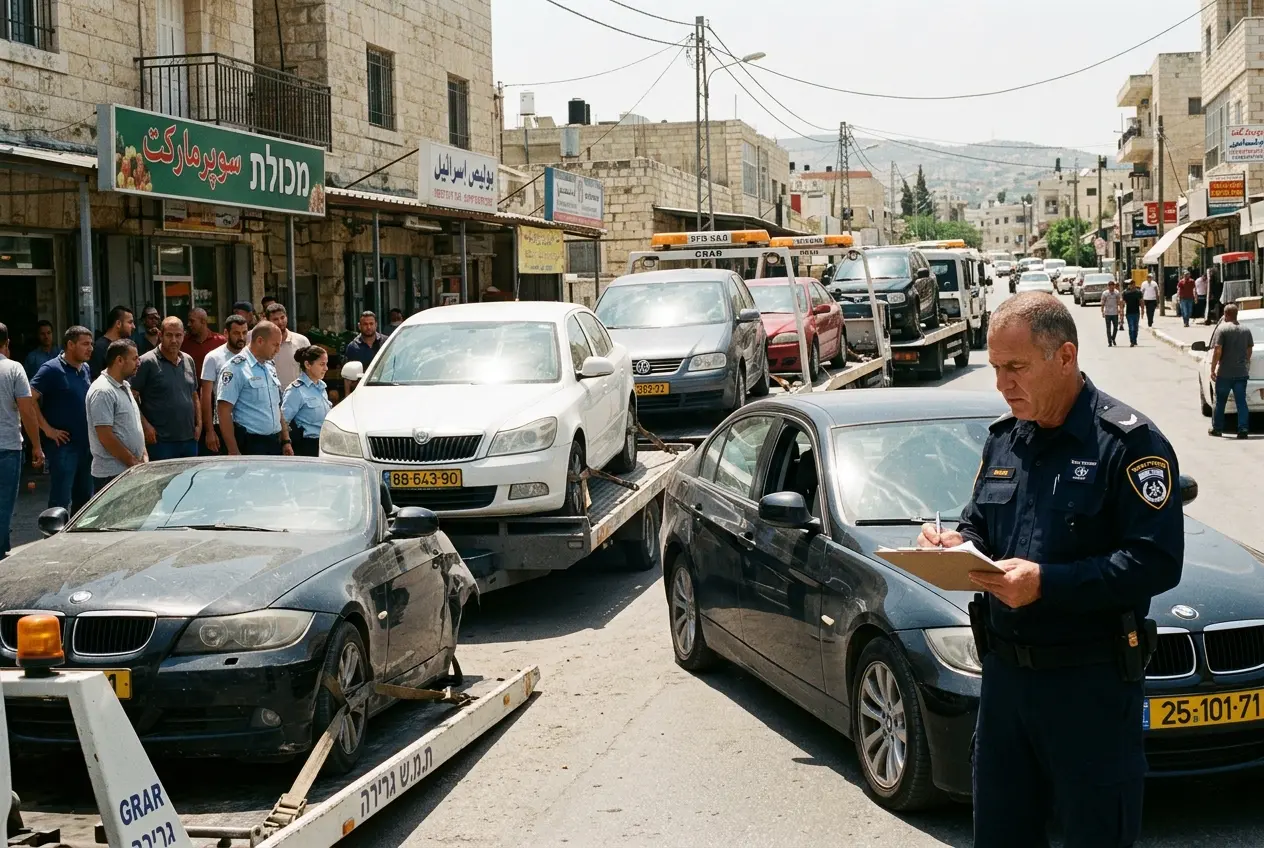
Israel Police have seized more than 30 vehicles in northern Galilee this week as part of a coordinated push against Arab-sector organized crime, the Jerusalem Post reported Tuesday. Operations are running in Sakhnin, Arrabe, Deir Hanna, Kafr Manda and surrounding villages, where vehicles tied to tax debts worth tens of millions of shekels were confiscated by police and tax authorities working together. Police call the seizures part of a “focused economic enforcement” push aimed at cutting off the “economic oxygen supply” of organized crime groups.
Running alongside the seizure push is a milestone that quantifies how serious the violence has grown: a 17-year-old became the 150th person murdered in Israel’s Arab community this year, Rambam Hospital announced Saturday. Wiaam Faisal, 17, and Jonathan Khouri, 18, died in a shooting in Haifa, while a third young man wounded in the same incident remains hospitalized in serious condition. The week’s enforcement followed an emergency meeting Police Commissioner Danny Levi had convened days earlier, called after five murders in less than half a day in Tayibe, Kafr Qasim, Jaffa and Holon.
Where This Week’s Police Operation Is Running
The week’s operations span a string of Galilee towns and a multi-agency response. Sakhnin, Arrabe, Deir Hanna, Kafr Manda and surrounding villages are the named sites of the enforcement push. The joint work is being led by the Prime Minister’s Office’s Headquarters for Combating Crime in Arab Society.
The Tuesday report on the Galilee vehicle seizures named the Tax Authority, the State Attorney’s Office, the Shin Bet, government ministries and civilian enforcement bodies as coordinating partners. The Headquarters for Combating Crime in Arab Society sits inside the Prime Minister’s Office and acts as the central hub for joint enforcement against organized crime in Arab communities. The vehicle seizures themselves flow through tax-debt enforcement. Police have framed the work as “focused economic enforcement,” wording that names asset seizure as the priority. No end date for the operations has been disclosed.
Coordinating agencies named in the Tuesday report
- Prime Minister’s Office Headquarters for Combating Crime in Arab Society
- Tax Authority
- State Attorney’s Office
- Shin Bet
- Government ministries and civilian enforcement bodies
A Running Tally of Vehicles and Weapons
The week’s enforcement tally combines vehicles and weapons in the same joint push. The vehicles themselves are tied to tax debts of tens of millions of shekels. Alongside them, officers seized dozens of weapons intended for criminal use in the Arab sector.
The weapons cache included pistols, rifles and explosives. Officers also raided several businesses suspected of involvement with Arab-sector organized crime as part of the same push. The Tuesday report did not include an arrest count for the week’s operations. The combined seizures are the enforcement results police have disclosed so far.
Police described the week’s actions as an effort to “cut off the economic oxygen supply of those who perpetrate crime on Arab streets,” language that names asset seizure at the center of the priority list. The same report describes the strategy as “focused economic enforcement.” The shift from arrest-led to asset-led enforcement is visible in the report’s language.
What the Galilee operations have produced so far
- 30+ vehicles seized in Sakhnin, Arrabe, Deir Hanna, Kafr Manda and surrounding areas
- Tax debts of tens of millions of shekels tied to those vehicles
- Dozens of weapons, including pistols, rifles and explosives
- Raids on several businesses suspected of organized crime links
Following the ‘Economic Oxygen’ Track
The strategy’s signature phrase is “cut off the economic oxygen supply.” Police used the language to describe why the operations target vehicles as the visible asset. The choice signals an explicit pivot toward asset seizure as the primary lever against organized crime. Going after vehicles tied to tax debts lets police build documented ownership chains. The asset-first framing now shows up alongside the seizure of pistols, rifles and explosives in the same week.
In February, Police Commissioner Danny Levi told the Federation of Local Authorities the police would seek to dry up funding sources for organized crime as part of its enforcement priorities. The Galilee operations now run tax-debt collection alongside weapons and business raids. The February priority was framed as a long-term goal to dry up organized crime funding. That priority now applies to specific vehicle seizures in named Galilee towns.
The phrase appears in slightly different forms in police statements through 2026. In February the priority was framed as a long-term goal to dry up funding sources of organized crime. The same logic applies to specific vehicle seizures in the Galilee this week.
cut off the economic oxygen supply of those who perpetrate crime on Arab streets
Israel Police used the phrase in the Tuesday report on the Galilee vehicle seizures. The same report calls the strategy “focused economic enforcement.”
Behind the 150th Killing of 2026
The week’s vehicle seizures are running against a backdrop the Galilee operations cannot deflect. Rambam Hospital in Haifa announced Saturday that a 17-year-old brought in after a shooting had died, pushing this year’s killing toll in Israel’s Arab community to its 150th victim. The dead teen, Wiaam Faisal, 17, and Jonathan Khouri, 18, died in a shooting in Haifa. A third young man wounded in the same incident remains hospitalized in serious condition.
Faisal and Khouri are both teenagers; Khouri was 18. The Jerusalem Post called 2026 “one of the most violent years,” using the paper’s own wording for the toll. The Haifa killings followed the year-to-date total past the same point in 2025.
The murder toll in the Arab sector has tracked sharply upward over the past two years. At the same point in July 2025 the running count was 128 murders, the Jerusalem Post reported. Across all of 2024, “only” 230 Arab citizens were murdered in circumstances of violence and crime. By early July this year, the running total had already cleared the 2025 mid-year count. The week’s enforcement push follows that trajectory.
Murders in Israel’s Arab community, year over year
| Year | Murders | Period covered |
|---|---|---|
| 2024 | 230 | Full year |
| 2025 | 128 | Through start of July |
| 2026 | 150 | Through start of July |
How Five Murders in Half a Day Prompted an Emergency Meeting
The vehicle seizures in Galilee came days after Police Commissioner Danny Levi convened an emergency meeting of his senior command staff. The meeting was called after a five-murder stretch in less than half a day across Tayibe, Kafr Qasim, Jaffa and Holon. The combination of the emergency meeting and this week’s enforcement push shows police treating the violence and financial tracks as the same crisis.
That five-murder half-day fit inside a wider Arab-community violence wave that hit central Israel the same week, with car bombings and shootings in Taibe and Holon that killed multiple victims this summer [a wave of central Israel car bombings in Arab communities]. Levi’s emergency meeting brought senior command staff together to weigh new tools against the violence. The financial seizures in Galilee are one of the tools that meeting produced. The Tuesday report did not name additional measures taken at the meeting.
A Two-Year Arab-Sector Crime Wave
The vehicle seizures fit a longer trend, not a single week of bad news. Arab-sector organized crime has grown into a structural challenge police and Arab local authority heads describe in near-permanent terms. The “focused economic enforcement” framing in the Galilee report echoes the language of Levy’s earlier statements about organized crime financing.
Sakhnin, the largest single site of this week’s seizure operations, has been a focus of Arab-community protests against organized crime earlier in 2026. Those demonstrations show how Arab clan violence has corroded rule of law inside Israel. This week’s Galilee operations run in towns where those protests were demanding stricter enforcement on organized crime. Local Arab leaders have framed the violence as “terrorism in every sense,” the words of Mazen Ghanaim, chairman of the Forum of Arab Local Authority Heads and mayor of Sakhnin. The matching priorities from community leaders and from police have run toward the same target through 2026.
The Galilee operations are the latest in a series of enforcement pushes against Arab-sector organized crime. Earlier Israeli campaigns have ranged from mass arrests to weapons seizures. The shift to vehicle seizures tied to tax debt adds a financing-led lever to the existing weapons-and-arrests toolkit. The new lever is meant to bring longer-term financial cases alongside street-level enforcement.
Levy has been the public face of the police response through 2026. The Galilee operations now run in the towns he flagged for harder enforcement in his February statements. The Galilee operations have no public end date.
Frequently Asked Questions
Who is leading Israel Police’s response in northern Israel?
Police Commissioner Danny Levi, who convened an emergency meeting of senior command staff before the Galilee operations. The week’s vehicle seizures are being run under the Prime Minister’s Office’s Headquarters for Combating Crime in Arab Society, with the Tax Authority, the State Attorney’s Office, and the Shin Bet as the named coordinating partners.
What does ‘focused economic enforcement’ mean in practice?
The Tuesday report’s wording for an operation that targets vehicles and assets tied to tax debts. The strategy centers financial-asset seizure at the top of the priority list. The police describe the strategy’s stated goal as ‘cutting off the economic oxygen supply’ of organized crime in Arab communities.
How does 2026’s Arab-sector murder toll compare to past years?
The year-to-date total in Israel’s Arab community through the start of July 2026 had already passed the 128 logged at the same point in 2025, the Jerusalem Post reported. The 230 logged across all of 2024 is the year-over-year full-year anchor being used in the Tuesday report’s wording. The early-July 2026 figure reflects two consecutive years of acceleration.
How does this week’s enforcement differ from earlier Arab-sector operations?
This week’s push is named ‘focused economic enforcement’ in the Tuesday report, with vehicles tied to tax debt as the visible lever. Earlier Israeli campaigns against organized crime in Arab communities have used mass arrests and weapons seizures as the primary tools. Police Commissioner Danny Levy’s February statements called for ‘drying up funding sources’ of organized crime without naming tax debt as the instrument, the Jerusalem Post reported.
