
The UN Human Rights Council adopted a Saudi-led resolution on women in cybersecurity by consensus on July 7, 2026, the final day of its 62nd session in Geneva. Submitted by Saudi Arabia’s Permanent Mission to the UN, the text builds on Crown Prince Mohammed bin Salman’s 2020 “Women Empowerment in Cybersecurity” initiative. Its stated aim is to grow female participation in the sector, develop skills, support career advancement, and help address a global shortage of cybersecurity talent. The Global Cybersecurity Forum Institute, the body the Crown Prince set up to run his two cyber initiatives, will handle implementation.
What the Council Adopted on Tuesday
Saudi Arabia’s Permanent Mission to the United Nations and other international organizations in Geneva drafted and submitted the resolution during the council’s 62nd session, which ran from June 15 to July 7, 2026, at the Palais des Nations. The text, titled “Women Empowerment in Cybersecurity” in council documents, calls for promoting women’s participation in the cybersecurity sector, enhancing their skills, supporting professional development, and helping address the global cybersecurity skills gap. The Saudi Press Agency reported the unanimous adoption on Tuesday, the closing day of the session.
The resolution frames its work around the international shortage of cybersecurity professionals and the under-representation of women in the field. It calls on states to share technical assistance, build capacity, and respect national priorities while expanding female expertise. It also pushes for women’s career progression into leadership positions in the sector, a thread the resolution borrows directly from the Crown Prince’s framing. The Saudi delegation described the text as a translation of the Crown Prince’s 2020 vision into an international framework. The resolution was adopted by unanimity at the council, a procedure under which no member state asked for a recorded vote.
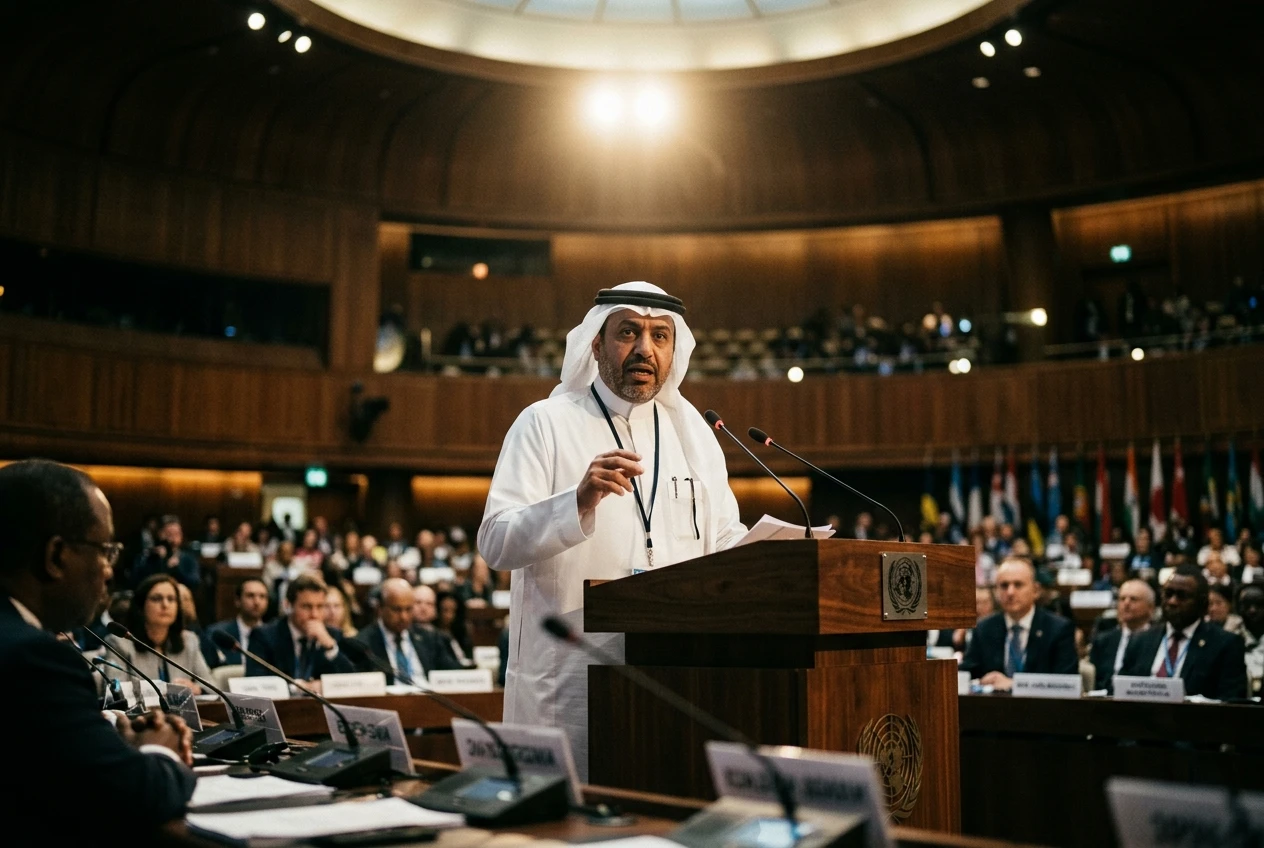
Saudi Arabia’s Permanent Representative to the United Nations in Geneva, Ambassador Abdulmohsen bin Khothaila, addressed the council before the vote. He said the initiative “demonstrates Saudi Arabia’s commitment to strengthening international cooperation, providing technical assistance, and supporting capacity-building efforts to empower women in cybersecurity while respecting national priorities.” He framed the resolution as the international framework version of the Crown Prince’s vision, with the goal of moving women into leadership positions in the sector. The Saudi Press Agency said the unanimous adoption “reflects broad international support for the initiative and recognition of its contribution to enhancing global cyber resilience.”
From a 2020 Initiative to a UN Resolution
The resolution is the international version of work the Crown Prince has been funding and convening for six years. Crown Prince Mohammed bin Salman launched the “Women Empowerment in Cybersecurity” initiative in 2020, around the Global Cybersecurity Forum held in Riyadh. The Crown Prince’s two cyber initiatives, “Women Empowerment in Cybersecurity” and “Child Protection in Cyberspace,” are now run by the Global Cybersecurity Forum Institute, the foundation set up to coordinate with international partners including specialized United Nations agencies. The institute’s website describes the women-in-cyber initiative as the Crown Prince’s personal project, with five strategic objectives and twelve projects to be implemented globally. Tuesday’s resolution carries the same five-pillar framing and recasts it as a UN-level commitment that member states are now expected to act on.
The 2020 initiative gave the institute a mandate to design programs in education, training, and entrepreneurship. The Global Cybersecurity Forum Institute runs those programs with international partners, including specialized United Nations agencies, separate from the council’s adoption process in Geneva. The resolution passed Tuesday is the formal text that links the Crown Prince’s initiative to a UN Human Rights Council decision and a consensus of member states.
The Workforce Gap Behind the Push
The case the resolution rests on is a global shortage of cybersecurity professionals and a stubborn gender gap inside that workforce. The Global Cybersecurity Forum Institute’s own think-piece, “Empowering Women to Work in Cybersecurity is a Win-Win,” puts the global shortfall at 4 million cybersecurity professionals. It also reports that 75% of the cyber workforce are men, a figure the institute uses to frame the talent pool that is being under-used. The institute points to a pipeline problem further down the education funnel: only 22% of female STEM students say they could be interested in cybersecurity careers.
- 4 million cybersecurity professionals, the global shortfall cited by the Global Cybersecurity Forum Institute
- 75%, the share of the cybersecurity workforce the institute reports as male
- 22%, the share of female STEM students open to a cybersecurity career, per the institute
- 12 projects under the Crown Prince’s WEC initiative, across five strategic objectives
- 62nd session, June 15 to July 7, 2026, at the Palais des Nations, Geneva
The numbers come from the institute’s own research, and the council resolution does not name a specific workforce figure. The institute’s framing has nonetheless been the basis for the Crown Prince’s 2020 initiative and the projects that grew out of it. The Saudi delegation’s address to the council leaned on the same talent-gap argument that Riyadh has been using at the Global Cybersecurity Forum since 2020. The 75% male share of the workforce and the 4 million professional shortfall are the institute’s figures, drawn from its own thought-leadership report. The resolution’s operative paragraphs use the same broad language: participation, skills, professional development, and the global skills gap, without naming a numeric target for member states.
Member states are invited to share technical assistance, build training capacity, and design programs for women and girls in cyber, all while “respecting national priorities.” The resolution is a framework text, not a budget, and the Global Cybersecurity Forum Institute is the only body with a fixed program of projects behind the framework. The institute’s website lists twelve projects across five strategic objectives, from K-12 cyber curricula to a fund for women cybersecurity entrepreneurs.
Riyadh’s Wider UN Cyber Portfolio
The women-in-cyber resolution is the latest piece of a wider Saudi-led cyber portfolio at the United Nations. Saudi Arabia’s Permanent Mission in Geneva has now steered two distinct cyber resolutions through the council, with the first covering child protection in cyberspace adopted at the council’s 59th session under Agenda Item 10. The Crown Prince’s two cyber initiatives, “Women Empowerment in Cybersecurity” and “Child Protection in Cyberspace,” are both run by the Global Cybersecurity Forum Institute with international partners, including specialized UN agencies. The institute’s website describes the women’s initiative as the Crown Prince’s personal project, with implementation routed through those UN partners.
- Women Empowerment in Cybersecurity: the Crown Prince’s 2020 initiative, endorsed by the UN Human Rights Council resolution adopted on July 7, 2026
- Child Protection in Cyberspace: the second Crown Prince initiative, whose resolution Saudi Arabia led through the council at the 59th session
- Global Cybersecurity Forum: the institute’s annual conference in Riyadh, co-organized with the National Cybersecurity Authority (see also the International Cybersecurity Forum’s 2024 Riyadh edition)
- Global Cybersecurity Forum Institute: the foundation that runs both initiatives with international partners, including specialized United Nations agencies (see the Saudi government release on the unanimous adoption)
Riyadh has also used the Global Cybersecurity Forum, the institute’s annual conference in Riyadh, as a parallel platform for the same push. The forum has hosted ministers, intelligence chiefs, and tech executives since 2020, with the women-in-cyber track growing alongside the main agenda. Saudi Arabia’s National Cybersecurity Authority, the regulator that co-organizes the forum, has used its platform to push the same two-pillar framing: women in cyber and child safety online. The Crown Prince’s role is public; he chairs Saudi Arabia’s Council of Ministers and is the named architect of both initiatives. Saudi Arabia’s two cyber resolutions at the council are the formal output of that two-pillar sequence, with the institute running the year-round work between sessions.
How Implementation Is Wired
Implementation sits with the Global Cybersecurity Forum Institute, not with the council in Geneva. The institute’s website lists twelve projects under five strategic objectives for the women-in-cyber initiative. Those objectives are the same pipeline-to-leadership arc the Crown Prince’s 2020 launch set out: expand the talent pool, build awareness, recruit and upskill, retain mid-level women, and advance senior women to leadership. The resolution text adopted Tuesday refers to that pipeline but does not name the institute.
The institute organizes the work as a sequence of strategic objectives, from the first cyber lesson for school-age girls to seed funding for a cybersecurity startup founded by a woman. The framing matters because the resolution itself is a framework text, not a budget, and the institute is the only body with a fixed program of projects behind it. The institute’s partner network handles the country-level delivery, from K-12 curricula in partner countries to scholarship programs for women pursuing cyber certifications. The resolution adopted in Geneva gives the institute’s existing work a UN-level text that member states can cite in their own cyber workforce policies. The Saudi delegation’s address to the council leaned on that link, framing the resolution as a translation of the Crown Prince’s vision into international commitments. The GCF Institute’s full breakdown of the initiative’s five pillars is the public reference for the projects under each objective.
- Expanding the pipeline: K-12 cyber curriculum advocacy and a junior mentorship program for middle and high school girls.
- Raising awareness: popular media that portray women in cyber, online gender-bias training, and a Global WEC Summit with an award.
- Recruiting and upskilling talent: scholarships and corporate hire-to-train programs.
- Retaining middle managers: advocacy for national laws and corporate workplace commitments that keep mid-level women in the field.
- Advancing to leadership: a fund for women entrepreneurs and startups in cybersecurity.
Most of those programs are run out of Riyadh, through the institute’s partner network. The council’s adoption provides a UN-level text that member states can cite when they design their own cyber workforce programs for women. The institute’s website frames its own project list as the practical translation of that text, from K-12 cyber curricula in partner countries to scholarships for women pursuing cyber certifications.
Reaction From Geneva to Riyadh
The strongest public endorsement outside Geneva came from the Muslim World League and the Organization of Islamic Cooperation. Both organizations welcomed the council’s adoption through a single post on X. The post tied the resolution to the two-pillar framing the Crown Prince has championed since 2020. The post was a single shared statement, and the verbatim text was brief.
Both organizations reaffirmed their pride in the leading role played by the Kingdom of Saudi Arabia in supporting international efforts to build a safer and more inclusive cyberspace.
The post was published on X by Mohammed Al-Issa, Secretary-General of the Muslim World League and President of the Organization of Muslim Scholars, on behalf of both organizations. Al-Issa’s framing put the resolution alongside the Crown Prince’s parallel work on child protection in cyberspace, the second pillar of the Saudi-led portfolio. The Saudi delegation in Geneva read the consensus as a broad international signal. The Saudi Press Agency said the unanimous vote “reflects broad international support for the initiative and recognition of its contribution to enhancing global cyber resilience.” The Crown Prince’s foundation runs the Global Cybersecurity Forum in Riyadh as the parallel platform where the resolution’s framing is tested against the practitioners who do the day-to-day work.
Frequently Asked Questions
What does the Saudi-led UN resolution on women in cybersecurity actually do?
The resolution calls on member states to do four things: grow women’s participation in cybersecurity, build their skills, support their career development, and help close the global skills gap. It was adopted by consensus at the council’s 62nd session in Geneva, the same session that ran from June 15 to July 7, 2026. The text is a framework resolution and does not name a specific numeric target for any of those four goals.
When did Saudi Arabia’s women-in-cybersecurity initiative start?
Crown Prince Mohammed bin Salman launched the initiative in 2020 at the Global Cybersecurity Forum in Riyadh. Six years later, the Crown Prince’s foundation, the Global Cybersecurity Forum Institute, runs the program with international partners and specialized United Nations agencies. The Crown Prince’s other cyber initiative, “Child Protection in Cyberspace,” sits alongside it at the institute.
How big is the cybersecurity workforce gap the resolution refers to?
The Global Cybersecurity Forum Institute, the body the Crown Prince set up to run the initiative, says the world is short by 4 million cybersecurity professionals. The institute’s own report, “Empowering Women to Work in Cybersecurity is a Win-Win,” also says 75% of the existing cyber workforce are men, and 22% of female STEM students say they could be interested in cyber careers. The council resolution itself does not name a specific workforce number.
What is the Global Cybersecurity Forum Institute?
The Global Cybersecurity Forum Institute is a Saudi foundation set up to run the Crown Prince’s two cyber initiatives: one on women in cybersecurity and one on child protection in cyberspace. The institute works with international partners, including specialized United Nations agencies, on a portfolio that the resolution adopted Tuesday now formally anchors in a UN Human Rights Council text. The institute also runs the annual Global Cybersecurity Forum in Riyadh.
Was the resolution adopted with a vote?
The resolution was adopted by consensus at the council’s 62nd session. In council procedure, consensus means no member state asked for a recorded vote, and the text does not name a state-by-state tally. The Saudi Press Agency called the vote a sign of broad international support for the Crown Prince’s cybersecurity initiative.
