
Saudi Arabia’s Royal Commission for AlUla approved the design of AlUla Manara on June 17, a planned observatory and visitor destination 70 kilometres north of the ancient city that the commission says will rank “among the largest observatories in the world.” The site sits between the Harrat Uwayrid Reserve and the Gharameel area, in a stretch of desert chosen for its dark skies and minimal light pollution.
The project joins a regional network of observatories, planetariums and stargazing operators that stretches from Egypt’s Kottamia in the north to Oman’s Jebel Akhdar in the south, with desert sites in Jordan and the UAE bridging the two. Several of those older sites have been running public programmes for years. AlUla Manara, which has no opening date, is meant to be the new centre of gravity.
Saudi Arabia Clears the Design for AlUla Manara
On June 17, the Royal Commission for AlUla’s board of directors approved the design for AlUla Manara, an integrated observatory, research facility and visitor destination. The project will rise on a sandstone-clad structure inspired by the region’s geology, located between the Harrat Uwayrid Reserve and the Gharameel site. The commission describes the location as “an area with clear skies due to low levels of light pollution.” No opening date has been announced.
The flagship instrument will be a main telescope with a diameter of four metres, paired with two further telescopes measuring two metres each, a configuration the commission says will place AlUla Manara among the largest observatories in the world. The site will also house replicas inspired by famous space telescopes and satellites, alongside exhibition halls, observation platforms and dedicated experimental areas.
The project has been in development since at least 2024, when the Royal Commission signed the August 2024 SETI Institute cooperation agreement to support observatory planning, data systems and educational programmes. SETI Institute senior planetary astronomer Frank Marchis described the observatory in that 2024 announcement as “a beacon of discovery, equipped with advanced and modern telescopes to detect new planets and stars, pushing astronomical research to further frontiers.” Current partners include the Saudi Space Agency and King Abdulaziz City for Science and Technology, both of which are also working with the Royal Commission on the facility. The commission has framed the project as part of Saudi Vision 2030, with stargazing and public engagement sitting alongside scientific research.
Specifications for AlUla Manara
| Detail | Source-stated value |
|---|---|
| Approval date | June 17, 2026 |
| Site | 70 km north of AlUla, between Harrat Uwayrid Reserve and Gharameel |
| Main telescope | 4-metre diameter |
| Secondary telescopes | Two units at 2 metres each |
| Partners | Royal Commission for AlUla, Saudi Space Agency, KACST, SETI Institute |
| Opening date | Not announced |
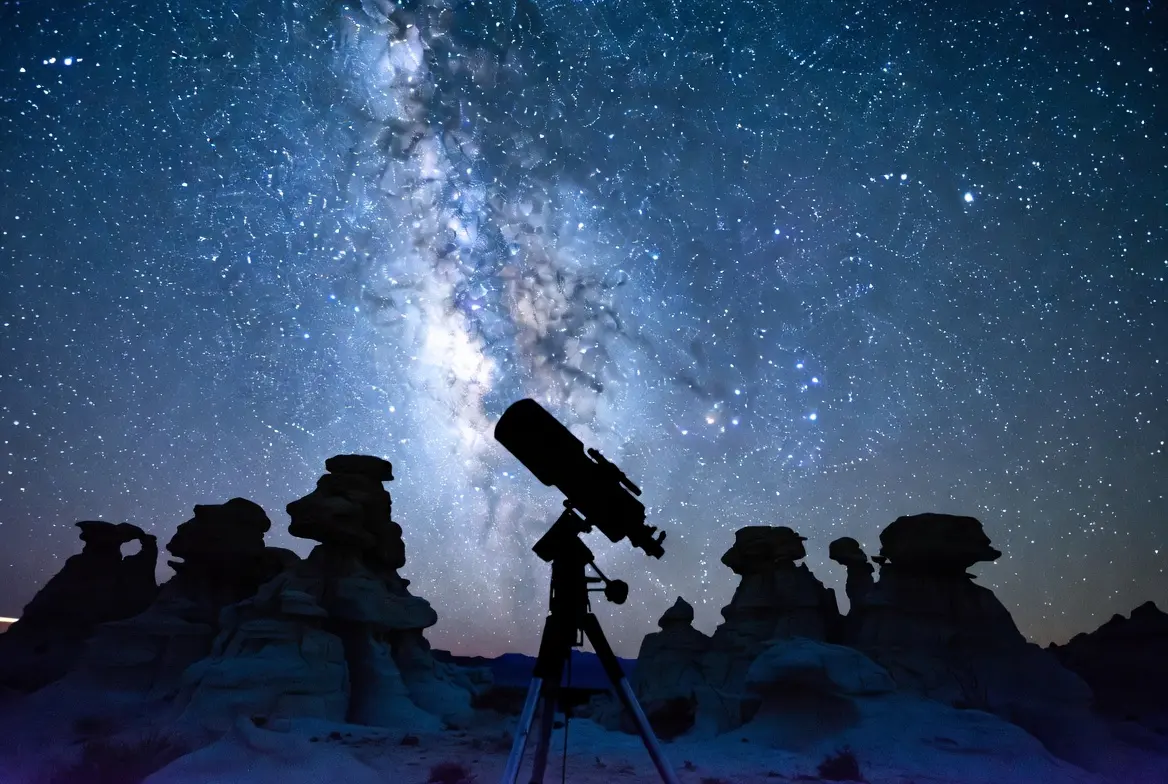
Observatories Across the Gulf Open Their Doors
Public observatories in the UAE and Qatar predate the Saudi announcement, and most welcome visitors year-round with paid or free sessions. Several pair telescope viewing with planetarium shows and exhibition spaces, and a few operate only in the evening while remaining closed during daytime hours. The Gulf’s astronomy centres are run by a mix of government bodies, university departments and private operators.
Al Sadeem Observatory opened in Al Wathba South in 2016, away from the main lights of Abu Dhabi, and offers paid guided tours with both a 40cm telescope and smart telescopes used for research and astrophotography. The centre also runs the Cosmic Cube, an immersive room that displays galaxies, nebulae and star clusters captured by the Al Sadeem team. Public sessions cover planetary and deep-sky observations, and the observatory has positioned itself as one of the few sites in the UAE offering hands-on deep-sky viewing.
Dubai’s Al Thuraya Astronomy Centre opened in Mushrif Park in 2017, in partnership with Dubai Municipality, and is operated by the Dubai Astronomy Group. It runs evening telescope observation sessions after 7.30pm, daytime solar observation, planetarium shows and courses on using telescopes. The Sharjah Space and Astronomy Hub, part of the University of Sharjah, adds the Sharjah Planetarium, optical and radio observatories, research laboratories and the Cosmic Park to the mix.
Across the water in Doha, the Al Thuraya Planetarium sits inside Katara Cultural Village and uses a full-dome digital system projected on a 22-metre screen with seating for 200 people. Its shows, free to visitors, run in Arabic and English and cover astronomy, the planets and space exploration. Together the Gulf’s four public-facing centres cover most of what a casual visitor might want from a first astronomy outing: telescope time, an indoor show and an exhibition walk-through.
Gulf observatories and planetariums
| Site | Location | Key offering |
|---|---|---|
| Al Sadeem Observatory | Al Wathba South, Abu Dhabi | 40cm telescope and Cosmic Cube immersive room |
| Al Thuraya Astronomy Centre | Mushrif Park, Dubai | Telescope sessions after 7.30pm, solar by day, courses |
| Sharjah Space and Astronomy Hub | University of Sharjah | Optical and radio observatories, Sharjah Planetarium, Cosmic Park |
| Al Thuraya Planetarium | Katara Cultural Village, Doha | Full-dome 22-metre screen, free entry in Arabic and English |
Where the Heavier Research Happens
Two observatories in the Arab world operate at the research end of the spectrum, with working telescopes producing data rather than just hosting visitors. Egypt’s Kottamia Astronomical Observatory sits about 80 kilometres from central Cairo on the road towards Suez, and is operated by Egypt’s National Research Institute of Astronomy and Geophysics. Morocco’s Oukaimeden Observatory, in the High Atlas south of Marrakesh, is affiliated with Cadi Ayyad University and runs an active sky survey. Both are working scientific facilities whose primary output is research papers and survey data.
Kottamia houses a 1.88-metre telescope that the institute describes as the largest in the Arab world, the Middle East and North Africa. The observatory accepts arranged public and school visits, but most of its time is spent on research rather than outreach. Kottamia is not advertised as a casual walk-in attraction.
Oukaimeden, by contrast, runs the Morocco Oukaimeden Sky Survey, known as MOSS, which uses a 500mm robotic telescope to track asteroids, comets and near-Earth objects. The observatory’s recent work includes three planetary-defence finds, with Cadi Ayyad University documenting Oukaimeden’s three recent planetary-defence discoveries in detail. An image captured at the site on January 8, 2025 was featured by NASA as part of a Pro-Am collaboration. Oukaimeden is treated as an active research site, and visitors interested in the area are directed to specialist tour operators and astronomy guides on the plateau rather than to the observatory itself. The contrast between the two observatories captures a wider truth about the region: some Arab-world sites invite the public in, while others expect the public to stay out.
Research observatories at a glance
| Site | Location | Main work |
|---|---|---|
| Kottamia Astronomical Observatory | 80 km from central Cairo, Egypt | Research with a 1.88-metre telescope; arranged visits |
| Oukaimeden Observatory | High Atlas, Morocco | MOSS asteroid and comet survey with a 500mm robotic telescope |
Stargazing Operators in the Mountains and Desert
Outside the Gulf and the larger research sites, several smaller operators turn the region’s dark skies into paid experiences for travellers. Astrolab Oman runs stargazing on Jebel Akhdar, combining telescope viewing with guided mountain activities, camping and Omani food. The company describes itself as a family-run project founded in 2022 by a group of young mountain guides and astronomers who recognised Jebel Akhdar as “the natural night star-lab.” It also offers astrophotography guidance for visitors who want to take their own pictures.
In southern Jordan, RumSky offers guided stargazing in Wadi Rum, with telescope sessions focused on constellations, planets and other objects visible in the desert sky. The experience is positioned as tourism rather than research, and both RumSky and Astrolab Oman bundle stargazing with broader mountain or desert stays. The astronomy component sits inside a longer trip rather than a stand-alone visit, so travellers booking either should expect evening departures and a guide who mixes astronomy with geography, food and local history. Neither operator is positioned as a research observatory, and visitors should not expect peer-reviewed data to come out of a session. What they should expect is clear desert air, an introduction to the constellations, and time under a sky the cities have long since washed out.
The Dark-Sky Push Behind the Boom
The new Saudi flagship is not appearing in a vacuum. DarkSky International, the US-based body that certifies protected night skies, has been adding sites across the Arab world at a steady clip. The AlUla Dark Sky Parks designation covers AlUla Manara and the AlGharameel Nature Reserves in northwest Saudi Arabia, with DarkSky International listing the certification on December 23, 2025. AlUla is the first Dark Sky Park in the Middle East, with night-sky clarity that ranks “among the best 5% of anywhere in the world,” according to the Royal Commission’s visitor-facing AlUla Manara overview.
Saudi Arabia added a second Dark Sky Park the same winter. AlNufud, located in the AlNufud AlKabir Desert, was certified by DarkSky International on December 15, 2025, per the certification entry for AlNufud. The certification page describes AlNufud as one of the largest and most ecologically distinct deserts in the Arabian Peninsula. The Royal Commission for AlUla has tied its AlUla Manara project to a wider set of outdoor lighting regulations covering AlUla, intended to keep skies dark as the area’s tourism builds out.
These certifications matter because they fix something hard to fake: a legally protected night sky, with rules governing light intensity, direction and glare. A destination that advertises dark skies but does not control its lighting can lose them within a few years of new development. The Royal Commission’s commitment to outdoor lighting rules in AlUla is part of what makes its observatory claim credible.
Saudi Arabia’s pair of Dark Sky Park certifications joined older regional designations. Egypt, Jordan, Morocco and Oman do not yet have matching national-level designations at the same scale, though several of their desert sites already qualify on sky quality alone. The result is a patchwork: Saudi Arabia has the formal dark-sky infrastructure, while the older observatories in Egypt and Morocco have the working instruments and research pipelines. AlUla Manara is the first site that brings both halves together in one project, with protected skies, a research-grade telescope and a public-facing visitor centre on the same plot of desert. Whether the rest of the region follows Saudi Arabia’s certification model will depend on whether neighbours see the dark-sky brand as worth the lighting restrictions that come with it.
What Travellers Should Plan Around
The region’s sites split roughly into three categories that demand different planning. Research observatories such as Kottamia and Oukaimeden are not casual visitor attractions and typically only accept arranged school or research visits; even then, public access is restricted. Public centres like Al Sadeem, Al Thuraya Astronomy Centre in Dubai, the Sharjah Space and Astronomy Hub and Al Thuraya Planetarium in Doha run scheduled paid or free programmes, with most evening sessions starting after 7.30pm and daytime visits focused on solar observation. Tourism operators in Oman and Jordan bundle stargazing into multi-hour or multi-day experiences, so a booking usually includes dinner, camping and transport rather than just telescope time.
Across all three categories, travellers should expect cold nights in the desert even in summer, especially at altitude on Jebel Akhdar or in the High Atlas. Photography policies vary: Astrolab Oman offers guided astrophotography, while planetariums typically prohibit cameras during shows. Visitors with mobility needs should check ahead, as some older observatories were not built for accessibility. Most sites publish updated hours and pricing through their own websites or tour partners rather than central booking platforms.
Frequently Asked Questions
What is AlUla Manara, and when will it open?
AlUla Manara is a planned observatory and research centre 70 kilometres north of the ancient city of AlUla in northwest Saudi Arabia. The Royal Commission for AlUla approved the design on June 17, 2026. No opening date has been announced.
Which observatories in the Arab world are open to visitors?
Public-facing sites include Al Sadeem Observatory in Abu Dhabi, Al Thuraya Astronomy Centre in Dubai, the Sharjah Space and Astronomy Hub, Al Thuraya Planetarium in Doha and SciTech Observatory in Al Khobar. Tourism operators Astrolab Oman on Jebel Akhdar and RumSky in Wadi Rum, Jordan offer paid stargazing experiences rather than research visits.
What is the largest telescope in the Arab world?
Egypt’s National Research Institute of Astronomy and Geophysics describes its Kottamia Astronomical Observatory, 80 kilometres from central Cairo, as the largest in the Arab world, the Middle East and North Africa. The telescope is 1.88 metres, or 74 inches, in diameter.
How many Dark Sky Parks are there in the Arab world?
DarkSky International lists at least two certified sites in Saudi Arabia: AlUla Dark Sky Parks, certified December 23, 2025 and covering AlUla Manara and the AlGharameel Nature Reserves, and AlNufud ITBA, certified December 15, 2025. Other countries in the region have not yet been added at the same scale.
Can I stargaze in Wadi Rum or on Jebel Akhdar without booking a tour?
Both Wadi Rum in Jordan and Jebel Akhdar in Oman sit far from city lights, but practical stargazing typically requires a guided operator. Astrolab Oman was founded in 2022 and bundles stargazing with mountain activities, camping and Omani food. RumSky runs guided sessions in Wadi Rum focused on constellations and planets visible to the naked eye and through telescopes.
