
The 2026 FIFA World Cup is scheduled for North American evenings. Hosted jointly by Mexico, the United States, and Canada, kick-off times for the eight Arab teams fall deep into the small hours for supporters across the region. The time-zone handicap that should have thinned the region’s viewing crowds has done the opposite: it has built a dawn-rush economy in Arab hospitality, led by Gulf cafés that have rebranded the pre-dawn hours as ‘football suhoor’ and constrained in the wider Arab world by early-closing regulations.
The match-day operating model is being rewritten. In Saudi Arabia and the United Arab Emirates, hospitality venues have installed additional screens, expanded viewing areas, and introduced group packages, special suhoor and snack menus, and score-prediction games for fans who arrive before dawn. In Türkiye, local media have labelled the moment the ‘breakfast economy.’
A Tournament Built for North American Time Zones
Speaking at the World Economic Forum in Davos in January, FIFA President Gianni Infantino told the gathering the 2026 tournament ‘will unite peoples and cultures, help drive global economic growth, create jobs, and deliver lasting social benefits to local communities.’ A FIFA and World Trade Organisation study, cited by Infantino on the same stage, projects the tournament could generate $80bn in global economic output, contribute almost $41bn to global GDP, and create around 824,000 jobs. As the World Cup organiser and rights holder, FIFA expects to generate $13bn in revenue in the 2023-26 financial cycle, a 72% increase over the previous four years, according to FIFA’s revised 2023-26 budget.
Forty-eight teams are competing this year, up from 32, with 104 matches instead of 64, per FIFA’s official match schedule. A 2025 study by the consultancy Kearney’s 2025 study on the global sports market valued the global sports market at $417bn and projects it will reach $602bn by 2030. ITV, the British commercial broadcaster carrying 51 of the 104 matches, has already called the tournament its most lucrative sporting event ever. Kelly Williams, the broadcaster’s managing director of commercial affairs, said its advertising revenues are running about 30% above those of Euro 2024.
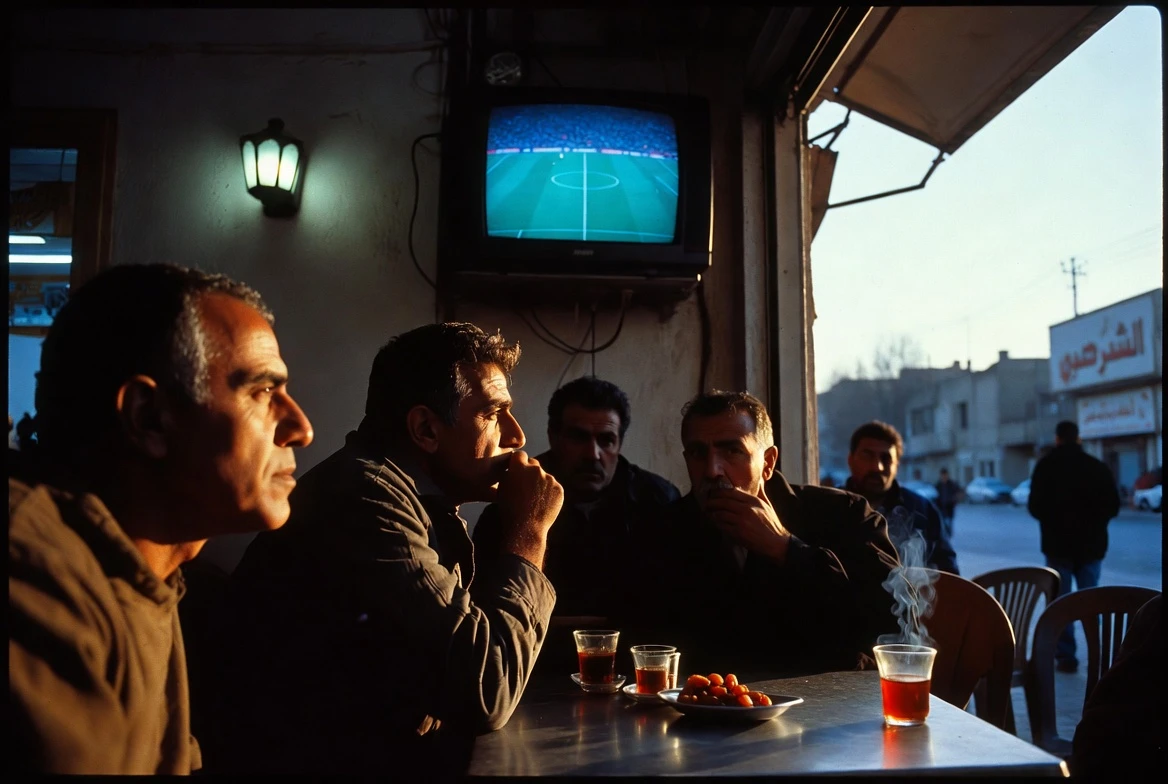
Eight Arab Teams, an Audience of Hundreds of Millions
Eight Arab states are playing in North America this summer. Their supporters number in the tens of millions at home and in the hundreds of millions once diasporas are counted. The combined population of Egypt, Morocco, Algeria, Tunisia, Saudi Arabia, Iraq, Jordan, and Qatar exceeds 300 million, rising to an estimated 523 million when diasporas are included.
The scale of the audience matters because the tournament is, for the first time, a 48-team, 104-match event. A larger bracket means more games at every hour of the day, and several fall into the 1am to 5am window for Arab cities.
The eight qualifiers are not a uniform bloc. Their football traditions differ in scale, and their fan cultures differ in structure. The off-pitch behaviour converges, though: fans in every Arab capital are reorganising sleep, work, and meal routines around the live broadcast.
The viewing migration matters commercially because Arab audiences are a defined consumer market, not a footnote. Williams said ITV’s advertising revenues for the World Cup are running about 30% above those of Euro 2024. For broadcasters and rights holders, the same time-zone handicap that reshaped viewing habits has opened up a long tail of high-value morning and pre-dawn slots. The audiences are there: the schedule has simply pushed them into hours that the rest of the world usually leaves to sleep.
- Egypt
- Morocco
- Algeria
- Tunisia
- Saudi Arabia
- Iraq
- Jordan
- Qatar
This will be our most commercially successful tournament ever. It is not just one game but six weeks of really big TV audiences. It is effectively our six-week summer Super Bowl moment.
Dawn Becomes the New Prime Time
Kelly Williams, ITV’s managing director of commercial affairs, made the point about British advertising, and the same physics are filling pre-dawn venues in the Gulf. The schedule’s commercial logic is the same wherever audiences decide to stay awake for kick-off.
The data on how fans are responding is starting to come in. Egypt’s Information and Decision Support Centre found that 84% of Egyptians are modifying their schedules for the 2026 World Cup. A report by Al Mashhad found that early-morning matches are not deterring viewers, who instead adjust their routines. The scale of the adjustment is what makes the model viable: if most fans were skipping the matches, the venues would not be open.
The early-morning hours bring a new set of customer behaviours. Establishments have begun offering group packages, special suhoor and snack menus, and score-prediction games for fans arriving before dawn. Spending concentrates on a tight menu of small plates, hot drinks, and breakfast staples, and the new line is appearing on balance sheets that have never carried one.
Football Suhoor and the Gulf Dawn Economy
Gulf venues have led the conversion. In Saudi Arabia and the United Arab Emirates, hospitality operators have installed additional screens, expanded viewing areas, and introduced offers that turn match-watching into a full social experience. The products are locally specific: ‘football suhoor‘ and fans’ breakfasts have become the new menu category, with venues marketing the late-night pre-dawn package as a full evening-and-morning experience for fans who would otherwise watch at home.
The conversion runs deeper than the menu. Food delivery apps, snack shops, and transport services are reorganising around the new schedule, and the match-night economy in the Gulf is becoming a match-dawn economy.
The pattern is not unique to the Arab world. Across the broader region, the time-zone problem is the same, but the response looks different wherever it lands. In Türkiye, local media have labelled the moment the ‘breakfast economy,’ and a comparison with the Gulf shows how the same tournament produces two distinct operating models.
The Gulf’s advantage is structural. Cafés in Saudi Arabia and the UAE were already open late, and the entertainment infrastructure for night-time crowds was already in place. The tournament’s dawn kick-offs slide into an operating environment that was built for Ramadan suhoor and weekend nights, and the marginal cost of opening a few hours earlier is small.
The wider Arab world, where night-time café culture is younger and licensing rules often pull venues closed before midnight, is operating with a thinner cushion. The bigger matches justify extended hours; the smaller ones do not. That is the ceiling on the dawn-economy upside, and it is set by regulation and labour cost, with fan demand taken as a given.
| Region | What is happening | Why it works | Key constraint |
|---|---|---|---|
| Gulf (Saudi Arabia, UAE, Qatar) | ‘Football suhoor’ and fans’ breakfasts, group packages, extra screens installed, late-night operating culture | Pre-existing late-night café and entertainment culture | None material; matches fall into the established late-night window |
| Wider Arab world (Egypt, Morocco, Algeria, Tunisia, Iraq, Jordan) | Ad-hoc early openings, special menus, group bookings, fans adapting routines | Strong match-day fan demand and at-home viewing migration | Early-closing regulations, cost of operating until dawn |
| Türkiye (comparable) | Municipal-backed public screenings, ‘breakfast economy’ with çorba, tea, simit at 5am | Pre-existing breakfast culture and municipal involvement | None material; matches fall within the established breakfast window |
Turkey’s Comparable Breakfast Economy
Türkiye offers the cleanest test case. It sits in a similar time zone to the Gulf for North American kick-offs, and local media have labelled the surge the ‘breakfast economy.’
The mechanics mirror the Gulf with a few telling twists. Cafés, restaurants, and bakeries are opening from 5am, offering special menus and group deals to fans. Municipalities, in some districts, are placing giant screens in public squares and serving tea and soup to crowds. The first knock-on effect is in bakeries and simit vendors; the second is in grocery stores and delivery services; the third is in telecoms firms, as internet usage spikes during match hours. Sultanbeyli, an Istanbul district, ran a Fajr prayer, communal breakfast, and public screening of Türkiye’s opening match against Australia in a single choreographed morning, with çorba, tea, and simit served to residents from 5:30am.
The Turkish example shows the dawn-economy effect is not strictly an Arab or Gulf phenomenon. Any market with a pre-existing late-night or early-morning food culture can absorb the kick-off times. The question is whether the commercial upside is large enough, and concentrated enough, to keep the venues open after the tournament is over.
Where Regulation Sets the Ceiling
The non-Gulf Arab world faces a tighter set of constraints. Café owners face early-closing regulations, licensing rules that pull venues closed before midnight, and the high operating cost of running kitchens and seating until dawn. The result is a thinner margin of upside: enough to extend hours for the bigger fixtures, not always enough to justify a permanent restructuring.
That is a real constraint, and it shapes who wins and who watches. The tournament is generating, in the language of the FIFA and World Trade Organisation study, $80bn in projected global economic output and almost $41bn in projected global GDP. The Arab share of that figure is set by regulation and operating cost as much as by fan interest. The countries that already had a 24-hour café culture, and a regulatory environment that allows one, are converting the World Cup into a balance-sheet line. The rest are doing their best with what they have, and watching the bigger numbers land on someone else’s spreadsheet.
Three Demand Waves Reshape Café Operations
The match-day operating model inside the venues that have made the conversion is also being rewritten. Match days now run in three distinct waves of demand around each fixture, with inventories, staffing, and delivery processes scaled to each one.
The first wave begins one to one-and-a-half hours before kick-off, as fans arrive in groups and place early food and drink orders. The second wave hits at half-time, when the venue empties briefly and the next round of food and drink goes in. The third wave comes after the final whistle, pushing a late-night food order into the kitchen, or, for dawn kick-offs, into the breakfast service, and the big matches require tailored operating plans, larger inventories, and heavier staffing that fold the three waves into a single service rhythm.
For the food and beverage sector across the Arab world and the wider Middle East, the 2026 World Cup is proving to be an unusual commercial season. The venues that have learned to operate across all three waves in a single match day will have a template long after the trophy is lifted.
- Pre-kick-off wave (1 to 1.5 hours before): fans arrive, claim seats, place early food and drink orders
- Half-time wave: venue empties briefly, the next round of food and drink goes in
- Post-whistle wave: celebrations or commiserations push food orders into the kitchen; for dawn kick-offs, into the breakfast service
