
A Saudi Aramco helicopter crashed at the Ras Tanura oil terminal on Sunday morning, killing all 14 Saudi nationals on board. State news agency SPA said the aircraft came down at around 6:00 a.m. local time on June 28, with the cause unknown and an investigation underway. The dead were passengers on a routine offshore flight operated by Aloula Aviation, a wholly owned subsidiary of Saudi Aramco.
By Monday, the loss had drawn condolence messages from at least five Arab governments, the secretary general of the Gulf Cooperation Council, and a senior Muslim world body. The crash landed at the largest refinery in the Middle East, the same terminal that had just resumed crude oil loadings on Friday after a four-month pause triggered by the regional war. Aramco did not immediately comment on the accident. Saudi Arabia, the world’s biggest oil exporter, had only restarted operations at Ras Tanura two days before the crash.
What Happened at Ras Tanura on Sunday
The helicopter crashed in the eastern coastal city of Ras Tanura, on Saudi Arabia’s Gulf coast west of the Strait of Hormuz, according to SPA. An official source at the Ministry of Energy said the aircraft came down at 6:00 a.m. local time on Sunday, June 28. All 14 victims were Saudi citizens, the agency reported, with the cause unknown and an investigation opened by the Saudi authorities.
Aviation tracking data shows the helicopter was a Leonardo AW139 registered HZ-AL65. It was flying a round trip between Ras Tanura Airport, code OERT, and an offshore installation on the morning of the crash. The last data point recorded shows the aircraft in a 1,216 feet-per-minute descent north of the airport, on final approach. The aircraft was destroyed, the database entry says, and the nature of operations is marked “offshore.” The database lists its confidence rating on the entry as “information is only available from news, social media or unofficial sources.”
- 14 people killed, all Saudi nationals
- 6:00 a.m. local time on Sunday June 28, 2026, the time of the crash
- Leonardo AW139, registration HZ-AL65, operated by Aloula Aviation
- 1,216 feet per minute descent on the final ADS-B data point
- Flight phase listed as “approach,” with the nature “offshore”
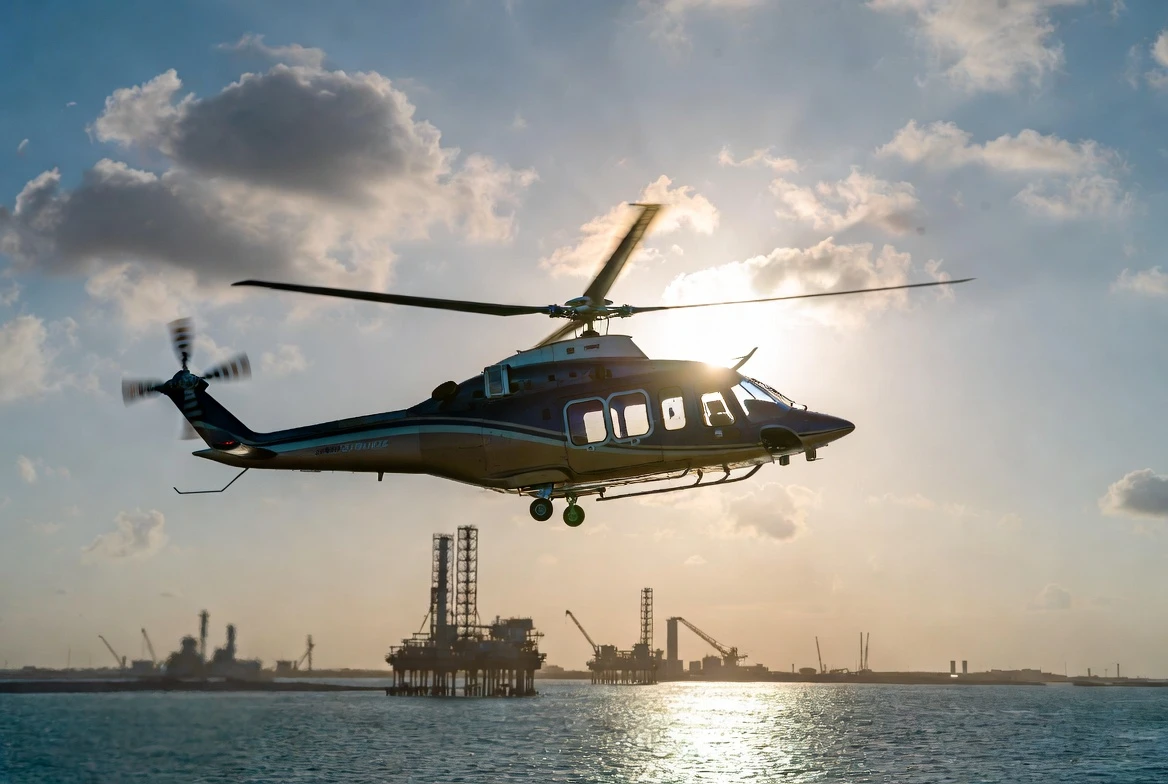
A photo distributed by SPA and published by Asharq Al-Awsat shows a Leonardo AW139, the same model operated in Aramco’s aviation fleet, with a seating capacity of 14 passengers. The aircraft, used for routine offshore transport, is at the centre of the investigation now under way. The flight came down on approach to Ras Tanura airport after a round trip to an offshore installation.
A Look at the Aircraft
The Leonardo AW139 is a twin-engine helicopter widely used in offshore and corporate transport roles. Aloula Aviation, a wholly owned subsidiary of Saudi Aramco, operates the fleet that includes the crashed aircraft, according to the helicopter’s flight data and registration record. The aircraft, registered HZ-AL65, was destroyed in the accident, the aviation database entry says. Aramco had rebranded the aviation arm as Aloula Aviation, a wholly owned subsidiary that now operates over 60 aircraft for the company.
ADS-B tracking recorded the final data point north of Ras Tanura airport at 06:11 local time on Sunday, in a steep descent. The flight phase is listed as “approach,” and the destination airport is Ras Tanura, code OERT.
Why This Refinery Matters More Than Most
Ras Tanura is more than a port. It hosts the largest refinery in the Middle East, one operated by Saudi Aramco, the national oil company of Saudi Arabia, the Jerusalem Post reported. The terminal sits on the kingdom’s eastern coast, the closest mainland point on the Gulf to the Strait of Hormuz, the narrow waterway that handles a significant share of seaborne oil. Crude loadings at the terminal had been halted for nearly four months, according to Reuters reporting cited by Al Jazeera and the BBC. Aramco had resumed loading at the site on Friday, ahead of Sunday’s crash.
The four-month pause at Ras Tanura followed the US-Israeli war on Iran, Al Jazeera reported, citing Reuters. The conflict pushed Iranian retaliation into Gulf Arab airspace, hitting Saudi airports, oil fields, and cities. Saudi Arabia, the world’s biggest oil exporter, joined a rush to move cargoes as Middle East producers ramped up oil and gas output and exports ahead of an interim deal to halt the war. Operations at the terminal only restarted on Friday, with Sunday’s crash following at the same site.
The crash came days into a freshly restarted loading schedule at the terminal, a four-month pause that mirrors the wider disruption that hit Gulf energy infrastructure during the war. Al Jazeera said Aramco resumed crude oil loading at the Ras Tanura terminal in the Gulf “after being halted for nearly four months because of the US-Israeli war on Iran.”
A return to active loading at Ras Tanura had been the clearest sign of a regional energy market coming back online. The war had throttled exports across the Gulf, and the four-month halt at Ras Tanura was the highest-profile pause. Sunday’s crash interrupted the restart, even as the cause of the accident remained unknown.
A Day of Condolences From Across the Arab World
On Monday, the day after the crash, several Arab governments moved quickly to express solidarity. Jordan’s official spokesperson for the Ministry of Foreign and Expatriate Affairs, Ambassador Fouad Majali, affirmed Jordan’s “full solidarity with the Kingdom” and extended sincere condolences to the families of the dead, according to the condolence messages from Arab leaders. The Sultanate of Oman, in a statement issued by its Ministry of Foreign Affairs, expressed “sincere condolences and heartfelt sympathy” to Saudi Arabia and to the families. Messages of condolences poured in from leaders of the United Arab Emirates, Bahrain, and Palestine, including UAE’s solidarity message after the crash, Asharq Al-Awsat reported.
Secretary General of the Gulf Cooperation Council Jasem Albudaiwi expressed his deep sorrow over the tragic incident and extended sincere condolences to the Saudi leadership and people. MWL Secretary-General and Chairman of the Organization of Muslim Scholars Sheikh Dr. Mohammed Al-Issa expressed the league’s deep sorrow over the tragic incident, according to the MWL’s condolence statement. The pattern of regional sympathy that followed the crash echoes a familiar Arab response to fatal incidents in the Gulf, including the condolences after a regional air crash that followed a military training accident in Egypt.
- Jordan: Ambassador Fouad Majali, foreign ministry spokesperson
- Oman: Ministry of Foreign Affairs statement
- United Arab Emirates, Bahrain, Palestine: leaders sent messages
- GCC: Secretary General Jasem Albudaiwi
- Muslim World League: Secretary General Sheikh Dr. Mohammed Al-Issa
- Kuwait: Foreign Minister Sheikh Jarrah Jaber Al-Ahmad Al-Sabah
A separate diplomatic exchange placed the crash in the kingdom’s active foreign policy diary. Saudi Minister of Foreign Affairs Prince Faisal bin Farhan bin Abdullah received a phone call from his Kuwaiti counterpart, Sheikh Jarrah Jaber Al-Ahmad Al-Sabah, on Sunday, with the Kuwaiti minister offering sincere condolences and heartfelt sympathy over the dead.
The energy ministry extends its deepest condolences and sincere sympathies to the families of the victims.
The Investigation So Far
The Saudi Energy Ministry said an investigation is underway, with the participation of relevant authorities, to determine the cause, the Jerusalem Post reported. SPA gave no preliminary indication of what brought the helicopter down. Aramco did not immediately comment when approached by the BBC, and the company had not issued a public statement on the crash as of Monday.
The Saudi Energy Ministry made the condolence statement through the official Saudi Press Agency on Sunday, hours after the crash. The ministry’s role in announcing the toll and opening the investigation puts it at the centre of the public response. The Saudi Press Agency has not reported any indication of hostile action, according to the BBC’s coverage. The aviation database’s confidence rating on the crash entry is “information is only available from news, social media or unofficial sources.” The next official word is expected from the Saudi Energy Ministry, which opened the investigation.
