
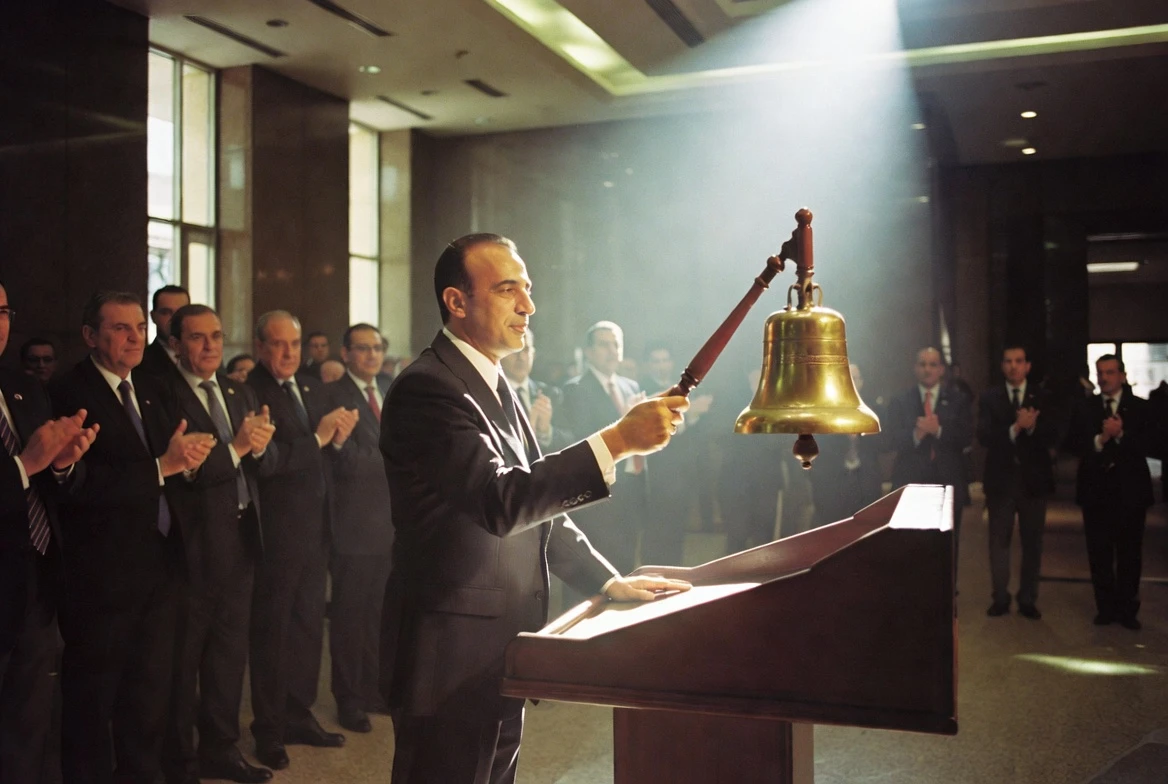
Egypt’s stock exchange rang the opening bell on Sunday for the temporary listing of four state-owned companies under the government’s privatization program, the latest visible step in a 30-company pipeline tied to Egypt’s IMF program. Three of the four are petroleum firms: Engineering for the Petroleum and Process Industries (ENPPI), Egyptian Linear Alkyl Benzene Company (ELAB), and Petroleum Marine Services (PMS). The fourth, Maamoura for Construction and Tourism Development, sits under the Holding Company for Tourism and Hotels. The Sunday ceremony at the EGX headquarters in Smart Village drew the deputy prime minister for economic affairs, the petroleum minister, and the heads of the State Ownership Unit and the Financial Regulatory Authority. The government has now temporarily listed 20 of the 30 companies it announced under the program, and the four on Sunday are non-tradable, pre-IPO placeholders, with the actual share sales still ahead.
The Four Listings at a Glance
The four companies span petroleum services and tourism infrastructure, with issued capital ranging from $120 million at the low end to $357.1 million at the top. Three of them sit inside the petroleum ministry’s portfolio, and the fourth is a tourism and construction arm of the Holding Company for Tourism and Hotels. Together they raise the count of temporarily listed state firms to 20 of the planned 30, the State Ownership Unit said on Sunday.
The issued capital on display is dominated by ENPPI at $357.1 million, almost three times the size of PMS at $120 million. ELAB, the linear alkyl benzene producer, sits in the middle at $210 million. Maamoura, the tourism company, is denominated in Egyptian pounds at EGP 250 million and is the only one of the four outside the petroleum sector.
| Company | Sector | Issued capital | Parent |
|---|---|---|---|
| ENPPI | Petroleum services | $357.1M | Petroleum Ministry |
| ELAB | Linear alkyl benzene | $210M | Petroleum Ministry |
| PMS | Petroleum marine services | $120M | Petroleum Ministry |
| Maamoura | Construction and tourism | EGP 250M | Holding Co. for Tourism and Hotels |
The Officials’ Case for the Listings
Each of the five officials who took the lectern on Sunday framed the four listings as a structural shift for the EGX. EGX Chairman Omar Reda called the listings a “significant milestone in strengthening Egypt’s capital market and enhancing its role as a platform for financing economic growth.” He said the energy and tourism additions would “broaden the exchange’s sectoral diversity, improve market depth, increase liquidity and provide investors with a wider range of investment opportunities.” Deputy Prime Minister for Economic Affairs Hussein Issa tied the listings to the government’s wider program to “maximize returns from state-owned assets, improve corporate governance, enhance competitiveness and expand private-sector ownership.”
Petroleum and Mineral Resources Minister Karim Badawi said the three petroleum listings mark the “official launch of the first phase of the ministry’s listing program.” Assistant Prime Minister and CEO of the State Ownership Unit Hashem El-Sayed said those three are the first tranche of a planned ten-company pipeline prepared by the ministry.
The government has already completed the temporary listing of 20 of the 30 announced under the privatization program, covering both the public enterprise and petroleum sectors ahead of their eventual public offerings.
Hashem El-Sayed, the assistant prime minister and CEO of the State Ownership Unit, said this at the EGX in Smart Village on Sunday. He also tied the program to “a comprehensive structural reform agenda developed in coordination with international partners, including the European Union, the International Monetary Fund and the World Bank.”
Financial Regulatory Authority Chairman Islam Azzam said the petroleum additions would “diversify Egypt’s capital market and deepen investment opportunities.” He said the regulator is committed to “facilitating listing procedures and promoting stronger standards of governance, transparency and corporate disclosure.” What the officials did not address on Sunday is when the non-tradable shares will begin trading. The four Sunday companies are book entries on the EGX, with no shares yet on offer. The cash side of the program lives in the next phase, when the temporary listings convert into tradable public offerings.
The Mechanics of a Temporary Listing
A temporary listing on the EGX is a pre-IPO step that does not involve a sale. It registers a company’s shares in the exchange’s database so the firm becomes visible to investors, but the shares are not yet tradable. Sada Elbalad reports the listings are “intended to pave the way for future public offerings as part of the state’s broader asset monetization strategy.”
- Adds the company to the EGX database
- Puts the issued capital on public record
- Creates a public corporate identity ahead of a future IPO
- Leaves shares non-tradable until a later offering
Each of the four companies on Sunday now has a profile in the EGX system, and their issued capital is on public record, but no shares have changed hands. The move gives the companies a public corporate identity ahead of a future IPO or stake sale. El-Sayed framed the listings as work “ahead of their eventual public offerings.” None of the four companies’ shares can be bought or sold on the EGX as of Sunday.
The pre-IPO step lets the state and its advisers gauge investor appetite, polish disclosure, and time the eventual sale to market conditions. For now, the four companies are book entries the EGX can point to. They remain unavailable to retail investors as of Sunday.
The 30-Company Pipeline and Its Pacing
The four Sunday listings are the latest slice of a 30-company program the government has been assembling in tranches. El-Sayed said Sunday that 20 of those 30 have now been temporarily listed, with the remaining 10 still in the pipeline. The petroleum ministry alone is preparing a ten-company pipeline of its own, the first three of which appeared on Sunday.
The program’s design has been built up in pieces. In February, the government’s 20-company roster plan reported a separate 20-company roster of state firms, focused on pharmaceutical, mining, and chemical companies, with a potential 10 to 20 percent stake sale in Misr El Gadida for Housing and Development on the list. The Sunday list spans petroleum services and tourism, a different sector mix. The two rosters share the same 30-company cap, but the Sunday names sit in a different bucket from the February plan.
The petroleum tranche is the largest single sector on the program. Sunday’s three petroleum listings are the first of ten the ministry is preparing. The petroleum sector has been the slowest of the major state sectors to open up, with the ministry spending months on legal and financial groundwork for the listings. Maamoura, the tourism and construction company, is the only non-petroleum name on Sunday’s list and the only one denominated in pounds.
A temporary listing does not raise money; an IPO does. The four companies on Sunday are book entries on the EGX, with no shares yet on offer. The cash side of the program lives in the next phase, when the temporary listings convert into tradable public offerings.
The IMF Anchor
Egypt’s privatization push is not a domestic-only program. El-Sayed, the head of the State Ownership Unit, said Sunday the program is part of a “comprehensive structural reform agenda developed in coordination with international partners, including the European Union, the International Monetary Fund and the World Bank.” The IMF’s program for Egypt runs through a series of reviews tied to the release of financing tranches, and a government source on the IMF loan review said in May the current phase involves finalizing the listing of 30 state-owned companies. The acceleration of the state privatization program and further budget consolidation are the main requirements the Fund has set for the period ahead.
The reviews are timed to disbursements. In February, EnterpriseAM reported the IMF’s Executive Board had penciled in February 25 to greenlight the fifth and sixth reviews, releasing a combined $2.3 billion (split between $2 billion from the Extended Fund Facility and $300 million from the Resilience and Sustainability Trust). The seventh and eighth reviews were expected later in the year. Each tranche is a checkpoint on the privatization program, and the listings the government announces are part of the evidence it shows the Fund.
The Fund’s review schedule has slipped in the past. The seventh review, originally scheduled for mid-March, was pushed back to late April or May after delays in the fifth and sixth, a source familiar with the negotiations told EnterpriseAM in February. The eighth review, scheduled for October, could also be pushed back, the same source said. With Sunday’s four listings, the government can now point to 20 of 30 named companies on the EGX, a number it can carry into the next review.
The Gap Between Listing and Selling
Twenty companies temporarily listed is a number the government can quote. The figure counts pre-IPO registrations, a stage that comes before any asset changes hands. The Sunday listings put the four new companies into the EGX database, with no shares offered to the public and no cash to the treasury.
The earlier phases of the program have produced real cash, but slowly, with a hiatus the government was openly trying to break in February, when it published a separate 20-company roster, and Egypt’s privatization proceeds and history shows the same pattern of stop-start sales. The actual cash from each tranche depends on the size of the eventual offer, the price set at IPO, and how much of the company the state chooses to retain. The four Sunday listings, by their nature, contribute zero to the cash count today, and the cash side of the program lives in the next phase, when the temporary listings convert into tradable public offerings. The market’s verdict on the four newcomers will arrive only when shares start trading on a board that has been seeing the EGX30 climbing in a recent session. The next test is whether the temporary listings convert into tradable IPOs on a schedule the IMF accepts.
Frequently Asked Questions
What does “temporary listing” mean on the EGX?
A temporary listing registers a company’s shares in the EGX database so it becomes visible to investors, but the shares are not yet tradable. The step is a pre-IPO placeholder ahead of an eventual public offering or stake sale. The four companies listed on Sunday, like the 16 before them, fall into this category.
Which four companies were listed on Sunday?
Three petroleum companies: Engineering for the Petroleum and Process Industries (ENPPI) at $357.1 million issued capital, Egyptian Linear Alkyl Benzene Company (ELAB) at $210 million, and Petroleum Marine Services (PMS) at $120 million. The fourth is Maamoura for Construction and Tourism Development, a subsidiary of the Holding Company for Tourism and Hotels, with EGP 250 million in issued capital.
How many state-owned companies has Egypt temporarily listed so far?
Twenty of the 30 companies the government announced under the privatization program have been temporarily listed, according to Hashem El-Sayed, the assistant prime minister and CEO of the State Ownership Unit, speaking at the EGX on Sunday. The 30-company target covers both the public enterprise and petroleum sectors.
Why is the IMF mentioned in Egypt’s privatization program?
Egypt’s privatization push is part of a structural reform agenda the government developed with the European Union, the International Monetary Fund and the World Bank, El-Sayed said on Sunday. The IMF’s program for Egypt runs through a series of reviews tied to the release of financing tranches, with the acceleration of privatization a key condition. Each review is a checkpoint on the program’s progress.
When will the four companies’ shares start trading?
The four companies’ shares are not yet tradable. The temporary listings are a pre-IPO step, and the actual public offerings, with offer prices, share counts, and timing, are decided in a later phase. The government has not yet announced dates for the four companies’ IPOs.
