
About 70 percent of Saudi Arabia’s territory is classified as desertification-affected, placing the Kingdom among the most land-stressed major economies globally. Four years into the Saudi Green Initiative (SGI), Riyadh has restored its first one million hectares of degraded land, a milestone the Food and Agriculture Organization of the United Nations (FAO) highlighted on World Environment Day as evidence that arid-region recovery can be scaled.
The partnership between Riyadh and FAO reaches back more than six decades, to irrigation projects in Wadi Jazan in southwestern Saudi Arabia in the early 1950s. Today the collaboration covers rangeland restoration, national park management, and food security strategy for a country that imports roughly 80 percent of its food and holds no permanent rivers or lakes.
Seventy Percent Under Pressure
Saudi Arabia’s desertification crisis has several simultaneous drivers. Rapid development, intensive overgrazing by livestock, and rising average temperatures have stripped vegetation from vast sections of the country. By 2019, World Bank analysis of land restoration in Saudi Arabia found, land degradation had consumed 20 million hectares, more than 10 percent of the Kingdom’s territory, and the country had lost roughly half its tree cover over the prior two decades.
The underlying geography provides little buffer. Less than 2 percent of Saudi Arabia’s land qualifies as arable. Annual rainfall averages below 100 millimeters across most of the country, and active sand encroachment from dune systems directly threatens agricultural plots, infrastructure, and pastoral communities that depend on rangeland pasture.
- 70% of Saudi land classified as desertification-affected, per PwC analysis of land degradation in the Kingdom
- 20 million hectares consumed by land degradation as of 2019 (World Bank)
- 50% of estimated tree cover lost over the prior two decades (World Bank)
- Less than 2% of territory classified as arable land
The UN Environment Programme estimates land degradation costs the global economy $10 trillion annually through lost productivity, soil erosion, and biodiversity collapse. For an economy pivoting away from oil dependence, those losses fall precisely on the agricultural sectors Vision 2030 is counting on to expand.
What FAO Brings to Arid Ground
The FAO operates in Saudi Arabia through a defined program architecture. The SRADP, the Sustainable Rural Agricultural Development Programme, is the central implementation vehicle: FAO and MEWA (the Ministry of Environment, Water and Agriculture) run it jointly, while the NCVC (the National Center for Vegetation Cover Development and Combating Desertification) leads field execution, managing forests, rangelands, and national parks across the Kingdom. FAO and NCVC have also built a joint learning and skills development hub, providing access to training resources on sustainable land management for practitioners across the restoration network.
| Institution | Primary Role | Key Responsibilities |
|---|---|---|
| FAO (Food and Agriculture Organization of the United Nations) | Technical advisory and reporting | SRADP co-implementation, UNCCD reporting, 124-site land degradation mapping dashboard, joint training hub with NCVC |
| NCVC (National Center for Vegetation Cover Development and Combating Desertification) | Field execution of national restoration plan | Reforestation, rangeland restoration, sand encroachment control, early warning systems for dune movement |
| MEWA (Ministry of Environment, Water and Agriculture) | Policy governance and coordination | Agricultural strategy, water resource management, restoration target-setting aligned to Vision 2030 |
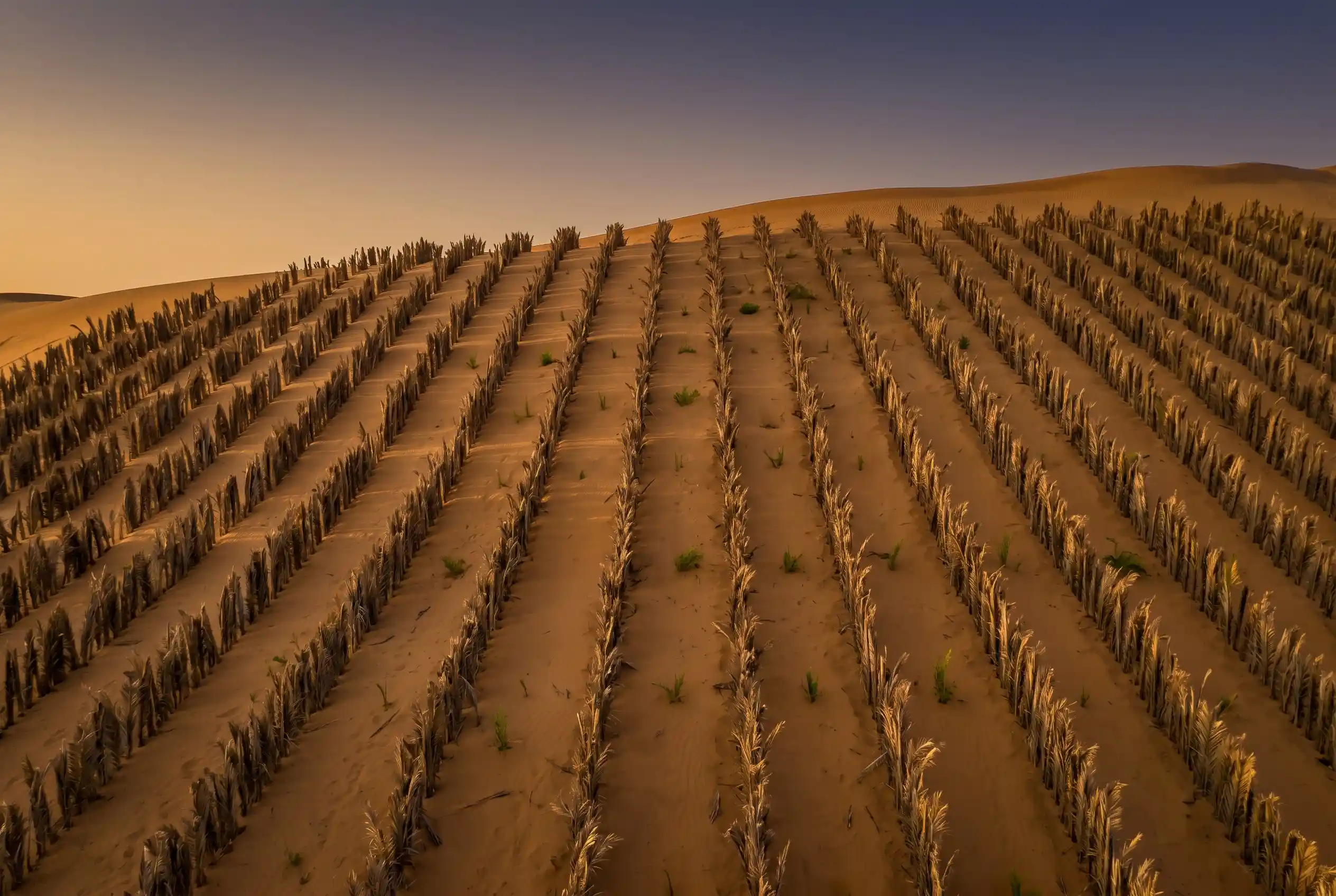
With FAO technical support, NCVC built a national plan covering early warning systems for sand encroachment, reforestation drives, rangeland restoration, and community-led land rehabilitation in priority zones including Al Jouf, Tabuk, and the Eastern Region. FAO also supported Saudi Arabia’s submission to the UN Convention to Combat Desertification (UNCCD) with land degradation mapping at 124 sites across the Kingdom, using satellite data layers, decision-support maps, and a visual dashboard to track progress. By distinguishing land that is degraded and recovering from land actively worsening, the mapping lets managers allocate restoration resources where they carry the most effect.
Two specific projects capture the ground-level scope. The Al Baydha regeneration model near Makkah integrates traditional Bedouin water-harvesting structures with permaculture methods adapted for hyperarid conditions. At Thadiq National Park north of Riyadh, hundreds of thousands of native saplings have stabilized soils and measurably improved ecosystem health on terrain that was largely bare.
One Million Hectares, and a Much Larger Target
The Saudi Green Initiative, launched in March 2021, set three headline restoration commitments for the Kingdom:
- Plant 10 billion native trees within Saudi Arabia by 2030
- Restore 40 million hectares of degraded land
- Convert 30 percent of the Kingdom’s territory into nature reserves
A March 2026 assessment by the G20 Global Land Initiative found that the SGI had restored its first million hectares across multiple distinct landscapes in roughly four years, including central plateau rangelands, dryland forests in the southwest, and coastal habitats. The geographic spread matters: each landscape requires different techniques, and demonstrating progress across all of them builds a more durable restoration methodology than any single-site program. The Kingdom’s protected area network expanded from 19 national parks in 2016 to more than 500, the share of protected land rose from 4 percent to 18 percent of territory, and planting campaigns have put 151 million trees in the ground against the 10-billion target.
The regional scope is larger by an order of magnitude. Through the Middle East Green Initiative (MGI), Saudi Arabia coordinates efforts to plant 40 billion trees across the wider region. The combined 50-billion-tree target across both programs represents 5 percent of the global afforestation commitment, equivalent to restoring 200 million hectares of land regionally per UNEP estimates. Riyadh has committed approximately $2.5 billion toward the MGI’s financing.
Saudi Arabia used its 2020 G20 presidency to launch the G20 Global Land Initiative with UNCCD, committing member nations to cutting land degradation by 50 percent by 2040. In December 2024, the Kingdom hosted COP16, the 16th Conference of the Parties to the UNCCD, in Riyadh. The UN puts the financing requirement for restoring 1.5 billion hectares of degraded land globally by 2030 at a minimum of $2.6 trillion.
The Food and Water Calculation
Saudi Arabia was once a significant wheat exporter, achieving grain self-sufficiency through groundwater irrigation in the 1970s and 1980s. The strategy worked until the aquifers didn’t: ancient water reserves accumulated over millennia were drawn down faster than any seasonal rainfall could replenish them. The Kingdom phased out domestic wheat cultivation in the 1990s and is now among the world’s most food-import-dependent major economies, spending more than $20 billion annually on wheat, rice, barley, poultry, dairy, and other agricultural commodities from dozens of countries.
Dr. Nizar Haddad, FAO Programme Director in Saudi Arabia, framed the restoration work as a strategic investment in food security, water security, and sustainable livelihoods alongside its environmental role. The connection is physical. Restored rangeland retains soil moisture, limits erosion, and reduces irrigation demand. Vegetation cover increases soil permeability and slows evaporation, which matter considerably in a country managing scarce freshwater resources under rising demand from a growing population and an expanding tourism sector.
Vision 2030’s agricultural targets make the land-productivity link concrete. The Kingdom aims to double agricultural output by 2030. Saudi agricultural GDP reached approximately SAR 114 billion in 2024, a record that already exceeded interim projections per the Vision 2030 food and agriculture sector annual report. King Abdullah University of Science and Technology (KAUST) is extending the scientific layer through SAUDINet, a terrestrial ecology research initiative adding biodiversity monitoring and carbon sequestration data to the land management picture. Saudi Arabia’s Ministry of Environment, Water and Agriculture has also announced agriculture investment opportunities in the Jazan region, tying land rehabilitation directly to sector expansion plans.
Saudi Arabia’s Public Investment Fund (PIF) has described food security as a core element of national resilience, with investments in controlled environment agriculture, aquaculture, and food processing technology positioned as economic diversification aligned with Vision 2030, per PIF’s own published strategy.
A Tension Built Into Vision 2030
The scientific literature introduces a complication. A 2025 study published in Scientific Reports examining Saudi desertification from 1990 to 2023 found that economic growth and rising CO2 emissions significantly aggravate land degradation, while improvements in vegetation cover can reduce desertification by up to 8.7 percent. The paper’s direct conclusion: Vision 2030’s development ambitions and its environmental restoration targets create tension without green safeguards embedded in each project decision.
The material risks are identifiable. Renewable energy installations across arid zones, another Vision 2030 priority, carry unintended ecological pressures on fragile soil systems. Some of the Kingdom’s most environmentally sensitive restoration zones sit adjacent to corridors where renewable energy infrastructure and giga-project construction are advancing fastest. The competing land-use pressures are not abstract policy conflicts; they are physical proximities that require joint planning between NCVC, MEWA, and the development authorities. Brine discharge from coastal desalination plants adds a further pressure on near-shore soil salinity. None of these risks disqualify the programs, but managing them requires monitoring infrastructure at a resolution Saudi Arabia is still building.
In March 2025, NCVC launched a project to assess degraded vegetation cover across six western and southern regions: Makkah, Madinah, Al-Baha, Aseer, Jazan, and Najran. Using advanced remote sensing, GIS mapping, and soil-water field sampling, the initiative will produce short-, medium-, and long-term rehabilitation plans calibrated to local conditions. That feedback loop is what allows the program to adjust when field results diverge from the model, turning restoration from a static target into a system that can correct itself.
Beyond Saudi Borders
FAO regards the Saudi experience as a potential template for other arid-region governments. The Kingdom has the capital to fund restoration at scale and the environmental severity to stress-test techniques under conditions more extreme than most of its neighbors face.
It is my hope that the successful efforts we have undertaken here will serve as a model for many countries around the world.
Dr. Nizar Haddad wrote those words in June 2025, marking the World Day to Combat Desertification and Drought, framing the accumulated partnership experience as an exportable body of knowledge for governments managing arid lands.
The Al Baydha project near Makkah has drawn particular attention for its community architecture. By reviving traditional Bedouin hema (collective land protection) systems alongside permaculture and rainwater harvesting, it embeds stewardship into communities that have managed arid terrain for generations. Projects built on existing community land knowledge are considerably cheaper to sustain over decades than those dependent on continued external technical input.
Saudi Arabia’s next international accountability milestone falls in the UNCCD reporting cycle, where the Kingdom’s 124-site land degradation dashboard contributes to the global assessment of progress toward 1.5 billion hectares restored by 2030. The G20 Global Land Initiative’s 2040 marker, cutting land degradation by 50 percent globally, extends the accountability horizon further.
The UN Decade on Ecosystem Restoration runs through 2030, the year the SGI’s planting and land rehabilitation targets, and Vision 2030’s primary economic transformation program, reach their main milestones.
