
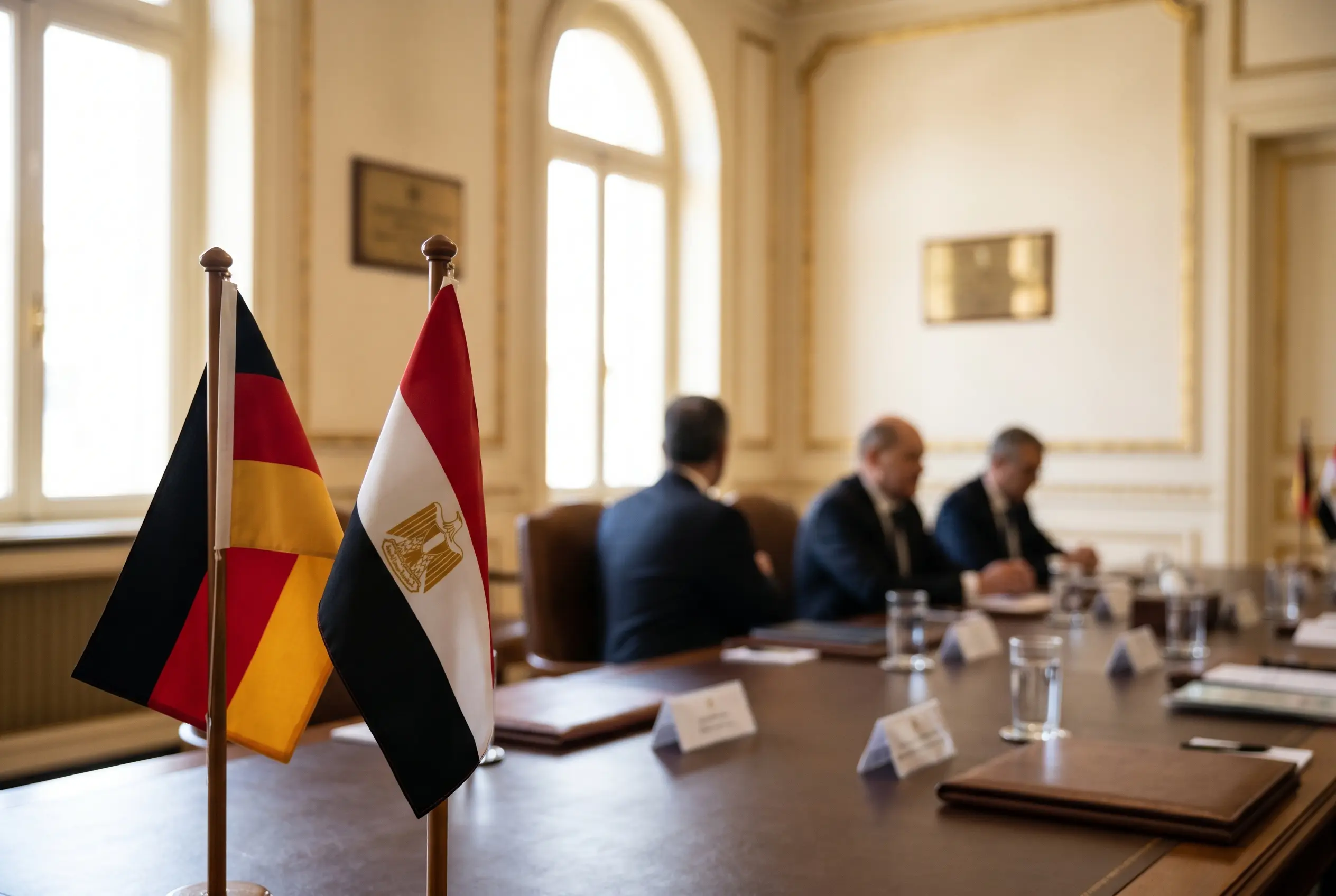
Serap Güler, Germany’s Minister of State at the Federal Foreign Office and the government’s deputy foreign minister, opened a tour of three Arab capitals in Cairo this week, telling Egyptian officials that their country has a real part to play in steadying a region crowded with crises. Sudan’s war sits at the top of her agenda, with stops in Saudi Arabia and the United Arab Emirates to follow. The trip frames Egypt as the partner Berlin wants closest as it tries to turn months of declarations into an actual ceasefire next door.
Behind the courtesy sits a specific machine. Güler’s three stops trace almost exactly the four governments that have taken charge of Sudan’s war over the past year, and one of them is accused by United Nations investigators of helping arm the force behind the conflict’s worst massacre.
Güler’s Cairo Stop Opens a Three-Capital Tour
Güler, a Christian Democratic Union (CDU, the party leading Germany’s governing coalition) politician who took the deputy minister post in May 2025, used the Cairo leg to run through the full Egyptian-German file: regional security, the war in Sudan, and the bilateral business that keeps the two capitals talking. She is not new to the dossier; she travelled to Port Sudan and Chad last October to press the same peace plan in person, and that visit gave her firsthand read on how badly the war has fractured the country.
Her public framing of Egypt was direct. “In light of the current crises facing the region, Egypt plays an important role in promoting peace, security, and regional stability,” she said in Cairo, adding that these questions would run through her meetings with Egyptian officials. The bilateral side of the talks covered economic cooperation, energy and migration; Cairo and Berlin are also deep into preparations for their joint economic committee, and she pointed to education and cultural ties she called among Germany’s closest anywhere in the region.
The itinerary reads like a regional security map:
- Cairo, the first stop, where Sudan and bilateral cooperation led the talks.
- Riyadh, where Saudi Arabia has hosted earlier rounds of Sudan diplomacy.
- Abu Dhabi, where the United Arab Emirates faces the sharpest questions about its role in the war.
Why Sudan Sits at the Center of the Trip
The war between the Sudanese Armed Forces (SAF, the national army) and the paramilitary Rapid Support Forces (RSF) began in April 2023 and has now ground into its fourth year. It has produced what aid agencies call the world’s largest displacement crisis, with famine confirmed in parts of the country and aid convoys blocked or looted on routes the warring sides control. The violence took its darkest turn last autumn.
RSF fighters seized El Fasher, the army’s last major stronghold in Darfur, in late October 2025, and the slaughter that followed drew global condemnation. A United Nations fact-finding mission concluded in February 2026 that the events bore indications of genocide against the Fur and Zaghawa communities. The scale of that catastrophe is what gives Güler’s shuttle diplomacy its urgency, and it is why a German deputy minister is spending a week in the Gulf instead of in Brussels.
The numbers behind the crisis:
- The war is in its fourth year, with no nationwide ceasefire since fighting erupted in April 2023.
- United Nations agencies count more than 12 million people driven from their homes, inside Sudan and across its borders.
- El Fasher fell to the RSF in late October 2025, ending a siege that had run for more than a year.
- UN investigators reported indications of genocide in their February 2026 findings.
The Quad Now Owns the Sudan File
For most of the war, mediation bounced between Jeddah, the African Union and a string of stalled side channels that produced paper truces nobody kept. That changed in 2025, when four governments with the most direct stakes in Sudan put their names to a single plan. The grouping, known as the Quad, brings together Egypt, Saudi Arabia, the United Arab Emirates and the United States, and it now sets the terms most outside players, Germany included, are working from.
| Member | What it brings | Where it leans |
|---|---|---|
| Egypt | Longest border with Sudan, shelter for huge refugee inflows | Close to the Sudanese army and its commander |
| Saudi Arabia | Hosted the earlier Jeddah talks, financial weight | Broadly aligned with the army, wary of the RSF |
| United Arab Emirates | Gulf money and political reach | Accused by UN investigators of backing the RSF |
| United States | Convening power, sanctions leverage | Brokered the September statement, pressing both sides |
What the September Plan Asked For
The four governments laid out the roadmap in a joint statement on restoring peace and security in Sudan on September 12, 2025. It called for a three-month humanitarian truce to open aid routes, a permanent ceasefire to follow, and a transition to a civilian-led government to be completed within nine months. The plan rests on three claims: Sudan’s unity is non-negotiable, the suffering is intolerable, and there is no battlefield victory worth chasing.
How Berlin Plugged In
Germany’s entry point was the conference circuit. In April, Berlin hosted the third international conference on Sudan, where co-hosts including the African Union, the European Union, France, the United Kingdom and the United States endorsed a set of guiding rules now known as the Berlin Principles for Sudan. Egypt, Saudi Arabia and the UAE signed on too. The text is blunt about the core question.
There is no military solution to this conflict.
That single line is the glue holding the four-nation group and its European backers together. It is also where the contradiction starts, because at least one signatory is widely accused of fuelling exactly the military solution the document rules out.
The UAE Problem Germany Cannot Avoid
The awkward part of Güler’s itinerary is the last stop. The UAE has spent the war denying it backs the RSF, but the evidence pointing the other way keeps stacking up. United States intelligence assessments tracked an increase in Emirati weapons reaching the paramilitaries from late summer into the autumn of 2025, and the advocacy group Refugees International set out fresh evidence of Emirati support fuelling the killing, including Chinese-made drones and Colombian mercenaries deployed around El Fasher as it fell.
That puts Germany in a tight spot. It is backing a peace coalition that seats a government UN investigators and US intelligence link to the force behind the worst massacre of the war. The strain is visible at home. Inside the governing coalition, the Social Democrats (SPD) and the Greens have pushed for a halt to arms deliveries and tougher pressure on Abu Dhabi, while Güler has leaned on Washington to keep the process moving. She has acknowledged that the UAE’s place at the table is itself a problem for many Sudanese officials in Port Sudan, who see the Emiratis as a party to the war rather than an honest broker.
Berlin’s bind is that the same Gulf state worrying its parliament is also one of the few outside powers with real leverage over the RSF, which makes excluding it from the talks as costly as keeping it in. The contradiction travels with Güler to Abu Dhabi, and it is the reason her Gulf message will be tested far more in the third capital than in the first.
Where Egypt’s Leverage Comes From
Egypt’s value to Germany on Sudan is mostly geographic and political. Cairo shares Sudan’s longest border, has absorbed a vast inflow of Sudanese fleeing the fighting, and keeps close ties to General Abdel Fattah al-Burhan, the army chief who runs Sudan’s internationally recognised government. When Berlin wants a line into the army’s camp, Egypt is the obvious channel, and that access is worth more than any communiqué.
Cairo also carries a longer résumé as a regional fixer. It has positioned itself at the centre of the Gaza ceasefire negotiations, hosting rounds and shuttling messages between sides that will not speak directly. That broker habit, paired with its army-to-army relationship with Sudan’s generals, is exactly what Güler is trying to tap on this trip.
The bilateral relationship gives the visit ballast too. Germany is one of Egypt’s larger European trading partners, and the two are preparing the next session of their joint economic committee, covering trade, investment and energy. Migration runs through all of it: Egypt sits on a route Europe watches closely, which gives Berlin a standing interest in keeping Cairo onside well beyond the Sudan file.
A Framework Signed Without the Fighters
For all the signatures, the Berlin gathering had a glaring absence: neither the army nor the RSF was in the room. The principles were endorsed by governments and civilian figures, while the two forces actually doing the fighting signed nothing and have shown little interest in the truce timeline. Donors at the April conference pledged roughly €1.5 billion (about $1.6 billion) in humanitarian funding, money that matters for the displaced but does nothing on its own to quiet the guns.
That gap is why analysts are cautious. The International Crisis Group has argued the roadmap could stall until the combatants face real consequences for ignoring it, and so far the RSF has kept advancing in Darfur and Kordofan even as the diplomacy churns. Güler’s tour is an attempt to close that gap by squeezing the Quad’s members, each of whom holds sway over one side or another, into actually leaning on their clients.
Güler flies on to Riyadh and Abu Dhabi with the same plan in her bag and the same problem waiting at the end of it: the two armies doing the killing have signed nothing.
