
The India-Middle East-Europe Economic Corridor was unveiled as a faster bridge for goods, energy and data. After the Iran war exposed what the European Council on Foreign Relations calls a $25bn warning around the Strait of Hormuz, the question has changed: can a corridor built for normal politics survive when trade routes become targets?
The answer now depends less on rail engineering than on redundancy. A May 22, 2026 paper by Cinzia Bianco, visiting fellow at the European Council on Foreign Relations, and Arturo Varvelli, head of ECFR Rome and senior policy fellow, argues that Europe should redesign the route for the grey zone between war and peace, where the cheapest path can become the most fragile one.
A Peacetime Corridor Meets a Chokepoint War
At the Group of 20 summit in New Delhi, the India-Middle East-Europe Economic Corridor (IMEC, a rail, port, cable and energy route) looked like the diplomatic version of a shortcut. The corridor’s founding memorandum committed Saudi Arabia, the European Union, India, the United Arab Emirates (UAE, a federation of Gulf emirates), France, Germany, Italy and the United States to build a link between Asia, the Arabian Gulf and Europe.
The original design had two parts: an eastern section from India to the Gulf, and a northern section from the Gulf to Europe. It also bundled rail with electricity cable, digital cable and clean hydrogen pipe. That mix made sense when the main assumption was smoother trade. It looks thinner when missiles, port capacity and public anger decide whether cargo moves.
| Design Question | Peacetime Plan | Wartime Problem |
|---|---|---|
| Route logic | Use the fastest ship-to-rail path from India to Europe. | Build several paths that can absorb a closed strait or a hit port. |
| Political assumption | Arab normalisation with Israel keeps widening. | Gulf partners avoid visible dependence on Israeli infrastructure. |
| Energy exposure | Connect energy flows into a wider trade corridor. | Oil and gas routes become pressure points in every regional crisis. |
| European role | Finance, standards and diplomatic backing. | Route arbitration, insurance confidence and crisis coordination. |
That table is why the project has slipped from infrastructure to statecraft. A railway can be engineered around desert, customs checks and port cranes. It cannot be engineered around a partner’s fear that joining the route will place its oil terminals, rail junctions or data cables on an adversary’s target list.
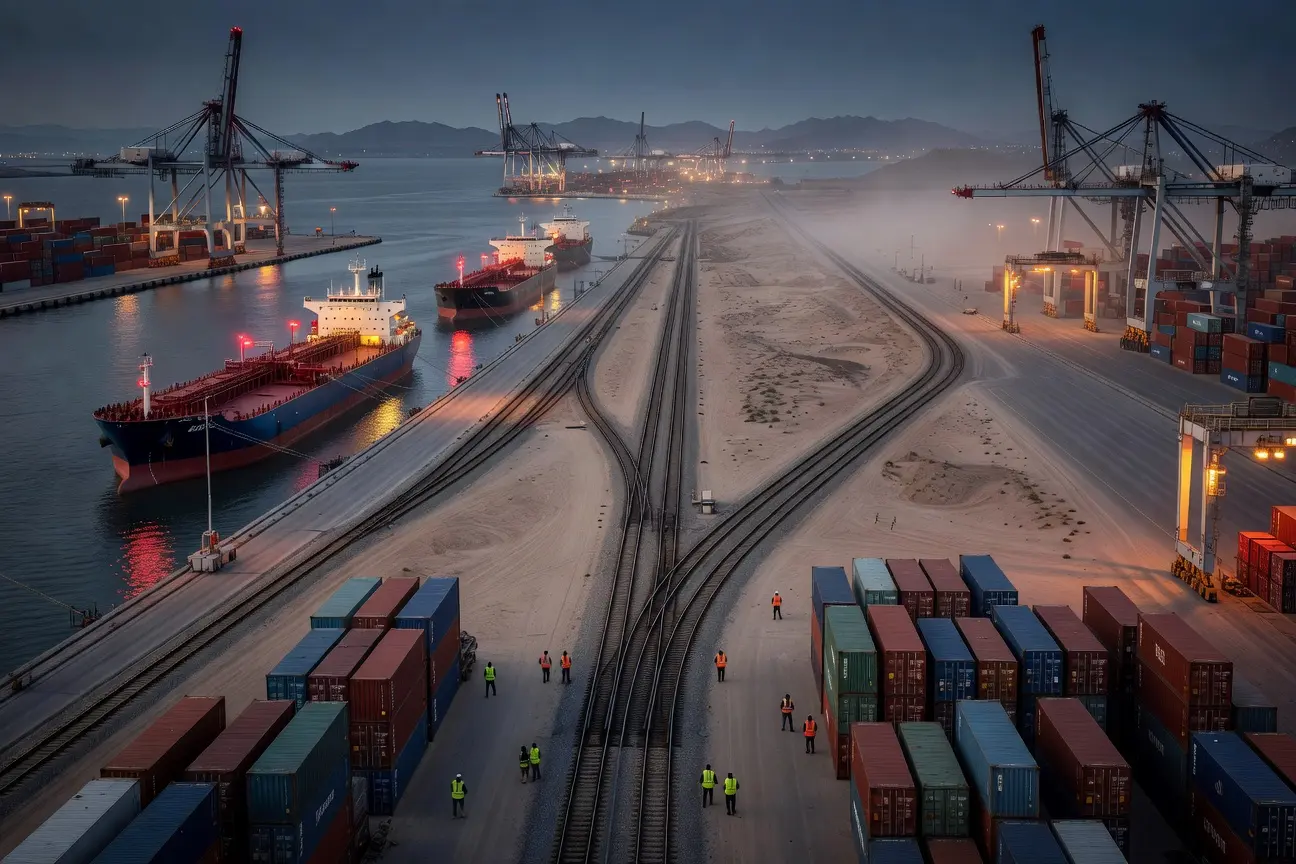
Hormuz Turns Redundancy Into the Main Product
The International Energy Agency (IEA, a Paris-based energy security body) puts the exposure in hard numbers. Its Strait of Hormuz energy factsheet says the waterway carried an average of nearly 20 million barrels per day (mb/d) of oil and oil products in 2025, around a quarter of world seaborne oil trade.
- 20 million barrels per day moved through the strait in 2025, with most flows heading to Asian markets.
- 3.5 to 5.5 mb/d of estimated alternative crude pipeline capacity could bypass the strait through Saudi Arabia and the UAE.
- 93% of Qatar’s LNG and 96% of the UAE’s liquefied natural gas (LNG, gas chilled for tanker shipment) exports transit the same chokepoint, according to the IEA.
Those figures do not kill the corridor. They make the old sales pitch too small. Faster trade is valuable only if it keeps moving during a crisis. Saudi Arabia’s East-West pipeline to the Red Sea and the UAE’s route to Fujairah show the logic: countries with spare exits can keep selling, while countries tied to one passage lose leverage fast. For Europe, the lesson is blunt. A corridor that cannot route around fear will struggle to attract freight, insurance and long-term political support.
Israel Becomes the Corridor’s Political Bottleneck
ECFR’s sharpest point is political. The Abraham Accords, the 2020 normalisation agreements between Israel and the UAE, Bahrain, Morocco and Sudan, once made a wider Gulf-Israel trade architecture seem plausible. The Hamas-led attack on Israel in 2023 and Israeli military campaigns in Gaza, Lebanon, Yemen and Iran changed the public cost for Gulf rulers. Saudi Arabia can still work quietly with many partners, but a route that visibly depends on Israel is harder to sell at home and easier for Iran to portray as hostile.
This implies a willingness among Saudi Arabia and other Arab states to sideline initiatives such as IMEC if they entail structural dependence on Israel
Bianco and Varvelli wrote that line in their May 2026 corridor redesign paper. Israel still has a role: India, the United States and Germany would likely resist a version that excludes it. The harder issue is political consent from Arab partners if access to the Mediterranean depends on Israeli ports, rail and security guarantees.
Benjamin Netanyahu, Israel’s prime minister, has publicly tied a postwar answer to routing Gulf oil and gas through Israel, the ECFR authors wrote. For Riyadh, that branding would turn a trade corridor into an Iranian target list. It would also let domestic critics argue that Saudi infrastructure was being built around someone else’s war logic.
Egypt, Oman and Syria Gain Bargaining Power
This is where the map starts to move. The routes gaining attention are not always the cleanest on a planning chart, but they answer the problem the crisis has exposed. They reduce single-point dependence, lower the visibility of Israeli control, or shift cargo toward ports that sit outside the two straits now haunting Gulf exporters.
- Egypt gives Saudi Arabia a Mediterranean-facing partner outside the original blueprint. ECFR says Riyadh wants to connect Egypt to its NEOM logistics hub, while a $4bn causeway linking the Saudi coast to Sinai is underway.
- Oman offers Salalah, Duqm and Sohar, ports that sit outside the Hormuz trap. That makes Muscat more than a neutral mediator. It becomes a physical exit ramp.
- Syria is the hardest route and the boldest political bet. Saudi outreach to Damascus could support future rail and fibre links through Turkey, Syria and Jordan’s al-Haditha crossing.
- Yemen’s Hadramawt route remains a long shot, but it is the cleanest answer to Bab al-Mandab if southern factions can be given a shared economic stake.
The security case is not theoretical. The U.S. Maritime Administration (MARAD, the U.S. ship safety agency) warned in a Red Sea and Gulf of Aden shipping advisory that Houthi attacks since Nov. 1, 2023 had affected more than 55 nations. A World Bank Red Sea shipping assessment said traffic through the Suez Canal and Bab al-Mandeb had dropped by half by the end of March 2024. That is the second warning light for Europe: bypassing one strait can still leave cargo exposed to the other.
Europe’s Choice Is a Corridor Portfolio
Europe can treat those alternate routes as distractions, or it can treat them as the portfolio. The European Commission already has a policy container for the job. Its Global Gateway connectivity strategy names transport, energy and digital links as core areas and relies on a Team Europe model that brings EU institutions, member states and financing arms into the same room.
That machinery is dull in the useful way. Standards, customs systems, insurance confidence, port upgrades and diplomatic pressure decide whether a line on a map turns into a route shippers trust. Brussels does not need to pick a single winner between Egypt, Oman, Jordan, Syria or Yemen. It needs to push route redundancy as the price of public money and diplomatic blessing.
The corridor should also be designed to include regional actors where possible, rather than sort them into friends and enemies on day one. That does not mean rewarding attacks on shipping. It means building commercial stakes that make attacks costlier for everyone around the route. A trade corridor in the Middle East cannot be only a shortcut. It has to be a crisis-management tool with rails attached.
The Corridor That Gets Built May Bypass Europe First
The sting in the ECFR paper is that alternatives are already moving. Saudi Arabia is looking at Egypt. Shipping lines are testing land bridges through Egypt and Jordan. Riyadh is sounding out Damascus. Oman has the geography everyone suddenly wants. If Europe waits for the original consensus to return, it may inherit a route architecture designed by Gulf urgency, shipping company workarounds and security improvisation.
If Brussels puts money and diplomacy into redundant routes now, the corridor can still serve its founding promise without pretending the region has returned to peacetime. If it clings to the first map, the project risks becoming a commemorative document from New Delhi while freight finds rougher, quieter and less European paths around the straits.
