
Egypt’s liquefied natural gas (LNG, gas cooled to liquid form for bulk sea shipment) import bill tripled in the first quarter of this year, rising from $560 million to $1.65 billion, as the Hormuz crisis stripped Cairo of two gas supply pillars within the same fortnight. Prime Minister Mostafa Madbouly’s office confirmed on March 28 that the country’s total monthly energy import bill had jumped from $1.2 billion in January to $2.5 billion in March.
The same Iran war forcing Cairo to shutter malls at 9 p.m. is also making its Mediterranean liquefaction infrastructure the most strategically valuable non-Gulf gas export capacity in the region. Europe draws 12 to 14 percent of its LNG from Qatari cargoes that once transited the strait with routine ease. Those cargoes are now largely blocked. Egypt’s terminals, sitting on the Mediterranean coast, bypass the strait entirely.
Egypt’s Two-Front Supply Shock
The crisis came at Cairo from two directions at once. On February 28, U.S. and Israeli strikes against Iran triggered what the International Energy Agency’s (IEA) April 2026 LNG market crisis report characterized as the largest disruption to global oil supply on record. Iran declared the strait closed to hostile shipping from March 4. On March 24, QatarEnergy declared force majeure after Iranian strikes on the Ras Laffan LNG facility, the world’s largest, wiped roughly 17 percent of Qatar’s LNG export capacity.
Simultaneously, Israel’s wartime safety procedures forced the shutdown of Leviathan and Karish, the two northern offshore gas fields that had been supplying roughly 1.1 billion cubic feet per day to Egypt via pipeline. Leviathan came back online April 2; Karish reopened a week later on April 9. The 32-day closure was the longest Israeli gas supply disruption since Israel first began exporting to its neighbors, and the third such interruption in less than three years, according to analysis published by Bar-Ilan University’s Begin-Sadat Center for Strategic Studies.
Egypt’s options for rapid replacement were limited. Under normal conditions, Cairo’s gas system rests on three external sources: LNG imports including Qatari cargoes, Israeli pipeline gas, and global spot markets. The Hormuz crisis attacked all three at once.
- $2.5 billion: Egypt’s monthly energy import bill by March, up from $1.2 billion in January
- 14-30%: rise in domestic fuel prices announced by Egypt’s Petroleum Ministry
- 8%: year-on-year fall in global LNG production in March, per the IEA
- 9 p.m.: mandatory closure hour for Cairo malls, restaurants, cinemas, and other entertainment venues under emergency conservation measures
What Zohr’s Output Collapse Left Behind
The Field That Made and Unmade Egypt’s Export Ambitions
The Zohr gas field, the Mediterranean’s largest offshore discovery at the time of its announcement in 2015 and developed at speed by Italian energy firm Eni SpA, transformed Egypt into a net gas exporter by 2019. Peak output reached roughly 2.7 billion cubic feet per day in the third quarter of 2021, making Zohr the engine behind Egyptian LNG exports to countries across Europe, Asia, and the Americas. By 2025, that contribution had fallen to around 1.6 billion cubic feet per day, a decline of more than 40 percent in four years, driven by water infiltration into reservoir formations, deferred well development, and a cascading arrears problem with international operators.
Eni resumed active development at Zohr with new completions, including the Zohr-6, Zohr-9, and Zohr-13 wells reaching individual outputs of 65, 70, and 55 million cubic feet per day respectively. The incremental additions have slowed the overall decline but not reversed it. National output fell from approximately 6.8 billion cubic feet per day in 2021 to about 4 billion cubic feet per day today, according to the EIA’s Eastern Mediterranean energy briefing. Against daily consumption of roughly 6.5 billion cubic feet, that gap creates a structural shortfall of 2.5 to 3 billion cubic feet that imports must cover. Domestic power plants consume over 60 percent of all gas produced, leaving practically no buffer when the import side fails.
The Arrears Cycle and Its Partial Unwinding
The decline traced a payment loop that Cairo has been working to break. Delayed payments to international oil companies (IOCs) cut exploration budgets, which slowed drilling, which shrank output, which pressured foreign reserves, which delayed IOC payments further. At its peak in October 2024, Egypt’s accumulated arrears to IOCs reached $6.2 billion. Under Karim Badawi, Minister of Petroleum and Mineral Resources, those arrears have been cut to $1.3 billion, with full clearance pledged for June 2026.
Foreign operators responded. Eni committed $2 billion to Egyptian operations in 2026 alone, while BP pledged a further $1.5 billion across 2026 and 2027. A five-year drilling plan covering 480 wells across the Western Desert, the Gulf of Suez, Mediterranean offshore blocks, and the Nile Delta carries projected investment of over $5.7 billion. Since July 2025, more than 18 new gas and oil discoveries have been announced, mostly in the Western Desert, adding roughly 44 million cubic feet per day of natural gas production incrementally. Fitch Solutions projected an 8 percent year-on-year increase in Egyptian gas output for 2026 before the current crisis disrupted baseline assumptions.
Morgan Stanley research cited by analysts in Cairo projects Egypt returning to net gas exporter status in 2027, assuming upstream recovery holds. The shock emanating from the strait has not changed that timeline on its own, but it has sharpened urgency at every link of the recovery chain.
The Two Terminals Europe Needs
Infrastructure Left Standing
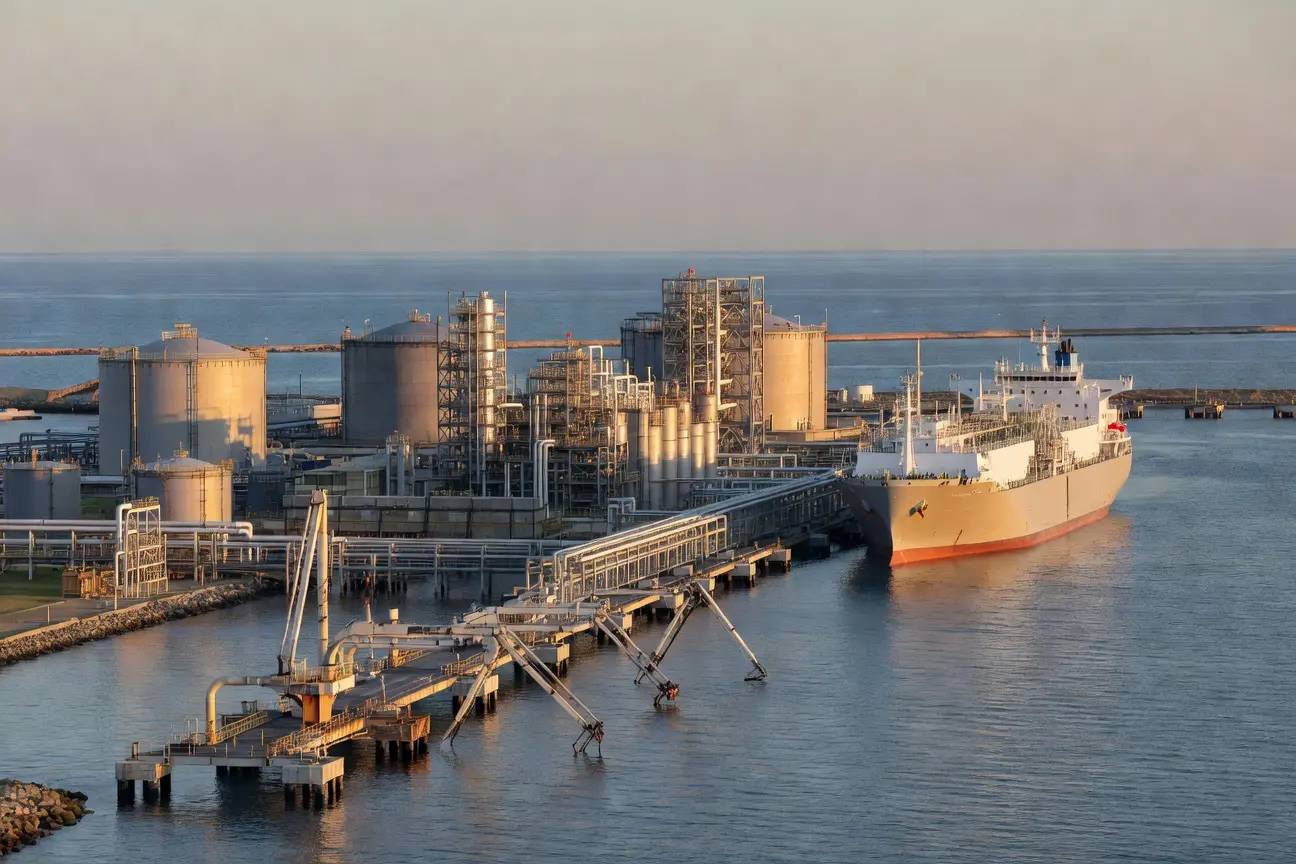
Egypt controls two large LNG export terminals on its northern Mediterranean coast, both entirely outside any Gulf shipping corridor. Together they hold 12.2 million tonnes per annum of liquefaction capacity, divided between two sites with complementary ownership structures.
| Terminal | Location | Operator | Capacity (mtpa) | Status | Primary Export Destinations |
|---|---|---|---|---|---|
| Idku LNG | Beheira, Mediterranean coast | Shell (with TotalEnergies, Petronas) | 7.2 | Operational, sporadic cargoes | Italy, Spain, France, Turkey, Canada, Greece |
| Damietta SEGAS | Damietta, Mediterranean coast | Eni / EGAS (50:50 joint venture) | 5.0 | Operational, reduced throughput | Italy; earmarked for Cyprus gas route |
In the peak export years of 2019 to 2022, these two facilities shipped regularly to European terminals. As Egypt reverted to net importer status in 2024, both slowed to occasional throughput. The Idku facility pushed out cargoes to Italy, Spain, Turkey, Canada, Greece, and Lithuania between late 2025 and early 2026, partly to service contractual obligations with Shell and Petronas and partly to generate foreign exchange against IOC arrears. Sporadic exports while simultaneously importing LNG at higher cost is an accounting paradox Cairo has lived with before; it is also the operating model it needs to resolve if the hub thesis is to be credible to long-term buyers.
The Hormuz Premium on Location
QatarEnergy’s Ras Laffan complex normally supplies a significant share of European LNG through the Strait of Hormuz, with Europe drawing 12 to 14 percent of its total LNG supply from Qatari cargoes using that route. Iranian strikes in late March damaged roughly 17 percent of Ras Laffan’s export capacity. The IEA now projects a cumulative loss of around 120 billion cubic metres of LNG supply between 2026 and 2030, combining physical damage with the knock-on effect of delayed capacity expansion. That loss reversed what had been a genuine period of market easing: global LNG trade had grown 12 percent year-on-year in the five months before the conflict, with European and Asian benchmark prices falling roughly 25 percent over that period.
European buyers responding to the shortfall imported a record volume of Russian Yamal LNG between January and April, with Yamal cargoes accounting for approximately 98 percent of that facility’s exports during the period, according to shipping data published by the environmental organization Urgewald. Political pressure within the EU to phase out Russian LNG imports by November 2027 creates a competing pull. American LNG, arriving in larger volumes from new Gulf Coast projects, provides some relief but at higher landed costs for Mediterranean delivery points compared with Eastern Mediterranean supply. The combination of lost Qatari volumes, political constraints on Russian gas, and cost differentials for long-haul American cargoes produces a specific demand signal for non-Gulf, non-Russian LNG at Mediterranean discharge terminals. As reporting on Saudi Arabia’s record crude premiums during the Hormuz crisis has documented, buyers across asset classes are already repricing Gulf supply risk. Egypt’s two terminals are the most structurally obvious answer on Europe’s side of the map.
Cronos Brings Cyprus Into Egypt’s Hub Math
The most consequential transaction in Egypt’s hub thesis is still unsigned. Eni and France’s TotalEnergies each own 50 percent of the Cronos gas field in Block 6 of Cyprus’s exclusive economic zone (EEZ), with Eni as operator. Cronos holds an estimated 3.1 trillion cubic feet of gas in place, discovered in 2022. In October 2025, Eni, TotalEnergies, and the Egyptian Natural Gas Holding Company (EGAS) signed three commercial agreements mapping a route for Cronos gas to flow via a 90-kilometer subsea pipeline to existing Egyptian offshore processing infrastructure in Mediterranean waters, then onshore for treatment, then directly to the Damietta LNG facility, bypassing Egypt’s domestic grid entirely. The Cronos field development profile sets out the infrastructure configuration in detail.
The structure concentrates value at Damietta in ways that mirror the hub model Cairo has described to investors for years:
- Cronos carries an estimated 2.5 tcf of recoverable gas, with a targeted export volume of 4 to 5 billion cubic metres per year, all earmarked for European markets
- Egypt’s petroleum minister offered to waive the standard 20 percent domestic gas allocation, directing the full Cronos export volume toward Europe
- Eni negotiated a tolling fee of roughly $1 per million British thermal units (MMBtu) and a processing tariff below $0.50 per MMBtu for using existing Egyptian infrastructure
- First gas was targeted for late 2027 or early 2028, subject to a final investment decision (FID) by Eni and TotalEnergies
- Cyprus’s cabinet approved the Cronos development plan on May 19, 2026, a domestic procedural step that keeps the project formally active
The FID, first expected by end-2025 and then Q1 2026, remains unsigned. Differences over liability for cost overruns between Cyprus and the two operators are the main reported sticking point. Long-term LNG price forecasts put the market dropping back toward $8 to $8.50 per MMBtu after 2028 as delayed U.S. and Qatari capacity eventually enters service, making the current elevated-price environment potentially the most commercially favorable window for a Cronos FID. Cyprus also holds the Aphrodite field, operated by Chevron, with an estimated 3.6 trillion cubic feet of additional recoverable gas, also routed toward Egyptian infrastructure, though Aphrodite development likely falls into the next decade.
The Paradox at Damietta Port
Egypt imported a record 8.92 million tonnes of LNG in 2025. By October of that year, S&P Global data showed the country taking in roughly 6.6 million tonnes more than it exported, a balance that had swung more than 13 million tonnes in three years from a net surplus of about 7 million tonnes in 2022. S&P Global analysts had projected 11 million tonnes of Egyptian LNG demand for full-year 2026 even before the Hormuz disruption added a new layer of pressure on that deficit.
Running a liquefaction terminal to export Cypriot gas while simultaneously importing LNG to keep Cairo’s power grid stable involves structural tension the commercial arrangements are specifically designed to manage. The Cronos pipeline bypasses Egypt’s domestic grid, routing gas directly from Cyprus to the Damietta liquefaction train. Cairo earns tolling and transit fees while the supply deficit stays a domestic accounting problem. The Middle East Economic Survey noted the optics of exporting LNG from Damietta while also importing it would be “politically awkward for Cairo,” which is precisely why the ring-fenced infrastructure design matters so much to the project’s political sustainability.
Whether European offtakers sign long-term commitments to Egyptian LNG rather than waiting for conditions at the strait to normalize, and whether the IMF, which has monitored Egypt’s fiscal trajectory through a series of support arrangements, views the transit-hub revenue model as structural or opportunistic, are the questions that will determine how durable this opening proves. Cairo’s energy import costs running at $2.5 billion per month in March create pressure on the broader fiscal consolidation effort that Badawi’s investment recovery depends on. The $1.3 billion in remaining IOC arrears pledged for clearance by June is the near-term signal the investment community is tracking most closely: settlement on schedule would confirm the reset is real and keep the Cronos FID timeline credible.
If the FID arrives before the end of this year, Egypt would enter 2027 as both a net gas importer by domestic need and a transit-and-liquefaction hub for regional production, the two roles running in parallel through separate infrastructure. If it slips again while the Hormuz situation gradually eases, the strategic window narrows. European buyers who diversified under pressure may re-sign long-term Gulf contracts as soon as passage reopens, leaving Egypt’s terminals to wait for the next crisis to prove what they are worth.
Disclaimer: This article is for informational purposes only and does not constitute financial, investment, or energy-sector advice. Energy supply conditions, commodity prices, and geopolitical developments change rapidly; figures cited reflect conditions as of the publication date. Readers making investment or business decisions in these sectors should consult qualified advisors.
