
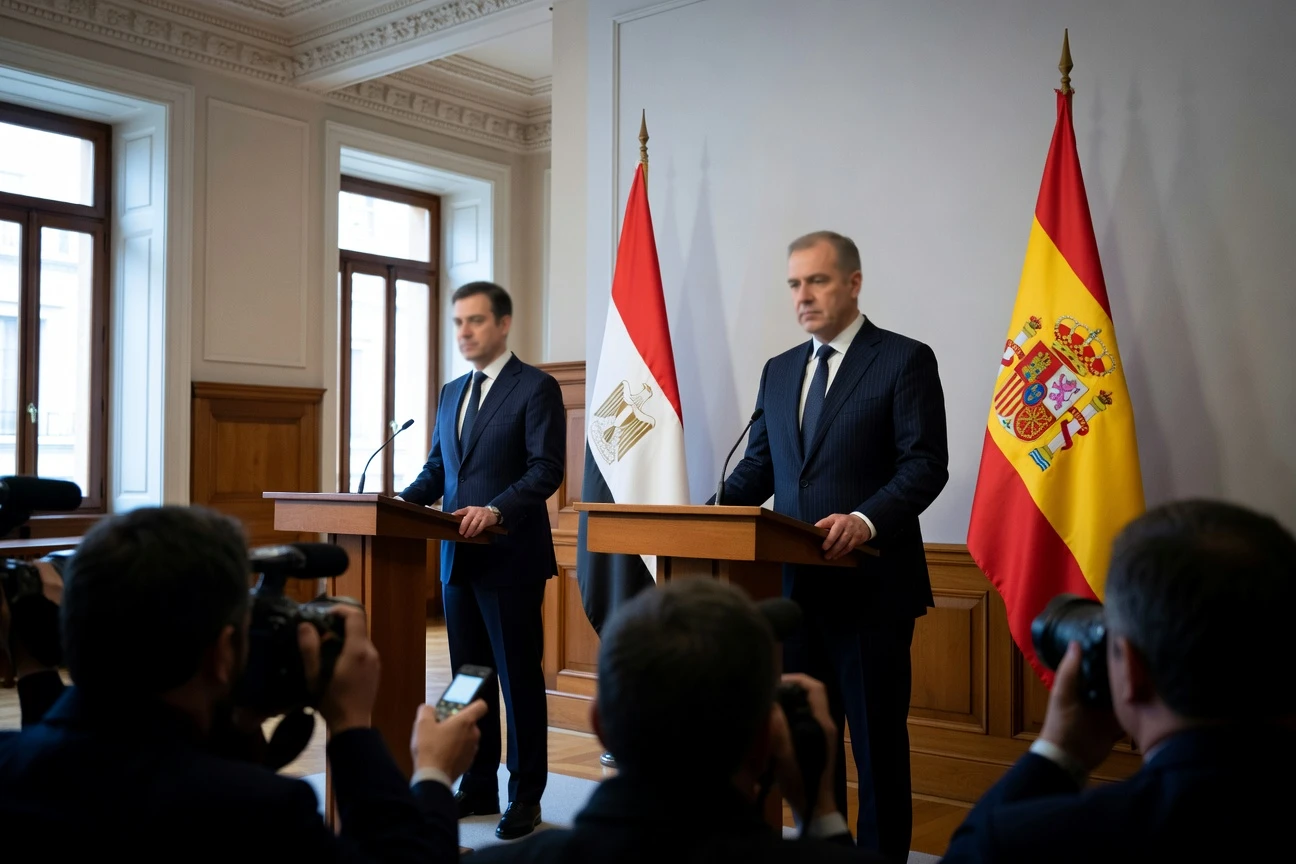
Egypt’s foreign minister told a Madrid press conference Monday there is no military solution to the Middle East crisis. Badr Abdelatty, Egypt’s foreign affairs and Egyptian expatriates minister, used the joint podium with Spain to push for a restart of direct Iran-United States talks, faster movement to phase two of US President Donald Trump’s Gaza plan, and a humanitarian truce of three to six months in Sudan.
That triple ask is the story. Spain’s José Manuel Albares, Madrid’s foreign minister, is the second-friendliest European audience after Ireland for the Palestinian state position, and the only senior European foreign ministry to lodge a formal protest over Israel’s interception of the Global Sumud Flotilla. Cairo wanted Madrid as an amplifier, not a mediator.
What Abdelatty Carried Into the Room
Monday’s briefing in Madrid was the second time in eight months Cairo and Madrid have used a joint stage to upgrade the relationship. King Felipe VI attended the November 1, 2025 inauguration of the Grand Egyptian Museum at President Abdel Fattah al-Sisi’s invitation, and the two governments signed the Egypt-Spain Partnership for Sustainable Development Program 2025 to 2030 during that visit.
Abdelatty arrived with four files in his portfolio, each at a different stage of stuck. Phase one of the Gaza ceasefire is technically holding; phase two is not moving. Iran-US nuclear talks were paused after the February strikes and an April truce, and have not resumed in any substantive form. Sudan’s war is approaching its third anniversary with no truce of any duration. And Gulf states, Jordan and Iraq have all faced cross-border incidents the Egyptian foreign minister openly called unjustified, after a spring spike in regional sirens and Trump warnings on Iran.
Cairo’s foreign ministry frames each of these as a file where Egypt holds back-channel access. The Madrid briefing was the public version of a claim that has been circulating in Arab diplomatic press releases for months: that Egypt is the only Arab capital fluent in every active regional crisis at once.
Gaza’s Phase Two Stalemate
Phase one of the twenty-point plan Trump announced in late 2025 produced a ceasefire, hostage exchanges, and a partial Israeli pullback to what the deal calls the yellow line inside Gaza. Phase two is the harder document. It requires Hamas disarmament, a full Israeli withdrawal from the strip, the start of reconstruction, and the seating of a Palestinian administrative committee inside Gaza itself, per the published twenty-point Gaza peace deal architecture.
That sequence has collapsed into a single chicken-and-egg fight. Hamas has said publicly it will not disarm until Israel has fully withdrawn. Israel has said it will not move beyond the yellow line until Hamas disarms. The US-led Board of Peace, the governance body the plan created, asked Hamas to begin a phased weapons handover by April 11; that deadline came and went without movement. The Washington Institute red-line analysis on phase two laid out the gap weeks before the deadline passed.
| Element | Phase One | Phase Two |
|---|---|---|
| Status | Implemented since October 2025 | Negotiations stalled |
| Israeli posture | Pulled back to yellow line, holds roughly two-thirds of Gaza | Refuses further withdrawal until Hamas disarms |
| Hamas posture | Released hostages on agreed schedule | Refuses to disarm until full Israeli withdrawal |
| Governance | Interim US-led Board of Peace | Palestinian committee operating from inside Gaza |
Abdelatty’s wording in Madrid was careful. He called for moving forward with the second phase and named disarmament and Israeli withdrawal as the package, but stopped short of assigning blame to either party from a foreign stage. Cairo wants to be the venue where phase two gets unstuck, not the capital that calls Israel out from Madrid.
The Egyptian position on the end-state is less ambiguous. Abdelatty repeated that no security or stability is possible without a just and lasting settlement to the Palestinian cause, and named the parameters: self-determination, an independent state, the June 4, 1967 borders, East Jerusalem as capital. That is the framework Spain already publicly recognized when Madrid extended recognition to the State of Palestine in May 2024.
An Iran Channel Cairo Wants Reopened
The Iran section of Abdelatty’s remarks was the most pointed. He explicitly hoped for a swift resumption of direct talks between Tehran and Washington, language Arab foreign ministries rarely use in public unless someone has asked them to. Negotiations have not had a working session since the April two-week ceasefire that followed the February US-Israeli strikes on Iran.
Tehran’s latest proposal to Washington, surfaced on May 19 and circulating through Pakistani intermediaries, asks the US to end hostilities on every regional front including Lebanon, withdraw forces from positions adjacent to Iran, and pay reparations for the damage of the February campaign. The Trump administration’s position has not moved off zero enrichment. Iran’s Atomic Energy Organization head has said publicly that Tehran will not accept enrichment limits. That gap, mapped in detail by a Carnegie analysis of Iran’s nuclear question after two wars, is not the kind of gap a Cairo phone call closes.
Egyptian officials have nonetheless been active on the file since President al-Sisi’s mid-2025 public appeal to Trump to halt the Iran war, an intervention framed around Hormuz oil flows and the price Egypt’s energy stack would pay. Cairo absorbed that price anyway when Kuwaiti deliveries through the strait halted last year and Egypt had to turn to Libya for at least one million barrels of crude a month. The back channel Abdelatty wants reopened is also the channel that protects Egypt’s own oil column.
Sudan’s Three to Six Month Ask
On Sudan, Abdelatty named a specific window. He called for a humanitarian truce of three to six months to let unrestricted aid into a country approaching the three-year mark of its civil war, followed by a sustainable ceasefire and a Sudanese-owned political process. The framing matches the Quad roadmap the US, Egypt, Saudi Arabia and the UAE have been promoting for months; the Quad version begins with a three-month truce before flipping to a permanent ceasefire, an architecture spelled out in a recent case for a Sudan humanitarian truce.
His second Sudan point was sharper. He called on neighboring countries to stop arms flowing to illegitimate entities operating outside the framework of the Sudanese state and armed forces. That is Cairo’s diplomatic phrasing for the Rapid Support Forces, the paramilitary the Sudanese Armed Forces have been fighting since April 2023, and a clear shot at the supply lines that have kept the RSF resourced.
The Egyptian minister listed the asks in a tight package Madrid agreed to support:
- A humanitarian truce of three to six months with unrestricted aid corridors.
- An immediate halt to weapons crossing into Sudan from neighboring states.
- A Sudanese-led political process with no exclusion clause and no external veto.
- Recognition of the Sudanese Armed Forces as the legitimate security framework.
The unspoken counterpart to that list is the United Arab Emirates, the country US intelligence and several UN panels have linked to RSF resupply. Abdelatty did not name Abu Dhabi. He did not need to; the Quad framework requires every Quad member to act on its own supply lines if the truce roadmap is to mean anything.
Why Madrid Is the Right Audience
Spain’s positioning on the Israeli-Palestinian question is the unstated reason Abdelatty’s stop in Madrid carries more weight than a routine bilateral. Spain recognized the State of Palestine in May 2024 alongside Ireland and Norway, the first wave of Western European recognitions since the 1990s. On May 18, the Spanish foreign ministry summoned the Israeli ambassador over the Global Sumud Flotilla interception, calling it a new violation of international law.
Without this, there can be no sustainable peace or stability in the region.
That line, delivered when Abdelatty was asked about the conditions for a Palestinian settlement, became the briefing’s most-quoted sentence in Arab and Spanish-language coverage. Spain did not push back. Albares used his own podium time to reaffirm the same end-state.
The wider bilateral file is a quieter story with bigger numbers. Spanish companies are inside Egypt’s Vision 2030 infrastructure rollout, with tourism, energy and rail the three sectors Madrid has flagged for additional capital. The Egypt-Spain Partnership for Sustainable Development Program, signed during Felipe VI’s September 2025 visit, runs through 2030 and elevates the relationship to a formal strategic partnership.
And then there is the museum diplomacy. Felipe VI’s attendance at the Grand Egyptian Museum opening was the closing image of a year in which Madrid and Cairo bought into each other as soft-power partners. Spanish archaeological missions now operate across multiple Egyptian sites; Abdelatty said he wants that footprint expanded. Cultural files are the easiest part of any bilateral. They are also the part that holds when the rest gets brittle.
Deadlines Cairo Does Not Set
The Madrid briefing’s arithmetic is uncomfortable for Egyptian diplomacy. Phase two of the Gaza plan has a calendar set by the US Board of Peace and by Israeli and Hamas politics. The Iran-US channel has a calendar set by Tehran’s enrichment red line and Washington’s zero-enrichment position. Sudan’s truce window is set by the Quad and by whoever is moving weapons into Darfur. None of those clocks tick on Egyptian time.
What Cairo did own in Madrid was the framing. By bundling four files into one briefing and getting Albares to nod through every one, Abdelatty established that Egypt expects to be at the table for the next round of all four. That is the small win the press conference was designed to produce, and the Spanish foreign minister delivered it.
The larger read is conditional. If phase two of the Gaza plan unlocks before the summer ends, and if either Tehran or Washington blinks on the enrichment question, Egypt’s claim to multi-file brokerage gets validated in months rather than years. If both files stay frozen through the autumn, the Sudan truce becomes the test that decides whether the pitch from a Madrid podium reads as leadership or as wish list.
