
Saudi Arabia’s airports moved 140.9 million passengers in 2025, a 9.6 percent jump over the previous year and the largest annual total ever recorded by the Kingdom. International traffic accounted for 75.8 million of that figure, up 9.4 percent year on year, with domestic travelers contributing 65.1 million, a 9.8 percent rise, according to data released this week by the General Authority for Statistics.
The number that matters less for the headline, more for the bet on a Gulf aviation shift, sits in a separate paragraph of the same disclosure. Between February 28 and May 3, neighboring countries’ carriers operated more than 2,000 flights through the Kingdom’s airports, moving over 258,000 passengers while routes east and north shut around them.
Where the 9.6 Percent Came From
The growth was almost evenly split between domestic and international segments, with domestic narrowly leading on percentage terms. International volumes scaled faster on absolute capacity, adding roughly 6.5 million seats year on year, while domestic added a little under 5.8 million.
Total movements reached 979,800 arriving and departing flights, an 8.3 percent annual rise. Domestic operations stood at 506,300 flights, up 6.8 percent. International operations totaled 473,500, up 9.9 percent and growing faster than domestic for the second consecutive year. On a daily average, the Kingdom handled 1,387 domestic and 1,297 international take-offs and landings.
The passenger split tells a structural story. Saudi Arabia is still adding intra-Kingdom seats at near double digits, a function of the secondary-city push behind NEOM, the Red Sea projects, and AlUla. But its international growth is now outpacing domestic on flight count, which is the first hint that the Kingdom’s airports are pulling more transfer traffic than they did in 2023 or 2024.
That tilt matters because the gap between 140.9 million and the 330 million annual passenger goal under the Saudi Aviation Strategy is no longer a domestic-traffic problem. It is a transfer-hub problem.
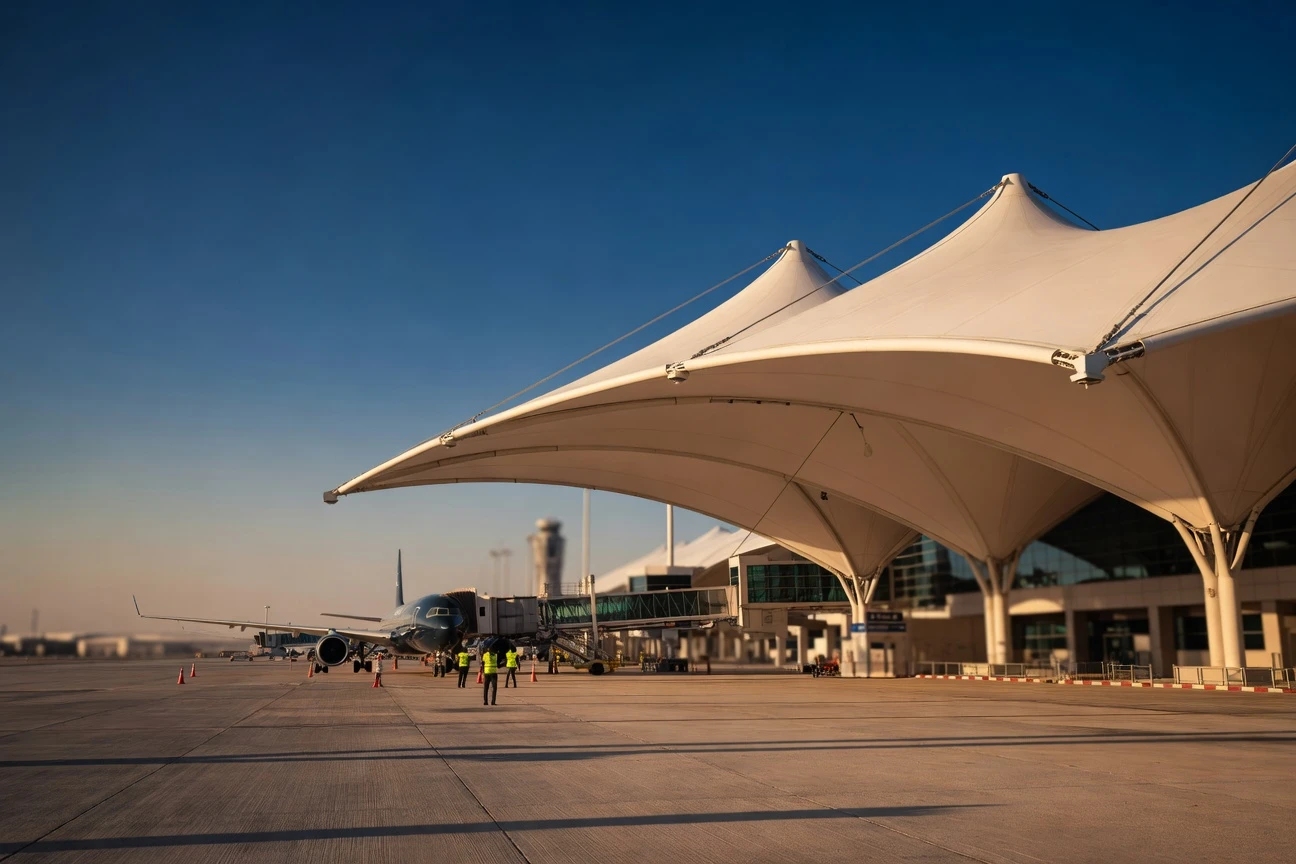
The 2,000 Flights That Tell a Different Story
The Iran conflict, which closed swathes of regional airspace in waves through the second quarter, became a stress test the Kingdom’s air-traffic system passed quietly. Saudi airspace absorbed east-west diversions as carriers from Iraq, Jordan, Bahrain, and beyond pushed their schedules through Jeddah, Riyadh, and Dammam. Daily overflights of the Kingdom roughly doubled at the peak of the diversions.
Saudi Arabia’s aviation sector has demonstrated resilience amid recent global operational challenges through contingency planning and expanded airport capacity.
The line came from Abdulaziz Al-Duailej, president of the General Authority of Civil Aviation (GACA, the Kingdom’s aviation regulator), speaking on May 15 at the 20th meeting of the Aviation Program Activation Steering Committee in Riyadh. Al-Duailej said neighboring countries’ carriers operated more than 2,000 flights through several Saudi airports between February 28 and May 3, transporting over 258,000 passengers without disrupting normal traffic flow.
Two read-outs sit inside that number. The first is operational. A regulator that publishes a precise diversion count, attributable to a foreign-carrier surge, has spare capacity in its slots, its ground handling, and its approach corridors. The Kingdom did not throttle local growth to absorb foreign load.
The second is commercial. Every one of those 258,000 passengers had a connecting itinerary that was originally not Saudi. Some will return; some will pull their next booking through Jeddah or Riyadh because the route held when others did not. That is exactly the kind of involuntary trial flow that the IATA connectivity report for 2025 credits with reshaping regional hubs after disruptive events. Saudi Arabia just received the trial.
Three Airports, Three Speeds
The Kingdom’s traffic concentration remains heavy. King Abdulaziz International Airport in Jeddah handled 53.5 million passengers, a 9 percent annual rise, helped by Hajj and Umrah volumes that compressed into a busy Ramadan window. The General Authority of Civil Aviation reported separately that Saudi airports handled more than 12.1 million passengers between Ramadan 1 and Shawwal 9, the period running February 18 to March 28.
King Khalid International Airport in Riyadh posted 40.8 million passengers, up 8.7 percent. Dammam’s King Fahd International Airport, which serves the Eastern Province and the cross-causeway Bahrain market, recorded 13.7 million, growing 7 percent. Flight movements followed the same pecking order: Jeddah 314,400, Riyadh 296,800, and Dammam 108,500.
| Airport | Passengers 2025 | YoY change | Flights 2025 |
|---|---|---|---|
| King Abdulaziz Intl (Jeddah) | 53.5 million | +9.0% | 314,400 |
| King Khalid Intl (Riyadh) | 40.8 million | +8.7% | 296,800 |
| King Fahd Intl (Dammam) | 13.7 million | +7.0% | 108,500 |
| All other Saudi airports | 32.9 million | n/a | 260,100 |
Jeddah’s lead looks durable because of pilgrimage flows, but Riyadh is closing the gap on flight movements faster than on passenger count. That is the early signature of a hub being built. Riyadh’s larger share of international flights with smaller average aircraft hints at a frequency play, which is the model Riyadh Air will inherit when it begins scheduled service in summer.
Fleet up 33.8 Percent, Cargo Tilted Inbound
The aircraft count is where the structural shift shows up. The Kingdom’s commercial and general-aviation fleet expanded to 483 aircraft in 2025, a 33.8 percent increase from 361 the year before. A jump of that size in one year is unusual for any country outside an initial-deployment phase.
Cargo told a different story. Air freight reached 1.18 million tonnes, with the mix heavily skewed toward goods coming in:
- Inbound: 695,600 tonnes, roughly 59 percent of total volume, reflecting consumer-import demand and project-related shipments tied to giga-project construction.
- Transit: 420,100 tonnes, the share that signals hub status because it captures freight neither originating nor terminating in the Kingdom.
- Outbound: 69,700 tonnes, less than 6 percent of the total, a reminder that the Kingdom still exports most of its weight by sea or pipeline rather than by air.
The country reach also widened, but only marginally. Saudi international airports connected to 66 countries in 2025, up 1.5 percent on the year, serving 176 destinations, up 2.3 percent. That destination growth is slower than the passenger growth, which suggests the Kingdom is thickening existing routes rather than opening fundamentally new ones.
The Connectivity Rank That Slipped
For the first time in three years, the country’s global ranking on a benchmark index moved the wrong way. Saudi Arabia placed 18th on the Global Air Connectivity Index for 2025, down one position from 17th in 2024. The drop is small in numeric terms and easy to dismiss, but it sits inside a longer trajectory worth reading carefully.
The Kingdom jumped from 27th in 2019 to 13th in 2023 on the IATA Air Connectivity Index, the steepest climb of any large economy in that window. The most recent dataset has it ticking back two slots over two years. Among the explanations: competitor hubs in the wider region added long-haul frequency at a faster rate, and the Kingdom’s own widebody capacity sits in delivery queues rather than in operating fleets.
The slip does not contradict the 9.6 percent passenger story. It complicates it. Total volumes can grow while a country’s relative position erodes if the rest of the world is growing faster on the metrics the index weights, which include unique destinations served, frequency, and seat capacity to the largest origin-destination pairs.
What 150 Million Tourists Will Demand
The Kingdom raised its Vision 2030 tourist target to 150 million annual visits after surpassing its original 100 million goal. To put 150 million tourists through the Kingdom’s terminals, the aviation strategy has been recalibrated to roughly 330 million annual passenger movements, more than double the 2025 figure. A few hard numbers frame the gap.
- 189 million more passengers per year required between 2025 and 2030 to hit the strategy’s working capacity number.
- 483 aircraft in the current commercial and general-aviation fleet, against a goal that the Vision 2030 aviation pillar describes as a tripling of fleet size.
- 4.5 million tonnes of annual air cargo targeted by 2030, against the 1.18 million tonnes recorded in 2025.
- Riyadh Air, backed by the Public Investment Fund, is scheduled to start commercial flights on July 1 with 15 initial destinations including London Heathrow, Bangkok, Mumbai, and Paris.
Saudia ranked first among airlines in airspace utilization, accounting for 25.5 percent of total flights, followed by low-cost carrier flynas at 13.3 percent and flyadeal at 8.6 percent. flynas raised $1.1 billion in its June 2025 listing, the largest Middle East IPO of the year so far, with proceeds earmarked for a fleet of up to 280 aircraft on order.
Hitting the 330 million passenger goal requires both the new entrant and the incumbents executing simultaneously, plus the King Salman International Airport build in Riyadh delivering capacity on a schedule that allows it. If any one of those slips meaningfully, the 2025 connectivity rank tells the more honest forward story than the 2025 passenger total does.
Frequently Asked Questions
Which Saudi Airport Handled the Most Passengers in 2025?
King Abdulaziz International Airport in Jeddah handled 53.5 million passengers in 2025, ranking first among the Kingdom’s airports, with growth of 9 percent over the previous year. The terminal benefits from sustained Hajj and Umrah volumes alongside leisure and business traffic into the Red Sea region.
How Did the Iran Conflict Affect Saudi Air Traffic?
Saudi airspace absorbed regional rerouting as neighboring carriers diverted around closed sectors. Between February 28 and May 3, foreign airlines operated more than 2,000 flights through Saudi airports, moving over 258,000 passengers without disrupting domestic flows, according to GACA.
What Is Saudi Arabia’s 2030 Aviation Target?
The Saudi Aviation Strategy under Vision 2030 targets roughly 330 million annual passengers and 4.5 million tonnes of air cargo by the end of the decade, with the tourism component raised to 150 million visits per year from the original 100 million goal.
Which Airlines Use Saudi Airspace Most?
Saudia leads with 25.5 percent of total flights, followed by flynas at 13.3 percent and flyadeal at 8.6 percent. Riyadh Air, owned by the Public Investment Fund, is scheduled to begin scheduled commercial operations on July 1, 2026 with an initial network of 15 destinations.
Why Did Saudi Arabia’s Air Connectivity Ranking Drop in 2025?
The Kingdom slipped to 18th on the Global Air Connectivity Index 2025 from 17th the year before, a small move that reflects faster widebody capacity growth at competing hubs rather than a decline in Saudi traffic itself. The country’s total passenger numbers grew 9.6 percent over the same period.
If Riyadh Air’s first northern summer schedule holds frequency through the autumn and the King Salman International Airport build stays on its calendar, the 2025 connectivity dip looks like noise. If either slips, the 9.6 percent line will read in hindsight as the year the Kingdom caught a regional accident and called it a strategy.
