
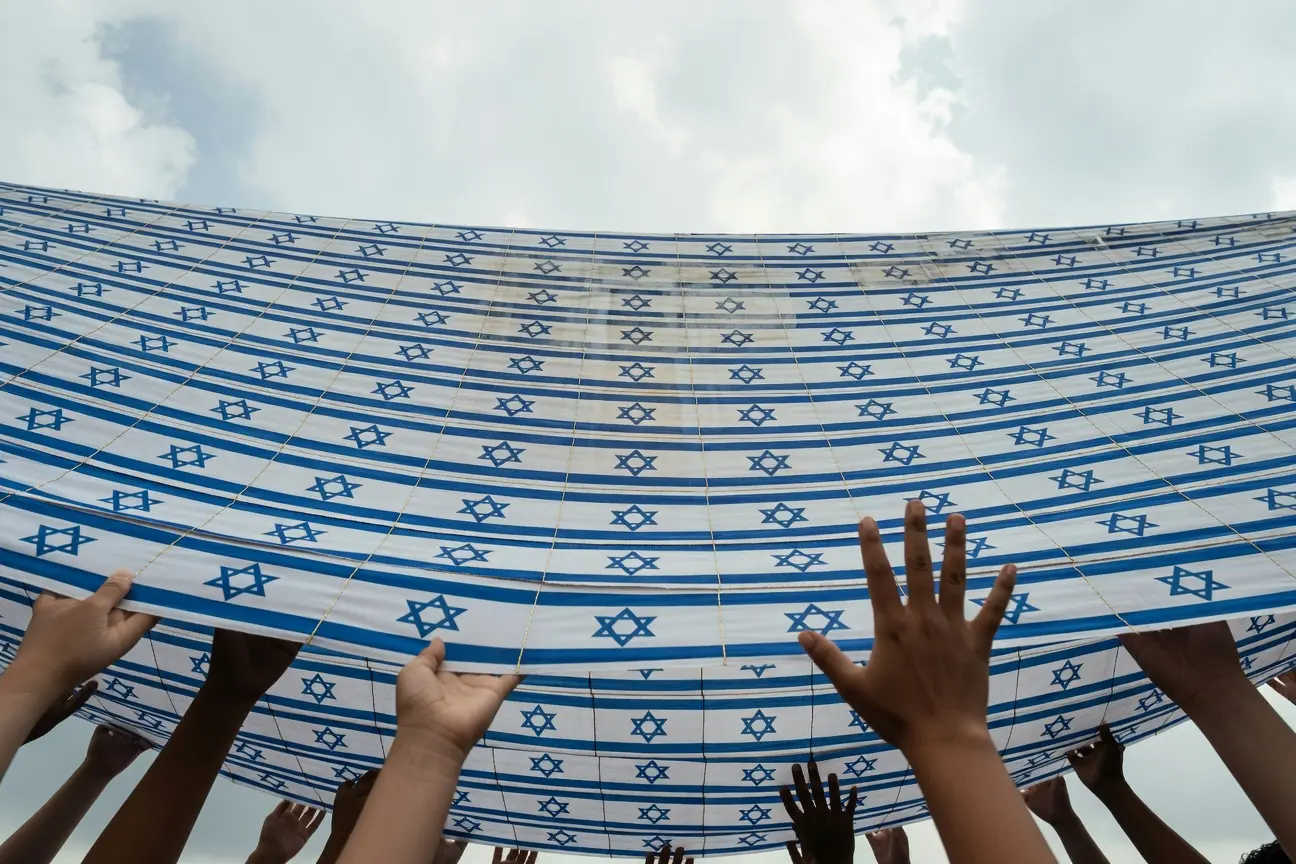
For eight years, Tel Aviv artist Tal Tenne Czaczkes has been carrying home flags she finds on the ground after Israel’s national holidays. She now has nearly 700 of them, washed, mended, and joined with gold thread into a 180-square-meter canopy she calls “The Flag of Flags.” The piece is touring schools, hospitals, and bereavement ceremonies across the country, usually held aloft by the people who came to see it.
It lands in a year when the blue-and-white has become the most fought-over piece of cloth in Israeli public life, claimed by the right at Jerusalem Day marches, raised by the left at weekly anti-government rallies, and draped over the coffins of more than 1,152 fallen security personnel since October 7, 2023.
Nearly Seven Hundred Flags, One Canopy
Most of the flags in the canopy are the small pennants Israelis tape to car windows for Yom HaZikaron and Yom Ha’atzmaut, the back-to-back memorial day and independence day every spring. They sell in supermarkets for a few shekels. They blow off windshield wipers in the afternoon wind, and most of them end up in gutters by the time the country wakes up the next morning.
- Nearly 700 flags stitched together, mostly the small car pennants Israelis fly on holidays.
- 180 square meters of finished canopy when fully unfurled, folding down into a single backpack.
- Eight years of collection, washing, and hand mending out of a Tel Aviv studio.
Some flags arrived from beneath car tires in Ramat Hasharon, the suburb where Tenne Czaczkes lives and works. Others came in plastic bags from strangers who heard about the project and wanted their old bunting to count for something. A few were retrieved from school storage closets after the holiday week.
Each piece is washed, dried, and reattached. None are replaced. The gold thread sits visibly on the surface, raised, the way a kintsugi seam sits proud on a repaired tea bowl.
An Independence Day in a Town Square
The first flag came home in April 2018, the night of Israel’s seventieth Independence Day. Tenne Czaczkes had dyed her hair blue for the occasion, a deliberate visual joke about being a human flag. A graduate of Jerusalem’s Bezalel Academy of Art and Design, she had already spent two decades making public sculpture in Israel, including the three-and-a-half-meter Sea Ball at Tel Aviv’s Gordon Beach, a sphere assembled from beach trash that argued with the country about its plastic habit (part of her wider Bigball plastic-waste sculpture series).
Walking through her hometown’s central square that evening, she noticed teenagers stepping on small flags that had blown off cars and been ground into the asphalt. None of them looked down.
She picked one up. Then another. Then a third.
The year was personally difficult, she has said in interviews. “I felt like a broken flag, like a broken woman,” the artist told The Times of Israel. “I identified with these flags; they sounded an alarm for me.” She brought them home, washed them, dried them, folded them, and set them aside without a clear plan. The point at the time was the picking up itself.
A year later she had about thirty flags. She sewed them into a single banner and named the work after two Hebrew words that had not yet reentered everyday Israeli speech: tikvah, meaning hope, and tkuma, meaning resurrection. “It was 2019, and no one understood what I was doing, talking about tkuma,” she said.
Then she put the banner away.
Tikvah and Tkuma Before October 7
The two words came back into general Israeli usage on October 7, 2023, the morning Hamas terrorists crossed the Gaza envelope fence and killed roughly 1,200 people while taking 251 hostages back into the Strip. By the end of that week, every public-affairs statement, fundraiser, and synagogue announcement was reaching for “tkuma” the way the country had once reached for “hatikvah.”
It came from the lowest place, from under the wheels of cars, from dust into something new, with emotional value.
That is how the artist has described the project since the attack, in talks at schools and bereavement ceremonies. The thirty-flag prototype had been in storage through the bloodiest months. She spent that period going to funerals, sitting shiva with families she had never met, and volunteering on the home front rather than making new work.
The flag itself, she has said, felt battered and bruised by Israeli society in the years before the attack, pushed and pulled by political opinion until the symbol felt closer to a property dispute than a shared possession. That sense had already shown up in the contested optics of recent Jerusalem Day flag marches through the Old City, where ultranationalist crowds chanted as the same blue-and-white was carried past shuttered Palestinian shops.
Bringing the canopy out in that climate did not feel right. A bereaved friend who had buried family members on October 7 changed that. She asked to see it.
Who Holds the Canopy Now
That private living-room viewing rerouted the project. Tenne Czaczkes started taking the patchwork out of storage and carrying it folded in her backpack to ceremonies, school assemblies, hospital lobbies, and informal gatherings. The change is participatory by design: the canopy is too large for one person to hold up, so it requires hands from across whatever room it has entered.
Bereaved Communities From the South
She has brought it to official ceremonies for families of victims from the attacks on Be’eri, Kfar Aza, and Nir Oz, where Nova festival survivors and parents of fallen soldiers hold sections together. The canopy is heavy when fully unfurled. Each section pulls on its neighbors. Holding one corner means feeling the weight of the next.
Hostage Families and Veterans
Hostage families have stretched parts of the canopy at protest rallies and at private gatherings on Tel Aviv’s hostages square. Veterans of the current war, reservists called up from October 8 onward, have held it at unit memorials and squad reunions. The flags inside the canopy do not match each other in size, condition, or vintage, and the same is true of the people holding it.
Mixed-Faith Communities
Bedouin, Druze, and Muslim families bereaved by the war have also held the canopy at joint memorials, photographs of which the artist documents on her studio’s Instagram. Bedouin community members from the Negev were among the Israeli citizens killed and taken hostage on October 7. Their participation is the part of the work the artist most often brings up in talks: the flag, in her telling, is not the property of any single constituency that has tried to claim it.
That framing puts her at odds with parts of the international art world. Earlier this year, more than fifty cultural figures publicly pressed for a high-profile Tel Aviv Museum exhibition by Judy Chicago and Nadya Tolokonnikova to be canceled over the Gaza war. Tenne Czaczkes has chosen the opposite vector, embedding the symbol deeper in domestic civic life rather than withdrawing it from view.
Gold Thread Borrowed From Kintsugi
The technique holding the canopy together is borrowed from outside Israel entirely. It is Japanese, dates to the late fifteenth century, and was originally a fix for a tea bowl that the shogun Ashikaga Yoshimasa refused to discard. The kintsugi tradition as documented by Japan’s government cultural office uses urushi lacquer dusted with powdered gold, silver, or platinum to fill the cracks of broken ceramics, turning the damage into the most visible part of the object.
The Original Repair
Tenne Czaczkes has translated the principle directly onto cloth. Each rescued flag’s tears, stains, and rips are closed with metallic gold thread that sits proud of the surface, the way a kintsugi seam sits proud on a tea bowl. The repair is the design feature. The canopy reads from a distance as a single weathered field of blue-and-white; up close, the gold runs visibly through every panel.
| Element | Ceramic Kintsugi | The Textile Version |
|---|---|---|
| Broken material | Tea bowls, plates, vessels | Discarded car pennants and bunting |
| Repair medium | Urushi lacquer with powdered gold | Gold metallic thread, hand sewn |
| Era of origin | Muromachi Japan, late 1400s | Israel, Independence Day 2018 |
| Visible scar | Lacquer-and-gold seam along the crack | Raised gold stitch line along the flag |
| Philosophical claim | Damage is part of the object’s value | No flag is too torn to be raised again |
The Education Ministry Pipeline
A few months ago the artist began working with Israel’s Education Ministry to bring the project into schools. Classes from kindergarten through high school collect their own discarded flags, then wash and mend them with parents and grandparents, building smaller versions of the canopy for their own buildings. “It’s like factories for the flags, and they hold onto them, they really hold the flags,” she said.
The school version makes the project intergenerational by construction. The flags are usually older than the children stitching them, and some of them carry handwritten dates on the hem.
The Eightieth Year on the Horizon
Israel marked its 78th Independence Day on April 22, 2026. The 80th anniversary lands in April 2028, the milestone Tenne Czaczkes is now building toward.
Three concrete steps are planned for the next two years: a diaspora tour bringing the canopy to Jewish communities in North America and Europe; an online exhibit mapping the journey of each individual flag inside the canopy back to the place where it was rescued; and a documentary that follows the canopy through the country told from the perspective of the people who have held it, rather than the artist who stitched it. The artist has discussed elements of the plan in her CreativeMornings Tel Aviv talk on the project.
The economics are modest. Tenne Czaczkes funds the work largely herself, taking on the travel and setup labor alongside volunteers. There is no gallery representation behind the project, no museum acquisition, and no sponsor logo on the cloth. The canopy moves on the artist’s own train fare and the goodwill of the hosts who book it.
What it produces in the room is less measurable than the numbers behind it. A canopy held aloft at the same moment by Bedouin families, Nova survivors, grandparents, and schoolchildren is not a policy outcome. It does not change the Knesset’s composition, end the war in Gaza, or bring any specific hostage home. It is a piece of cloth carried on the train by a single artist.
That, the artist argues, is enough, because a flag becomes whatever people make of it when they pick it up. After the next showing, scheduled for a school in the Negev, the canopy will fold back into the backpack and travel on.
