
A Kuwaiti gold medalist refused to shake hands with an Israeli bronze medalist on the podium at the season-closing round of the Abu Dhabi Grand Slam Jiu-Jitsu World Tour, then walked out of the medal ceremony before officials could complete the traditional winners’ photograph. Jassim Alhatem, the 22-year-old who took the men’s amateur blue belt under-77kg title at Mubadala Arena, told the Israeli competitor, Yoav Manor, “You Israelis kill children,” according to the Israeli delegation that was standing within earshot.
The moment is being shared widely as a one-off insult. It is closer to a recurring script. Arab and Muslim athletes have been refusing to shake hands with Israeli opponents at international tournaments for at least fifteen years, and the venue where it keeps happening, increasingly, is a country that has full diplomatic relations with Israel.
What Happened on the Mat
Alhatem went undefeated through four bouts to win gold in his blue belt division, the rank below purple in the Brazilian jiu-jitsu progression. Manor, fighting in the same bracket, won three of his four matches to take bronze. The two never met on the mat. They met on the podium.
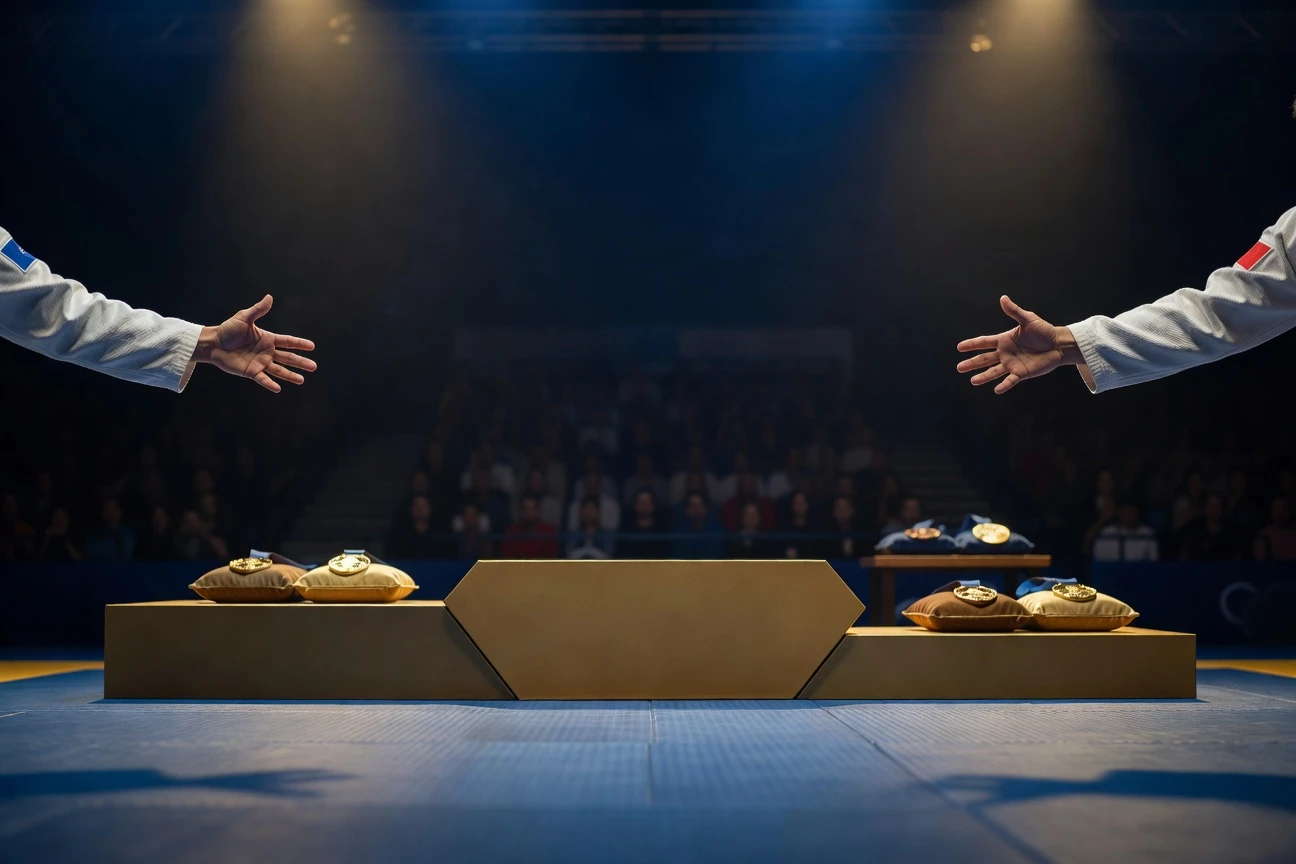
According to members of the Israeli delegation, the Kuwaiti fighter approached his bronze-placed counterpart before the ceremony and told him, in substance, to stay on his side of the platform. When Manor extended a hand during the ceremony itself, the gold medal winner declined to take it. He then refused to stand with Manor for the post-medal photograph and left the podium area while organizers, including senior Emirati hosts, tried to persuade him to return.
The event drew more than 2,000 competitors from 75 countries to Mubadala Arena over the weekend of May 17, with senior figures from the UAE and Asian jiu-jitsu federations attending the awards. The blue belt amateur brackets sit several tiers below the professional black belt rounds that headline the tour, but they still carry official AJP medals and ranking points.
The Israeli national jiu-jitsu team coach, Amir Boaron, said his fighter had stayed composed. “Yoav had an excellent tournament: three victories, one loss, and a bronze medal,” Boaron said in a statement to Israeli media. “Yoav continued trying to shake his hand and behave like a sportsman.”
The Words After the Podium
Within hours of leaving the arena, Alhatem posted a video in Arabic defending his conduct. He said Manor had tried to manufacture a victim narrative by offering the handshake on camera, and that he had already made his position clear in private before the medal ceremony began.
Even though I had spoken to him before the podium and told him, I don’t want to know you, and I don’t want to greet you. Stay on your side, and I’ll stay on my side, so there would be no problem.
That was the Kuwaiti fighter speaking in the video, according to translations circulating with the original Arabic clip. He went further on the broader question of whether athletes should leave politics at the venue door. “Even if you tell me sports is separate from politics, no, no. There is no separation,” he said in the video. “If that were true, Russia wouldn’t be banned right now from participating in the Olympics.”
He described Israel as a “Zionist entity,” urged fellow Muslim athletes to “have a principle,” and added a line that has carried further than any of the others: “We do not play with these types. We do not respect these types. As Kuwaitis, we do not respect them at all.” Arik Kaplan, president and chief executive of the Ayelet Association for Non-Olympic Sports in Israel, said Manor had “brought great honor to Israeli sports today, not only because of the athletic achievement on a prestigious international stage, but especially because of his respectful and appropriate behavior in the face of hostile and unsportsmanlike conduct from another athlete.”
Abu Dhabi’s Awkward Host Position
The venue matters as much as the moment. The UAE signed the Abraham Accords with Israel in September 2020, the first Gulf state to formalize diplomatic ties with the Jewish state. Since then, Emirati federations have actively hosted Israeli teams in football, rugby, basketball, e-sports and grappling. The Abu Dhabi Jiu-Jitsu Pro circuit has been one of the most visible carriers of that opening, putting Israeli fighters into draw sheets alongside competitors from countries that still have no formal ties with their government.
That includes Kuwait. The Gulf state has not normalized relations with Israel, has rejected pressure to join the Abraham Accords framework, and senior Kuwaiti officials have repeatedly said the country will be among the last in the region to do so. Kuwaiti citizens entering the UAE for sport are physically meeting Israeli citizens that their own state does not recognize.
The mismatch is the structural fact behind every incident like this one. Emirati organizers cannot wave away handshake refusals without alienating athletes from neighboring states whose publics remain hostile to normalization, especially since the Gaza war began. They cannot tolerate them publicly without undercutting the diplomatic argument that made the Accords possible. The response in Abu Dhabi this week followed the established pattern: hosts apologized privately to the Israeli delegation, made no public statement about the refusing athlete, and let the medal results stand.
A Fifteen-Year Script of Refused Handshakes
Alhatem’s gesture is not improvised. The handshake refusal is now a recognizable form of athlete protest, with a documented record stretching back to at least the early 2010s and a roughly consistent pattern of consequences for the athlete, the opponent, and the federation involved.
The Olympic Cases
The most visible incidents have happened on the largest stages. At the 2016 Rio Games, Egyptian judoka Islam El-Shehaby lost his opening-round bout to Israel’s Or Sasson and refused the customary post-match bow and handshake. The International Olympic Committee’s disciplinary commission issued him a “severe reprimand,” and the Egyptian Olympic Committee sent him home. At the 2024 Paris Games, a Tajik judoka declined the handshake after a match against an Israeli opponent and instead lifted a prayer gesture in front of the cameras.
The Grand Slam Pattern
Outside the Olympic spotlight, the same script has played out repeatedly on the IJF World Tour and the AJP circuit. Egyptian heavyweight Ramadan Darwish refused a handshake with Israel’s Arik Zeevi at the 2011 Moscow Grand Slam, then did it again at a 2012 event after beating the same opponent. The story shared by general historians of combat sport traditions across cultures is that the courtesies between fighters carry weight precisely because the violence between them is real; that weight is what makes the refusal a statement.
| Year | Athlete | Nationality | Event | Outcome for the Athlete |
|---|---|---|---|---|
| 2011 | Ramadan Darwish | Egypt | Moscow Judo Grand Slam | No formal sanction |
| 2016 | Islam El-Shehaby | Egypt | Rio Olympics, judo | IOC reprimand, sent home by NOC |
| 2019 | Saeid Mollaei (defected) | Iran | Tokyo World Championships, judo | Iran Judo Federation banned four years |
| 2024 | Nurali Emomali | Tajikistan | Paris Olympics, judo | No formal sanction reported |
| 2026 | Jassim Alhatem | Kuwait | Abu Dhabi Grand Slam, jiu-jitsu | Pending; no AJP action announced |
How Governing Bodies Have Punished This Before
The Iran case is the heaviest precedent on the books and the one most relevant to what Emirati organizers do next. After Iranian world champion Saeid Mollaei said in 2019 he had been ordered by his federation to lose a match in order to avoid facing an Israeli opponent in the final, the International Judo Federation (IJF, the sport’s world governing body) imposed a protective suspension on the Iran Judo Federation. The IJF’s full ruling against the Iranian federation was later upheld at the Court of Arbitration for Sport, which described “an institutionalized scheme” to avoid Israeli athletes. The end result was a four-year suspension of the federation from world competition.
For an individual blue belt fighter at an AJP Grand Slam, the immediate exposure is narrower but still real. The tour publishes its athletes’ rules of conduct, which give the AJP authority to act on unsportsmanlike behavior at any sanctioned event. Past disciplinary actions in similar federations have followed a recognizable ladder:
- Formal warning or reprimand from the organizing body, with the result on the mat left to stand
- Suspension of the athlete from future events on the same circuit, typically counted in months
- Withdrawal of ranking points already earned at the event in question
- Referral to the athlete’s national federation, with possible domestic-level penalties
- In the heaviest cases, full federation-level suspension, the route used against Iran’s judo body
None of those steps has been formally announced in this case. Emirati organizers have so far apologized privately to the Israeli side and said nothing publicly about Alhatem.
Kuwait’s Position and the Athlete’s Risk
Inside Kuwait, the political incentives run the other way. The country has no diplomatic relations with Israel, public opinion polling across the Arab world has hardened against normalization since the Gaza war, and Kuwaiti parliamentarians have repeatedly framed any contact with Israeli citizens as a red line. An athlete who declines to shake an Israeli opponent’s hand on camera, then explains the choice in Arabic on social media, is operating well inside what is politically safe at home and is likely to gain support rather than lose it.
The reputational exposure is the inverse for Manor. The 31-year-old fighter has been competing on the AJP circuit for years and is a recurring name in the Israeli delegation’s medal tallies at Mubadala Arena. The Israeli federation will treat his composure on the podium as a marketing asset and an argument for keeping Israeli athletes in the bracket regardless of who else is in it. His coach’s public statement, praising the conduct rather than condemning the snub, was written for that purpose.
The harder calculus belongs to Abu Dhabi. The Emirati federation has built a six-year record of hosting Israelis on its mats without incident, paid in the currency of diplomatic credibility. A pattern of unaddressed podium refusals would erode that record. A heavy public sanction against a Kuwaiti blue belt would put the host country in the position of disciplining a fellow Gulf citizen for the politics most of its neighbors still hold.
If the AJP issues even a token reprimand by the next tour stop, the message to athletes on both sides of the bracket is that Abu Dhabi’s mats remain neutral ground. If the silence holds through the summer schedule, the podium becomes the script’s next regular venue, and the next refusal will be easier than this one.
