
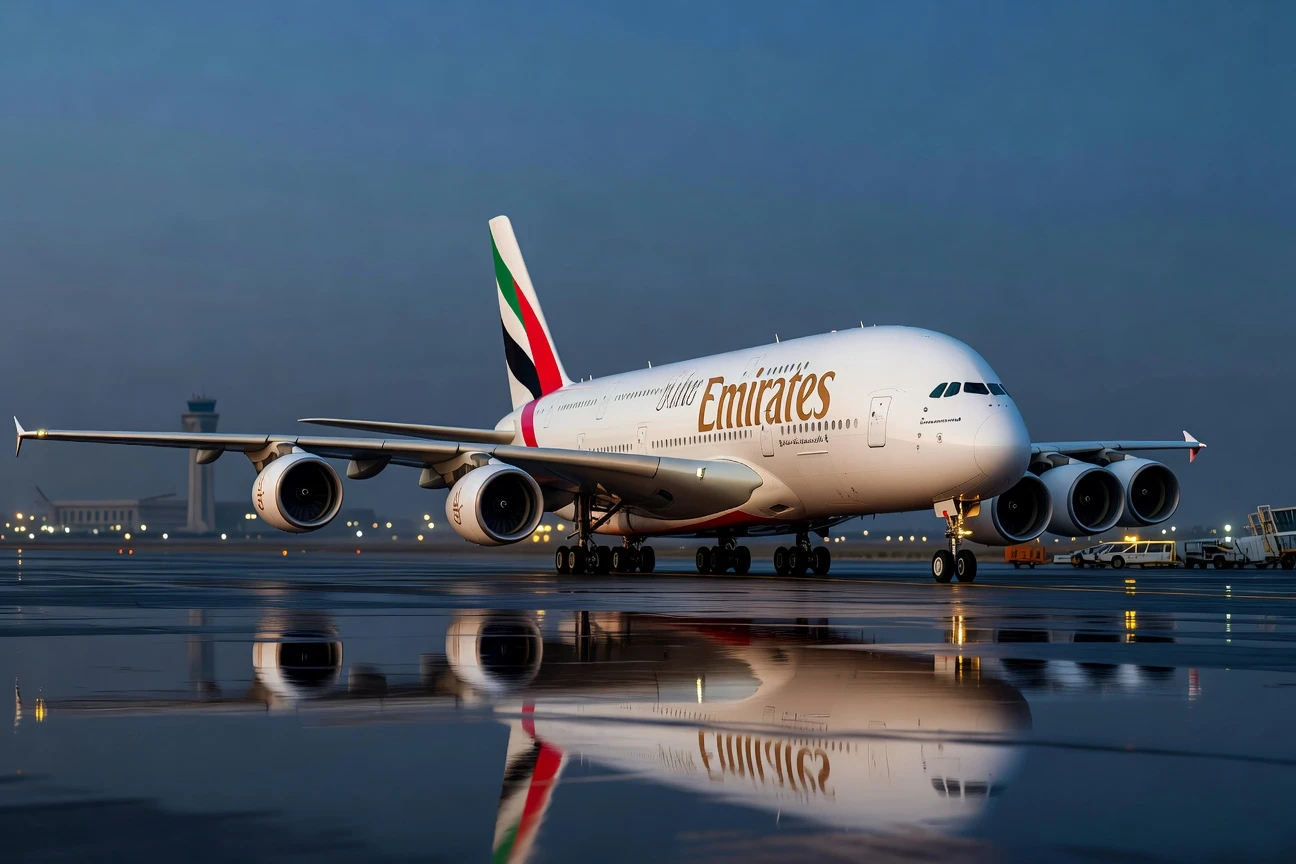
Israel’s Ministry of Transportation has asked Emirates to put an Airbus A380 on the Tel Aviv to New York corridor with no Dubai connection required, a request first reported by Channel 12 (N12, an Israeli broadcaster) on May 18. If approved, the arrangement would create the first seventh-freedom long-haul service by a major network carrier in commercial aviation history.
Behind the ask sits a market where EL AL Israel Airlines has held near-monopoly control since the October 2023 attacks and where Israel’s Competition Authority is pursuing a record 144 million shekel ($39 million) antitrust fine over what regulators called excessive wartime fares.
The Pitch on the Table
According to the N12 report, a delegation of senior Transportation Ministry officials met last week with representatives from Emirates and the United Arab Emirates government. The Israelis brought a specific shopping list: Tel Aviv (TLV) to New York’s John F. Kennedy International (JFK), Tel Aviv to Bangkok’s Suvarnabhumi (BKK), with rights for Emirates to base aircraft and crew at Ben Gurion Airport.
The ministry’s offer reportedly goes one step further than aviation lawyers would have predicted twelve months ago. Israel signalled it is willing to grant seventh-freedom rights, meaning Emirates could operate the Tel Aviv routes as standalone services entirely detached from its Dubai hub. The carrier could fly an A380 from JFK to Ben Gurion, turn the aircraft on the ground in Israel, and fly the return leg back to New York, with no requirement to connect to Dubai (DXB) at all.
Emirates has not commented publicly. The carrier launched its Dubai to Tel Aviv route on June 23, 2022, scaled to three daily flights within a year, and then suspended all Israeli service after the October 7, 2023 Hamas attacks. As of May, the route remains suspended, although earlier reports of a 2026 Emirates Tel Aviv resumption citing Bloomberg and KAN News had pointed to a first-quarter restart that has not materialised.
EL AL’s 88% Grip on the JFK Route
The market the ministry is trying to crack is one of the most lucrative long-haul corridors in the world, and one EL AL has more or less owned since the war broke out. In the second quarter of 2024, the airline captured 88.2% of seats on the Tel Aviv to New York route, up from 35.5% in the same quarter of 2023, according to data cited by Israeli business daily Globes.
The pricing followed the share. One-way fares in September 2024 averaged $1,759, against $1,430 a year earlier. Return tickets around the October Jewish holidays reached $2,000, up from $1,500. EL AL booked record second-quarter profits of $147.4 million in 2024, against $58.9 million in the equivalent quarter of 2023, with load factors near 92%.
That windfall produced a regulatory reckoning. In February, the Israel Competition Authority announced its intent to impose a $39 million antitrust fine on EL AL for excessive and unfair pricing during the war period. The authority’s investigation found EL AL held a dominant position on 38 of the 53 routes it operated, including London, New York, Paris, Bangkok, Tokyo, and Los Angeles. Average wartime fares rose 16% on the company’s network; some routes saw single-ticket jumps north of 31%.
EL AL operates roughly 32 weekly flights between Tel Aviv and New York’s three airports today, per its published Tel Aviv to New York schedule. The carrier has indicated it will fight the antitrust fine in court. Whether or not the Authority prevails, the political damage from a year of war pricing is what gave the Transportation Ministry the cover to invite a foreign carrier into the most profitable Israeli long-haul market in the first place.
Why a Seventh-Freedom Flight Would Be a First
Aviation treaties are built on a ladder of nine air freedoms agreed under the 1944 Chicago Convention. The fifth lets a carrier pick up and drop passengers at an intermediate stop between its home country and another foreign country; Emirates ran a celebrated Milan to JFK fifth-freedom service for over a decade before discontinuing it in 2024. The seventh sits one rung further out: an airline operates a service between two foreign countries that never touches its home base.
No major full-service network carrier has flown a long-haul seventh-freedom passenger route. Ryanair built much of its European footprint on the model, but inside the single European aviation market the regulatory friction is essentially zero. A Tel Aviv to JFK service flown by a UAE-headquartered airline that never lands in the UAE is the kind of arrangement that historically required either an open-skies bloc or a specific bilateral concession from both endpoint countries.
The proposal also folds in cargo, crew, maintenance, and slot considerations that have no precedent in either Israel or the United States. Setting up a permanent Emirates base in Tel Aviv, with aircraft and crew stationed there rather than rotated through Dubai, would require labour, tax, and aviation-security frameworks that the Knesset has not yet drafted. For Emirates, the cost of standing up a Tel Aviv crew base would only make sense if the political risk premium on the route falls considerably below where it sits this spring.
The Fifth-Freedom Workaround Hidden in the Proposal
Read closely, the headline-grabbing seventh-freedom pitch is probably not what gets built. The mechanism for an Emirates A380 to land at JFK from Ben Gurion already exists under fifth-freedom rights, provided Dubai to Tel Aviv service is restored.
The cleaner structure looks like this: Emirates resumes its Dubai to Tel Aviv service, then operates a tag-on flight from Tel Aviv onward to New York. The first leg can be flown by a Boeing 777, the second by an A380 with the same flight number. Tickets can be sold as standalone Tel Aviv to JFK travel even though the aircraft is technically continuing a Dubai-originating service. The Open Skies agreement between the United States and the United Arab Emirates already permits this structure; the United States and Israel have a separate Open Skies framework dating to 2010. No new bilateral concessions are needed.
This is the same engineering Emirates used on its Milan to JFK service and that Singapore Airlines uses on its Frankfurt to New York leg. The model preserves the marketing punch (an A380 sold as a Tel Aviv to JFK product) without requiring Israeli aviation law to be rewritten. It also avoids forcing the US Department of Transportation to issue a novel seventh-freedom permit at a moment when American carriers are lobbying against any foreign expansion at JFK.
There is already a strong interest in service from Tel Aviv. I wouldn’t be surprised to see a second flight from Tel Aviv in the next few months.
That line is from Adnan Kazim, Emirates’ chief commercial officer at the time, speaking to reporters at the original Tel Aviv inaugural in June 2022. The commercial signal was strong before October 2023 made it irrelevant. If the Dubai to Tel Aviv service restarts, the New York tag-on becomes a natural extension of a thesis Emirates already tested.
American, Delta, United: Empty Gates at JFK
The reason Israel is shopping the route to a Gulf carrier in the first place is that the three US legacy airlines have shown no urgency in coming back. American Airlines confirmed in April that it will not resume Tel Aviv service until January 2027, marking more than three years off the route. Delta Air Lines has pencilled in a September 2026 return; United Airlines has hinted at the same window but kept its language conditional.
| Carrier | Tel Aviv status, May 2026 | Earliest plausible return | Aircraft used pre-suspension |
|---|---|---|---|
| EL AL | Operating, 32 weekly TLV to NYC flights | n/a (uninterrupted) | Boeing 787-9 |
| Emirates | Suspended since Oct 2023 | Reported Q3 2026 if Dubai leg restored | Boeing 777-300ER (one A380 ferry in 2021) |
| Delta Air Lines | Suspended | September 2026 (planned) | Airbus A330-900neo |
| United Airlines | Suspended | September 2026 (conditional) | Boeing 787-10 |
| American Airlines | Suspended | January 2027 | Boeing 777-200ER |
Nine foreign carriers, mostly European, have begun staged Tel Aviv resumptions in recent weeks, but the long-haul JFK gap remains unfilled by anyone other than EL AL. The list of nine airlines restarting Ben Gurion service includes short-haul European operators rather than wide-body North American long-haul carriers. From the Transportation Ministry’s seat, a single Emirates A380 between Tel Aviv and JFK adds roughly 489 seats a day, the equivalent of about four EL AL 787-9 frequencies a week, on the highest-yield Israeli international route. That arithmetic is the political case for asking.
What Has to Clear Before an A380 Lands at JFK
For the proposal to translate into a published Emirates schedule, several distinct approvals have to clear in sequence, and any one of them can stall the project for a year.
- Israeli aviation law: Current statutes restrict standalone seventh-freedom operations by foreign carriers. The Knesset would need to amend the framework, and EL AL plus Israir and Arkia are expected to lodge formal objections during any consultation period.
- United States DOT foreign air carrier permit: Emirates would need a fresh permit covering the JFK end of the route. The Open Skies agreement between Washington and Abu Dhabi makes this routine for fifth-freedom service; a seventh-freedom variant is novel ground for the US Department of Transportation.
- Slot allocation at JFK: JFK is slot-controlled. Emirates would either negotiate slots from incumbent holders or apply during seasonal slot rounds, with US legacy carriers expected to file competitive objections.
- Security and insurance framework: A foreign carrier basing aircraft and crew permanently at Ben Gurion needs an insurance market willing to underwrite it. War-risk premiums on Israeli operations remain elevated and would price the route’s economics directly.
- Dubai to Tel Aviv restoration: Whether the structure ends up seventh-freedom or fifth-freedom, the political optics of a UAE flag carrier serving Tel Aviv require the original Dubai route to come back first. Reports of a Q1 2026 resumption did not deliver.
If the Dubai leg returns in the third quarter and is paired with a fifth-freedom JFK tag, Israel gets meaningful new long-haul competition before US carriers come back, EL AL faces price pressure heading into the high-season fourth quarter, and the Knesset avoids a fight over rewriting aviation law. If the Dubai leg keeps slipping or Emirates concludes that war-risk insurance still does not pencil, the route stays a press release and EL AL keeps its book through 2026.
