
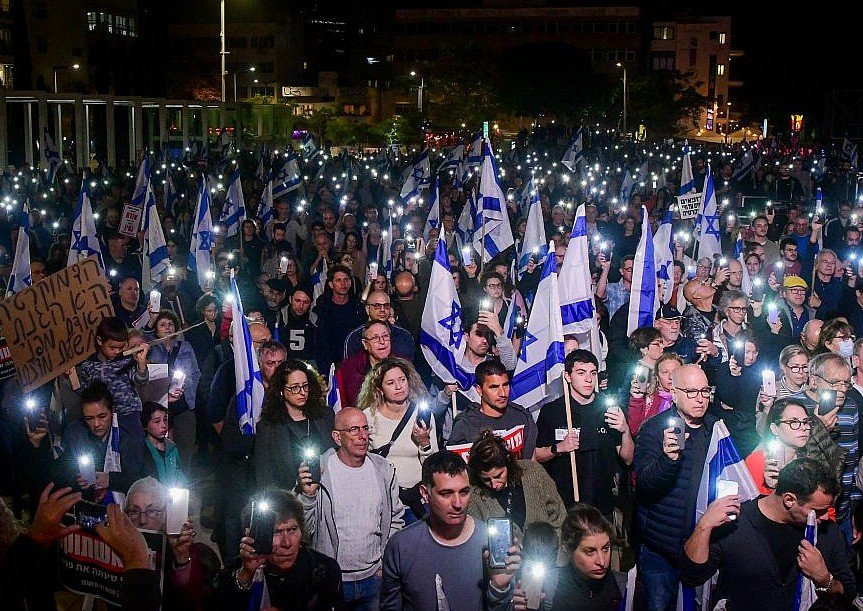
Rain fell steadily over Tel Aviv on Saturday night, but it didn’t thin the crowds. Thousands gathered across Israel to protest the government, with a former police chief delivering one of the sharpest public rebukes yet of Prime Minister Benjamin Netanyahu as new details surfaced in the growing Qatargate scandal.
Former Israel Police commissioner Roni Alsheich addressed demonstrators at Habima Square, accusing the cabinet of moral failure and political cowardice. His words cut through the drizzle, landing hard.
A blistering speech under dark skies
Standing before a sea of umbrellas in central Tel Aviv, Alsheich aimed his fire directly at the government benches. His message was blunt, emotional, and laced with disbelief.
“How dare you sit in the cabinet eating bourekas without asking Netanyahu tough questions?” he demanded, referring to ministers he said had abandoned their duty to challenge the prime minister.
The crowd responded with cheers, whistles, and chants that echoed across the square.
Alsheich went further, accusing Israel’s leadership of helping reshape Qatar’s image in Washington while allowing money to flow into Gaza under a dangerous political theory. Israel, he said, “stepped in to whitewash Qatar in the eyes of the United States” and helped turn it into a key financer of Hamas in the Gaza Strip.
The former police chief was clear about who he held responsible.
“It wasn’t aides. It wasn’t spokespeople,” he said. “It was the prime minister.”
Qatargate moves from whispers to the main stage
This week’s protests took on a sharper focus after fresh reporting linked Prime Minister Benjamin Netanyahu more closely to the so-called Qatargate affair, a scandal already rattling Israel’s political system.
At the center of the investigation are allegations that senior aides in Netanyahu’s orbit worked with a pro-Qatari lobbying firm while employed by the prime minister. The claims include contact with a foreign agent and a web of corruption-related offenses tied to lobbyists and business figures.
Two names dominate the probe: Jonatan Urich, a close adviser, and Eli Feldstein, a former spokesman. Both are alleged to have maintained ties that critics say crossed clear ethical and legal lines.
The prime minister has denied wrongdoing. His office has pushed back, calling the accusations politically driven.
But the timing has been brutal.
As the war in Gaza drags on and public patience wears thin, Qatargate has become a lightning rod, folding questions of security, money, and trust into one volatile mix.
One protester in Tel Aviv put it simply: “This feels like the moment where everything collides.”
Protesters refuse to let go
Saturday’s demonstrations were not confined to Tel Aviv. Rallies took place in Jerusalem, Haifa, Be’er Sheva, and smaller towns, despite cold weather and persistent rain.
At Habima Square, the mood shifted between anger and exhaustion.
People stood shoulder to shoulder, some holding placards accusing the government of betrayal, others waving Israeli flags soaked through. Families came. Veterans came. Reservists came. Many said they had been protesting for months and saw no reason to stop now.
One man, wrapped in a rain poncho, said he felt Alsheich’s speech voiced what ministers refused to say out loud. Another woman said the former police chief’s presence mattered because he “knows the system from the inside.”
For organizers, the appearance of establishment figures like Alsheich signals a widening protest tent.
It’s no longer just activists shouting from the margins.
Political fallout grows louder
Alsheich is not alone in raising the stakes. Former prime minister Naftali Bennett weighed in earlier this week, calling Qatargate “the most serious act of treason in Israeli history,” a phrase that ricocheted across talk shows and social media.
Such language would have been unthinkable a few years ago.
Now it’s part of the nightly news cycle.
Coalition figures have accused opposition leaders of exploiting the scandal to destabilize the government during wartime. They argue that internal division only strengthens Israel’s enemies.
But critics say that argument no longer lands.
They point out that the allegations center on Qatar, a country widely known as a major backer of Hamas, and ask why any Israeli official would allow blurred lines in such a sensitive arena.
That question keeps coming back, again and again.
Trust, rain, and a country on edge
As the rain intensified late Saturday, some protesters began to drift home. Others stayed, chanting under flickering streetlights.
There was no single demand shouted from the stage. No neat list of reforms. Instead, the protest carried a heavier, messier emotion: disbelief that the leadership had reached this point.
Alsheich’s challenge to cabinet ministers lingered in the air long after he stepped down.
Why didn’t they ask tougher questions? Why didn’t they stop it earlier?
For many Israelis, Qatargate feels like a symbol rather than a standalone scandal. It taps into long-running frustration over governance, accountability, and a sense that decision-making has become detached from public interest.
A retired civil servant at the protest said, “It’s the feeling that no one is minding the store.”
The government, for now, shows little sign of shifting course. Netanyahu remains defiant, and coalition partners continue to close ranks.
