Egypt is caught in a tightening political vise as Hamas demands the full opening of the Rafah border crossing into Gaza, putting Cairo at risk of a confrontation with Israel and complicating its already delicate regional balancing act.
Public Challenge to Cairo
The pressure burst into public view after Hamas leadership in Gaza issued calls for unrestricted humanitarian access through Rafah — the only crossing between Egypt and Gaza not under direct Israeli control. The group framed the appeal as a moral obligation, urging Egypt to act against what it described as Israeli “plans to expel” Palestinians from the enclave.
By taking its grievances public, Hamas is applying maximum pressure on President Abdel Fattah el-Sisi’s government, knowing the Rafah crossing is both a humanitarian lifeline and a political fault line. The move is widely seen as an attempt to challenge Cairo’s authority while rallying Palestinian public opinion.
Egypt’s Delicate Balancing Act
Egypt’s position on Rafah has always been a study in caution. While Cairo has long championed the Palestinian cause in rhetoric, it also prizes its peace treaty with Israel and works to avoid direct military entanglement.
That balancing act was spelled out bluntly by Osama al-Daleel, a journalist close to the Egyptian government, in an interview with Al-Arabiya. Opening Rafah without Israeli coordination, he warned, could escalate into “a wider military conflict” along Egypt’s 245-kilometer border with Israel.
Egypt currently operates its side of Rafah for humanitarian aid transfers, but only under a system in which shipments are vetted by Israel before entry into Gaza. Hamas claims this arrangement effectively places Egypt in Israel’s corner, even accusing Cairo of inflating aid delivery numbers.
The Humanitarian Choke Point
The Rafah crossing has become a focal point in Gaza’s ongoing crisis. For Palestinians, it represents a narrow lifeline to the outside world — for goods, aid, and, in rare cases, medical evacuation. For Egypt, it is a heavily monitored and politically sensitive gateway, where every truckload is subject to a complex web of coordination, inspection, and diplomacy.
Egyptian officials say they keep Rafah open as much as possible within the limits of security coordination with Israel. They point to the logistical and political reality that uninspected shipments could include weapons or dual-use items, a concern Israel cites regularly.
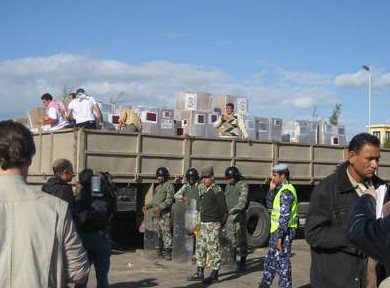
Still, humanitarian agencies report bottlenecks, with aid convoys queued for days or even weeks before clearance. For Gaza’s two million residents, living under blockade since 2007, those delays are measured in food shortages, medicine scarcities, and rising desperation.
Cairo Under Fire
The public accusations from Hamas are awkward for Cairo, which has positioned itself as a mediator in the Israeli–Palestinian conflict for decades. Egypt has hosted numerous ceasefire talks and prisoner exchanges, and it often serves as a discreet backchannel between Israel and Palestinian factions.
But Hamas’s latest rhetoric suggests Cairo’s credibility with the group — and potentially with parts of the Palestinian public — is wearing thin. By alleging Egypt is overstating aid volumes, Hamas has introduced a narrative that could undermine Egyptian influence in future negotiations.
Risk of Escalation With Israel
Opening Rafah unilaterally would almost certainly draw a sharp reaction from Israel. While Israel does not directly control the Egyptian side, it claims the right to inspect all goods entering Gaza to prevent the transfer of weapons and military equipment.
Any breach in that process could lead to heightened military readiness or even cross-border incidents. That’s a risk Sisi’s government appears unwilling to take, particularly at a time when Egypt is grappling with economic strain, domestic political pressures, and security concerns in the Sinai Peninsula.
Regional Implications
The standoff over Rafah touches broader regional dynamics. Egypt’s role as a mediator between Israel and Palestinian factions is part of its diplomatic brand, allowing it to wield influence in Washington, Brussels, and Gulf capitals. If Cairo is seen as bowing to Israeli pressure at the expense of Palestinian suffering, it risks losing credibility in Arab public opinion.
Conversely, if it caves fully to Hamas’s demands, it could strain its peace with Israel and jeopardize security cooperation that has kept the border largely quiet for years.
Hamas’s Strategy
Hamas’s decision to escalate its rhetoric now may be tactical. With the humanitarian situation in Gaza worsening and international attention divided by other crises, raising the profile of Rafah could bring fresh pressure on Egypt and, indirectly, on Israel.
By portraying Egypt as a gatekeeper aligned with Israeli policies, Hamas positions itself as the uncompromising defender of Palestinian rights. That posture may also serve the group’s internal politics in Gaza, where managing shortages and public discontent is a constant challenge.
What Happens Next
Diplomatic sources say Cairo is unlikely to abandon its coordination with Israel, but it may seek small concessions to ease the tension. That could include faster inspection timelines, expanded categories of permitted goods, or limited periods of more open crossing hours.
However, unless Israel agrees, such measures will be difficult to implement. And Israel, wary of security risks, is unlikely to greenlight wholesale changes without extensive safeguards.
For now, Egypt’s strategy appears to be a mix of public reassurance and quiet diplomacy — keeping Rafah open enough to deflect accusations of closure, but controlled enough to avoid a showdown with Israel.
A Political Crossroads
The Rafah issue leaves Egypt walking a narrow line, under fire from Hamas for not doing enough and under the watchful eye of Israel for doing too much. How Cairo navigates this moment will not only affect the humanitarian flow into Gaza but also its standing as a regional powerbroker.
In the words of one regional analyst: “Rafah is not just a crossing. It’s a mirror reflecting Egypt’s struggle to be both a friend to Palestine and a partner to Israel — without losing either.”