
On the Glass Hall stage of the Grand Egyptian Museum, between an India dance troupe and a French choir, a thirty-minute slot on Monday went to a single reed flute. Turkish ney performer Sinem Hondaroglu played the second cultural set of the day, opening the country programme at International Museum Day under the 2026 theme Museums Uniting a Divided World.
The booking reads as a routine cultural exchange. It is not routine. It is the most public Turkish artistic appearance inside Egypt’s flagship museum since the two countries signed a new tier of bilateral agreements in February, and the instrument she chose is one of the few cultural objects that genuinely belongs to both civilisations.
The Half-Hour That Drew the Crowd
Hondaroglu’s set ran from 12:00 to 12:30 PM in the Glass Hall, the museum’s central performance space underneath the Khufu obelisk. The slot sat inside a day-long programme that also featured a vocalist from France, a jazz singer from Germany, the Maulana Azad Centre troupe from India, three musical performances from China, a pianist-and-choir pairing from Japan and a Spanish classical guitarist. Egypt’s contribution to the day was structural, not performative: the museum kept its full footprint open, ran complimentary mixed-reality tours, and rolled out a 45-metre papyrus scroll on the Obelisk Piazza for visitors to add their names in cartouche form.
The country line-up itself is the signal. International Museum Day in Cairo this year was framed as a diplomatic showcase, and the ordering of the Glass Hall schedule placed Turkey first among the foreign cultural acts.
| Time | Country | Performer or Group |
|---|---|---|
| 11:30 AM | Egypt | Session: When Games Tell Stories of Nations |
| 12:00 PM | Turkey | Sinem Hondaroglu, ney |
| 12:30 PM | France | Miriam Ramez Said with Chorale de Notre Dame de la Delivrande |
| 2:00 PM | Germany | Laura Kipp, jazz vocalist |
| 3:00 PM | India | Maulana Azad Centre Troupe |
| 4:00 PM | China | Three musical performances |
| 5:00 PM | Japan | Hitomi Kanno and Sout El Ward Choir |
| 6:00 PM | Spain | Miguel Trapaga, guitarist |
Audiences in the hall responded to the ney with the kind of stilled attention the instrument tends to draw. The reed produces a breath-driven, slightly hollow tone that carries the texture of the player’s exhale, and Hondaroglu’s programme leaned into the meditative register the instrument is known for.
A Reed With Two Homes
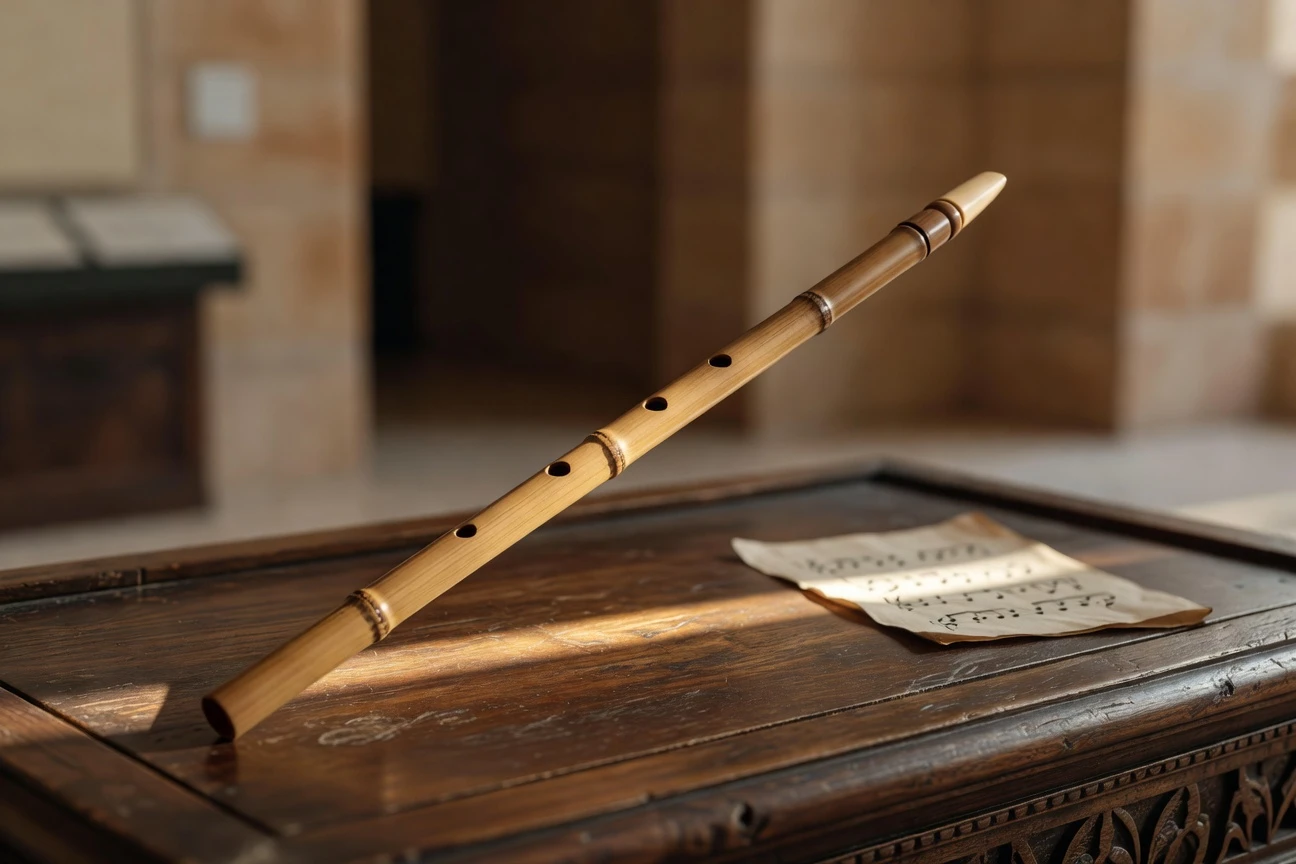
The ney is one of the very few instruments where an Ottoman classical performer and an Upper Egyptian Sufi player can both claim deep ancestral ownership. Archaeological fragments of end-blown reed flutes have been recovered from Egyptian sites dated to roughly 3000 BCE, and the instrument shows up in tomb wall paintings centuries before it migrated north into Anatolia and Mesopotamia.
The Turkish ney as Hondaroglu plays it is the version that took shape inside the Mevlevi Sufi order, founded in Konya in 1273 in the wake of the poet Jalaluddin Rumi’s death. In that tradition the instrument is treated as a metaphor as much as a musical tool, a reed cut from its bed crying its way back to the divine. The Egyptian cousin, the shorter kawala, kept its own ritual footprint inside Sufi dhikr ceremonies in the Nile Delta and across the Maghreb.
How the Family Splits
The two versions diverged in tuning and length, but they share the same physics: a cane reed, no reed mouthpiece, sound produced by blowing across an open rim at a precise angle.
- Turkish ney: nine segments of reed, six finger holes plus one on the underside, head fitted with a horn or buffalo-bone mouthpiece called the bashpare
- Egyptian kawala: shorter, six finger holes, no mouthpiece insert, played at a steeper embouchure angle
- Persian ney: five finger holes plus one on the underside, played with the tongue against the reed, producing the distinctive breathy attack
Hondaroglu’s academic work, according to the cultural brief circulated by the Turkish embassy, has focused on how the Turkish version of the instrument can be integrated into modern orchestral arrangements. That research thread matters here. The ney’s Sufi associations have historically kept it inside a fairly narrow performance frame; pushing it into chamber and orchestral settings is how the instrument earns a new audience outside the takya circuit.
Inside Hondaroglu’s Practice
Hondaroglu trained in Ankara through the institutions attached to Turkish Radio and Television Corporation (TRT, Turkey’s state broadcaster), studying classical Turkish music before moving into a working performer’s life across radio, television and stage. She has appeared as a ney musician in televised TRT music productions, recorded for Voice of Turkey radio programming, and performed with orchestras inside Turkey and abroad.
Her Cairo trip was her first to the Egyptian capital, though she has performed in several other Arab countries before. In remarks to the Egyptian press during her visit, she said part of her family origin traces back to Egypt, and that she has been studying Arabic for years with a particular focus on the Egyptian dialect.
Cairo is a city where history, music and culture come together in a unique way. I have long been interested in Egyptian culture and have done research related to it.
Sinem Hondaroglu, ney performer, speaking to local press during her Cairo visit on May 18.
Between performances she filled out a fairly compressed tourist itinerary: the Giza pyramids, a walk through Khan El Khalili market, and a stop at El Fishawy Cafe, the Mamluk-era coffee house in the Khan that has been operating for roughly 250 years. She described the cafe’s atmosphere as the moment her interest in Egyptian heritage became something more physical than academic.
A Cultural Thaw Years in the Making
The performance landed on top of a thicker diplomatic file than the museum’s press release acknowledges. Turkey and Egypt spent most of the decade after 2013 in an open political freeze, with embassies downgraded, broadcasters on both sides trading accusations, and the cultural-exchange channel almost completely shut. The rapprochement only began moving in 2022, deepened through the September 2024 Erdogan visit to Cairo, and tipped into a formal upgrade in February when the two presidents signed an additional batch of bilateral agreements and committed to a strategic-partnership framework.
The numbers behind the file tell the story:
- $6.8 billion: total Turkey-Egypt trade volume in 2025, up from $6.6 billion the year before, per Turkey’s foreign ministry
- $3.2 billion: Egyptian exports to Turkey in 2025
- $3.6 billion: Egyptian imports from Turkey in 2025
- November 2025: first meeting of the Egypt-Turkey Planning Group held in Ankara, with the second High-Level Strategic Cooperation Council session scheduled for Cairo this year
Soft-power instruments have been re-activated in parallel with the trade and security tracks. The Yunus Emre Institute’s Cairo office, Turkey’s flagship cultural and language outpost, has been one of its busiest globally, with the Turkish-language course waitlist among the largest in the network. Anadolu Agency, TIKA and TRT have all rebuilt their Egyptian footprints. A ney recital at the Grand Egyptian Museum sits cleanly inside that strategy, even when nobody in the hall is treating it as politics.
The pattern is visible elsewhere in the commercial calendar too. Turkish industrial presence in Cairo has crept up across sectors, including a strong showing at the StoneAfrica trade fair debut in the Egyptian capital, where a third of all exhibiting companies came from Turkey.
Why the Grand Egyptian Museum Matters Here
The choice of venue is not incidental. The Grand Egyptian Museum was officially inaugurated in a state ceremony on November 1, 2025 after a two-decade build and a roughly one-billion-dollar price tag, and reopened to the public three days later on the 103rd anniversary of the Tutankhamun tomb discovery. Egyptian authorities have been deliberate about positioning it as a regional cultural hub rather than only a national archaeology showcase.
Early operational data has tracked the ambition. The museum drew about 18,000 visitors on its first public day, averaged near 19,000 per day during the opening week, and has run at roughly its 15,000-per-day stated daily capacity since. The Egyptian cabinet has projected an annual visitor target of around five million.
The Soft-Power Math
Hosting International Museum Day with a multi-country performance roster is exactly the kind of programming that converts the museum’s footfall into a diplomatic asset. The 2026 Museums Uniting a Divided World theme set by the International Council of Museums for the day frames museums as mediators between communities, an idea that lines up neatly with the way Cairo is now describing the Grand Egyptian Museum’s role.
What This Does for Egypt
For Egypt, the day was a chance to lock in foreign cultural-mission participation on its own terms. For Turkey, it was a chance to send a first-time visitor as the opening foreign act in a museum that is currently the most watched cultural venue in the Arab world. The booking does work that a press conference cannot.
From the Glass Hall to the Embassy
Hondaroglu’s Cairo agenda did not end at the museum. On May 19, she performed again at the Embassy of Turkey in Cairo for the diplomatic mission’s annual joint commemoration of Ataturk Memorial Day and Youth and Sports Day, a national holiday marking the centenary-plus of Mustafa Kemal Ataturk’s 1919 arrival in Samsun.
The two-stop itinerary is itself the small diplomatic signal. A foreign cultural performer who plays a national museum slot and then plays the sending country’s embassy on consecutive days is being treated as part of an embassy soft-power rotation, not a one-off booking. That is the choreography of a relationship that is being warmed up deliberately, with budget behind it, on both sides.
The next visible point on the calendar is the second meeting of the Egypt-Turkey High-Level Strategic Cooperation Council, scheduled to be held in Cairo before year-end. The political agenda there will be the headline. The cultural file the museum quietly opened on Monday is one of the inputs.
