The White House is examining whether Israel violated the Gaza ceasefire after an airstrike killed a senior Hamas commander, President Donald Trump said Monday, injecting new uncertainty into an already delicate truce and exposing growing friction between Washington and Jerusalem.
The comments follow reports that US officials sharply rebuked Prime Minister Benjamin Netanyahu, warning that further unilateral moves could undermine Trump’s credibility as the broker of the Gaza deal.
A strike that shook a fragile calm
The incident at the center of the storm occurred over the weekend in Gaza City.
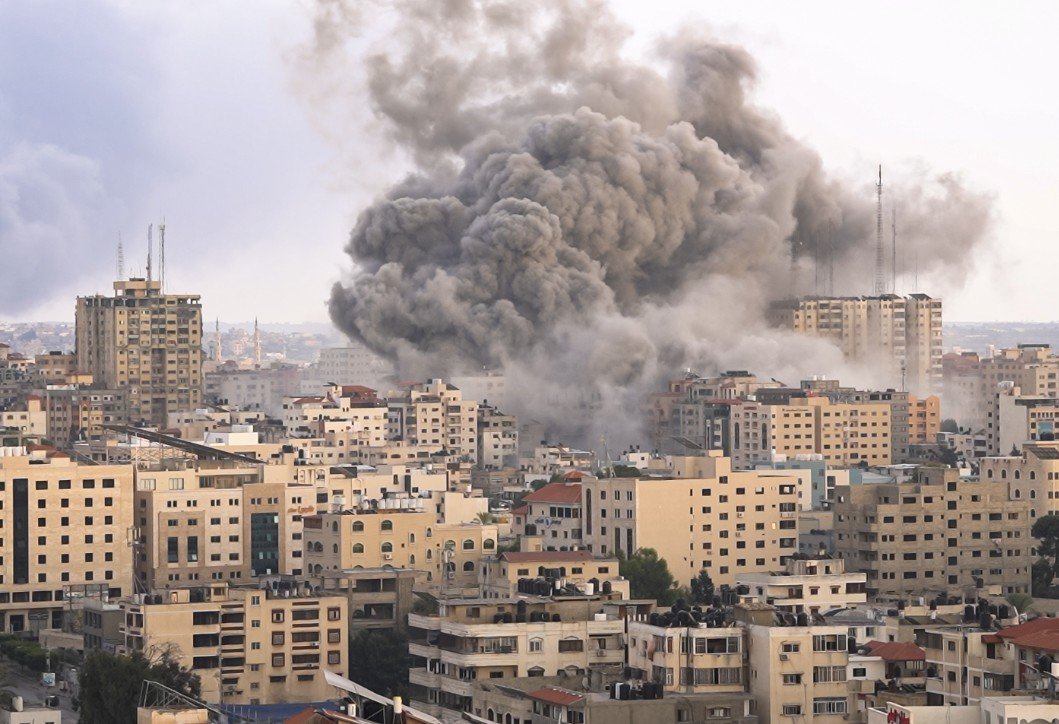
An Israeli strike hit a vehicle, killing Hamas commander Raad Saad, according to Palestinian officials and confirmed by international media. Images from the scene showed a mangled car and widespread destruction, quickly circulating across news networks and social platforms.
The timing raised eyebrows.
The strike came during an agreed ceasefire period, one meant to pause fighting, allow humanitarian access, and create space for negotiations tied to Trump’s multi-phase Gaza plan.
Asked directly whether Israel had violated the truce, Trump did not offer Israel a free pass.
“We’re looking into it,” he told reporters, a brief answer that carried unusual weight given Washington’s traditionally cautious public language on Israeli military actions.
It was not an accusation. But it was not a defense either.
Behind the scenes, frustration boils over
Public statements tell only part of the story.
According to Axios, senior US officials delivered a blunt message to Netanyahu following the strike. The warning, as described by one official, was personal and political.
“If you want to ruin your reputation and show that you don’t abide by agreements, be our guest,” the message reportedly said. “But we won’t allow you to ruin President Trump’s reputation after he brokered the deal in Gaza.”
That phrasing matters.
Trump has invested political capital in the ceasefire, portraying it as proof that his approach can deliver results where others failed. Any perception that the agreement is unraveling, especially due to an ally’s actions, risks denting that narrative.
Several senior figures inside the administration are said to be increasingly irritated.
US Secretary of State Marco Rubio, Middle East envoy Steve Witkoff, and Trump adviser Jared Kushner were described by American officials as openly frustrated with Israel’s posture, particularly its resistance to elements of the plan’s second phase.
One official put it bluntly: “Steve and Jared are pissed by Israeli inflexibility.”
That language is not common in diplomatic briefings.
Netanyahu denies a rift, but doubts linger
Despite the reports, Trump publicly rejected the idea that relations with Netanyahu are breaking down.
“There’s no rift,” he said, pushing back against suggestions of a serious split between the two leaders.
Israeli officials, for their part, insist the strike targeted a legitimate militant figure and argue that Hamas commanders do not gain immunity simply because talks are ongoing. From Israel’s perspective, deterrence must be maintained even during pauses in fighting.
Still, the optics are difficult.
A ceasefire depends as much on perception as on text. If one side appears to be acting freely while the other holds fire, trust erodes fast.
Within Israel, the concern is less about Trump’s words and more about what Washington might do next.
Israel’s fear: pressure to move to phase two
Israeli media report growing anxiety that the US could push ahead with the next phase of the Gaza plan sooner than Jerusalem would like.
According to Ynet, Israeli officials worry Washington may insist on advancing even if unresolved issues remain, particularly the return of Master Sgt. Ran Gvili, the last deceased Israeli hostage still held in Gaza.
Gvili’s return is supposed to be completed under the first phase of the deal.
From Israel’s viewpoint, moving forward without that closure would be politically explosive and morally fraught. Families of hostages have already staged protests, accusing the government of moving too slowly and making dangerous compromises.
The fear is that US impatience could override Israeli red lines.
That fear deepened after Trump appeared relaxed about the timeline.
What the second phase actually involves
Trump’s Gaza plan is structured in stages, each more complex than the last.
The second phase, expected to begin soon, goes far beyond ceasefire mechanics. It addresses who governs Gaza and how security is handled once large-scale fighting ends.
Key elements outlined so far include:
-
Hamas laying down its weapons
-
Israeli forces withdrawing from most of the Strip
-
Deployment of a multinational International Stabilization Force
-
A Palestinian technocratic body taking over civilian administration
This phase is where everything gets harder.
Disarmament, governance, and foreign troops on the ground are not abstract ideas. They touch sovereignty, security, and long-standing fears on all sides.
Asked when the International Stabilization Force would begin operating, Trump said that “in a form, it’s already running,” a comment that raised more questions than it answered.
So far, no country has publicly confirmed participation in such a force.
A ceasefire under strain, not collapse
Despite the tension, the ceasefire itself has not formally collapsed.
Aid continues to enter Gaza, though in limited quantities. Negotiations remain active. Mediators are still engaged. That matters.
But the mood has shifted.
What once felt like cautious optimism now feels brittle. Each incident, each leak, each sharp word adds stress to a structure that was never solid to begin with.
For Washington, the challenge is balancing pressure with partnership.
For Israel, it is balancing military priorities with diplomatic realities.
And for Gaza, it is another reminder that even pauses in war come with risk.
A relationship tested in public
US-Israel relations have weathered disagreements before, often behind closed doors.
What feels different now is how openly frustration is spilling into view. Leaked rebukes. Candid language. Presidential remarks that leave space for doubt.
Trump has long prided himself on being Israel’s strongest supporter. That has not changed. Still, support does not mean silence, especially when a deal personally associated with him is at stake.
For Netanyahu, the calculus is brutal.
Backing down risks domestic backlash. Pushing ahead risks alienating Washington at a sensitive moment.
Neither option looks easy.
A moment that could shape what comes next
The review Trump referenced may conclude quietly, with no formal finding and no public consequence. That is possible.
Or it could become a turning point, tightening US expectations and narrowing Israel’s room to maneuver during the ceasefire.
Right now, uncertainty dominates.
The ceasefire holds, barely. Diplomats talk. Armies wait. And leaders calculate their next move, aware that one decision could tip the balance.
For a deal built on fragile trust, that tension may be the most dangerous element of all.