A small, weathered pendant has reopened a very big historical question. Unearthed in Jerusalem, a 1,300-year-old menorah-decorated artifact suggests Jewish presence in the city centuries after Rome supposedly shut the door for good. For historians and archaeologists alike, it’s a quiet find with loud implications.
A modest object with an outsized message
The pendant is not flashy. It’s round, made of cast lead, and small enough to rest in a palm.
Yet stamped on both sides is a seven-branched menorah, one of the most enduring symbols of Jewish identity. Archaeologists uncovered it at the Davidson Archaeological Park, just southwest of the Temple Mount, during excavations announced on December 15.
The object dates back roughly 1,300 years, placing it in the final centuries of the Byzantine period. That timing matters. According to long-accepted historical accounts, Jews were barred from Jerusalem after the Romans crushed the Bar Kokhba revolt in 135 CE and rebuilt the city as Aelia Capitolina.
And still, here it was.
Esther Rakow-Mellet of the Israel Antiquities Authority explained that the pendant was found embedded in the foundations of a Byzantine-era structure, between walls from the later Umayyad period. Basically, it was not a stray item dropped yesterday. It was part of the site’s lived history.
Just one object, yes. But objects carry stories.
Rome’s ban, and why it was meant to be final
After destroying the Second Temple in 70 CE, Rome tightened its grip.
The revolt of 132–135 CE proved to be the breaking point. Emperor Hadrian responded with force, flattening Jerusalem and renaming it Aelia Capitolina. Ancient sources describe a sweeping ban on Jews entering the city, with rare exceptions, such as mourning rituals on the Ninth of Av.
The intent seemed clear. Jerusalem was to be severed from Jewish life, memory, and daily presence.
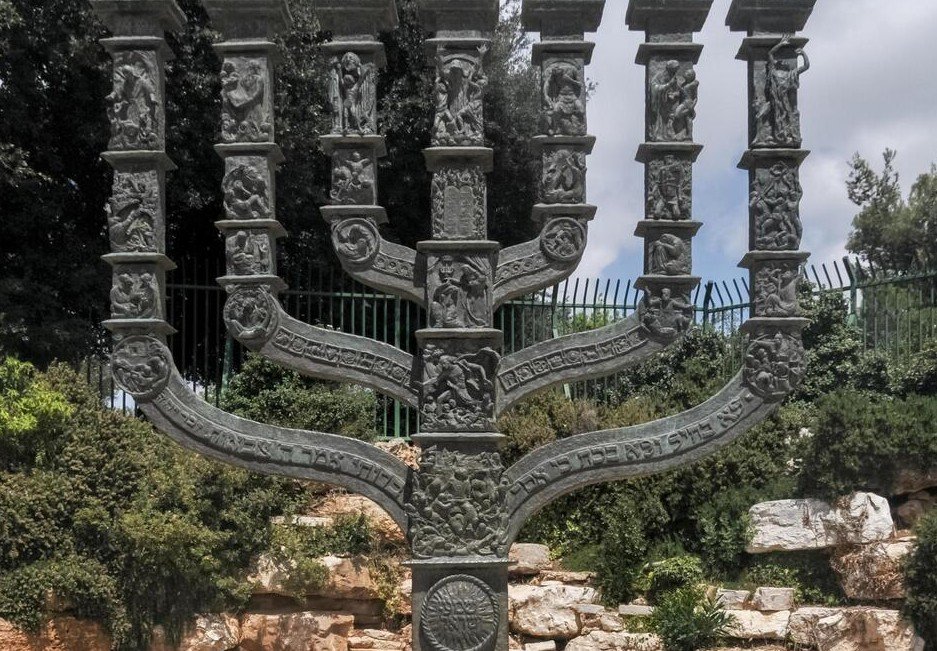
For centuries, historians largely accepted that narrative. Jewish life continued elsewhere, in Galilee, the Negev, and beyond, but Jerusalem remained out of reach.
That is why this pendant feels disruptive.
If Jews were fully excluded, who wore it? Who cast it? And why place such a visible symbol so close to the Temple Mount?
What the pendant tells us, and what it doesn’t
Archaeology rarely gives clean answers. It offers clues, hints, friction against old ideas.
The menorah pendant suggests that Jewish individuals were at least visiting Jerusalem during the late Byzantine era. Some scholars now believe small communities may have lived there quietly, under shifting political realities.
By the 7th century, the region had seen major changes. Byzantine control weakened. The Persian invasion of 614 CE, followed by the early Islamic conquests, altered who ruled and how rigid earlier Roman policies remained.
The pendant fits into that gray space.
A few points stand out:
-
The menorah is a distinctly Jewish symbol, especially powerful after the Temple’s destruction
-
The artifact’s location places it near the heart of ancient Jerusalem
-
Its dating aligns with periods of political transition, not rigid Roman rule
This does not mean there was open, unrestricted Jewish life in the city. It suggests persistence. Quiet returns. Footsteps that history texts barely recorded.
Sometimes survival looks like silence.
A city layered with contradictions
Jerusalem has never been simple.
The excavation site itself tells that story. Archaeologists were working through layers from different periods, Byzantine fills beneath Umayyad walls, each era building on the debris of the last. The pendant was tucked into those layers, literally wedged between worlds.
That physical layering mirrors historical reality.
Roman laws might have declared Jerusalem off-limits. Local enforcement, shifting rulers, and human determination often tell a different tale. People find ways back to places that matter to them, even if the door is only cracked open.
Rakow-Mellet noted that the artifact was found in a foundation context, meaning it could have been intentionally placed or simply lost during construction. Either way, its presence was not accidental in time.
Jerusalem does that. It refuses clean breaks.
How rare is this kind of evidence?
Very rare.
Jewish artifacts from Jerusalem dating to the late Byzantine period are few and far between. That scarcity has long reinforced the idea of a near-total absence.
This pendant joins a small but growing list of finds that complicate the picture.
To put it in context:
| Period | Traditional View | What New Finds Suggest |
|---|---|---|
| Roman (135–300 CE) | Near-total Jewish exclusion | Very limited, symbolic presence |
| Byzantine (300–638 CE) | No Jewish residency | Possible visits, small groups |
| Early Islamic (post-638 CE) | Gradual return | More visible Jewish life |
The table doesn’t rewrite history. It nudges it.
Each new artifact forces scholars to adjust assumptions, even slightly. Over time, those adjustments add up.
Faith, memory, and stubborn return
There is also a human angle here that statistics and laws cannot capture.
Jerusalem was not just a city. It was a memory, a prayer, a direction faced during daily rituals. Even after destruction and exile, it remained central to Jewish identity.
Wearing a menorah pendant in Jerusalem, centuries after a ban meant to erase that presence, feels deliberate. Almost defiant.
Not loud defiance. Not rebellion. Something quieter.
A reminder to oneself. To God. To history.
Archaeologists are careful not to romanticize. Still, it’s hard to ignore the emotional weight of such objects. They carry belief, hope, and stubborn attachment across centuries.
And they survive, sometimes when texts do not.
Why this discovery matters now
This find lands at a moment when Jerusalem’s past is intensely debated.
Archaeology in the city is often pulled into modern arguments, sometimes unfairly. Still, material evidence has its own voice, even when people argue over its meaning.
The Israel Antiquities Authority emphasized that the pendant does not stand alone. It joins other discoveries that hint at continuity rather than rupture.
History books once painted Rome’s ban as absolute. Reality, as usual, appears messier.
People bend rules. Empires fade. Cities endure.
A small pendant, a lasting question
The menorah pendant does not overturn centuries of scholarship overnight.
It does something more subtle. It asks a question.
If Rome tried to lock Jews out of Jerusalem, and this object still ended up buried near the Temple Mount centuries later, then how complete was that lock?
The answer may never be fully clear. Archaeology rarely offers certainty.
What it offers instead is presence. Proof that someone was there. That memory didn’t vanish. That even under bans and ruins, life found a way back.
And sometimes, history survives not in grand monuments, but in a small piece of lead, stamped with light.